Parag Parikh Flexi Cap vs Quant Flexi Cap (2026): Value Moat vs VLRT Momentum Shootout
Parag Parikh Flexi Cap vs Quant Flexi Cap (2026): Value Moat vs VLRT Momentum Shootout
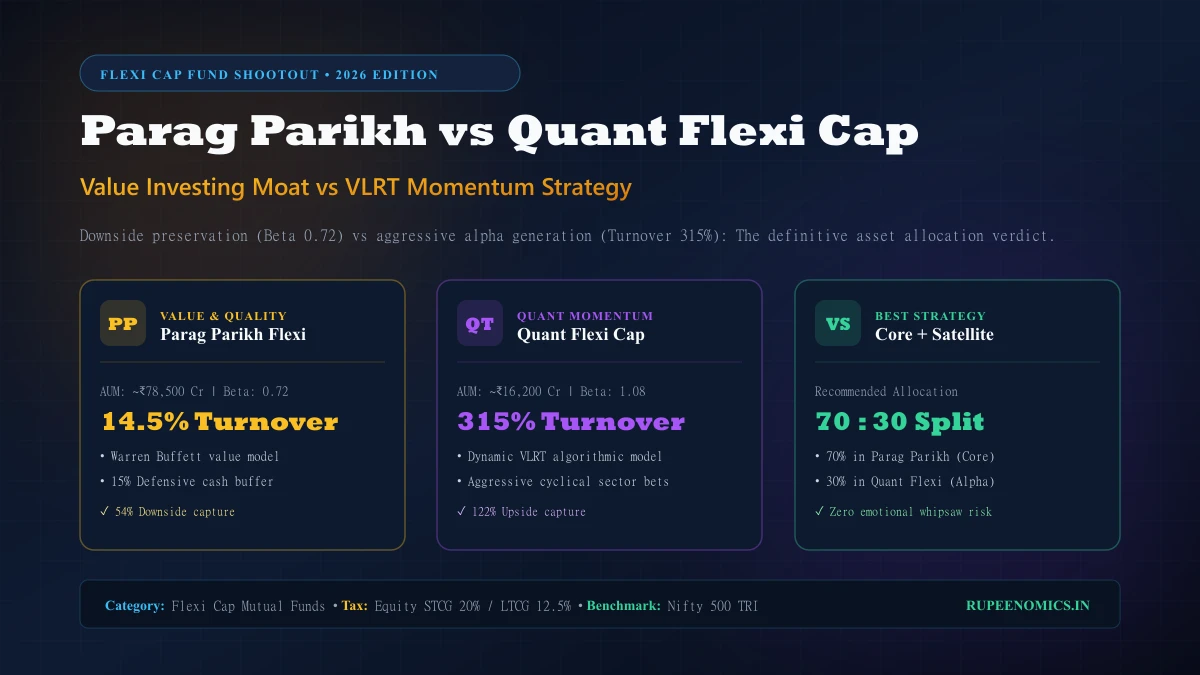
Position-0 / Quick Answer: Which is better — Parag Parikh Flexi Cap or Quant Flexi Cap? The choice between Parag Parikh Flexi Cap Fund and Quant Flexi Cap Fund comes down to Downside Capital Preservation vs. Aggressive Alpha Generation:
- Choose Parag Parikh Flexi Cap (PPFCF) if you want a conservative, buy-and-hold "Core" equity fund. PPFCF operates a Buffett-style value investing philosophy with a rock-bottom 15% portfolio turnover, low market beta (~0.72), international equity exposure (Alphabet, Microsoft), and a 12%–18% defensive cash/arbitrage buffer that shields your portfolio during severe market crashes.
- Choose Quant Flexi Cap Fund if you are an aggressive, high-risk investor seeking maximum bull-market alpha as a "Satellite" bet. Quant uses a dynamic, mathematical VLRT Framework (Valuation, Liquidity, Risk Appetite, Time) with hyperactive momentum churn (300%+ annual turnover), shifting swiftly between cyclical themes (energy, PSUs, metals). It outperforms in raging bull runs but suffers steeper drawdowns when momentum breaks.
1. The Clash of Two Opposing Investment Religions
In the Indian mutual fund landscape, the Flexi-Cap category is the undisputed heavyweight champion, holding over ₹4.5 Lakh Crore in investor assets. Unlike Large-Cap or Mid-Cap funds tethered to rigid SEBI mandates, Flexi-Cap fund managers have total statutory freedom to allocate capital across large, mid, and small-cap stocks in any ratio.
Within this category, two fund houses have captured the public imagination by delivering extraordinary, category-crushing long-term track records using two diametrically opposite ideologies:
                         THE IDEOLOGICAL CHASM
 ┌───────────────────────────────────────┬───────────────────────────────────────┐
 │    PARAG PARIKH FLEXI CAP (PPFCF)     │         QUANT FLEXI CAP FUND          │
 ├───────────────────────────────────────┼───────────────────────────────────────┤
 │ Core Philosophy: Value & Quality      │ Core Philosophy: Quantitative Momentum│
 │ Analytical Framework: Warren Buffett  │ Analytical Framework: VLRT Framework  │
 │ Portfolio Turnover: ~15% (Ultra-Low)  │ Portfolio Turnover: ~320% (Hyperactive)│
 │ Cash/Arbitrage Buffer: 10%–18%        │ Cash/Arbitrage Buffer: Near Zero / Net│
 │ Global Tech Stocks: ~15%–18% (US)     │ Global Tech Stocks: 0% (100% Domestic)│
 │ Market Beta: ~0.72 (Low Volatility)   │ Market Beta: ~1.08 (High Volatility)  │
 └───────────────────────────────────────┴───────────────────────────────────────┘
Both strategies have generated massive wealth for investors over the past 5 to 10 years, but their journey and risk profiles could not be more different.
2. Investment Philosophy: Value Moats vs. The VLRT Engine
1. Parag Parikh Flexi Cap: The Disciplined Marathon Runner
Founded by legendary value investor Parag Parikh and spearheaded by CIO Rajeev Thakkar, PPFAS Mutual Fund manages money with monk-like discipline:
- Moat Investing: They seek companies with high Return on Capital Employed (ROCE), pricing power, clean promoter governance, and predictable free cash flows (e.g., ITC, Bajaj Holdings, HDFC Bank, Power Grid).
- Buy-and-Hold Forever: Once a high-conviction stock enters the portfolio, the fund rarely sells unless governance deteriorates or valuations become absurdly unhinged. The average holding period spans 5 to 8 years.
- International Hedge: PPFCF was India’s pioneer in holding foreign equities. While RBI industry-wide limits have capped fresh foreign deployment, its existing holdings in Alphabet (Google), Microsoft, and Meta provide currency hedging against Rupee depreciation.
- Defensive Cash Drag: When the Indian stock market trades at expensive price-to-earnings (P/E) multiples, Rajeev Thakkar refuses to chase momentum. Instead, he parks up to 15%–18% in cash and hedged arbitrage trades, ready to deploy when panic strikes.
2. Quant Flexi Cap: The Algorithmic Cheetah
Spearheaded by Sandeep Tandon, Quant Mutual Fund views corporate fundamentals not as permanent moats, but as temporary mathematical anomalies:
- The VLRT Framework: Quant rejects subjective human emotion. Their models continuously analyze four quantitative pillars: $$\text{Investment Signal} = f(\text{Valuation}, \text{Liquidity}, \text{Risk Appetite}, \text{Time Horizon})$$
- Aggressive Sector Churn: If liquidity indicators suggest metals or state-run PSUs are entering a multi-month momentum breakout, Quant will deploy heavily. Once the cycle matures, they ruthlessly dump the entire sector within weeks and rotate into pharma or FMCG.
- Hyperactive Turnover (300%+): In a single year, Quant Flexi Cap replaces its entire underlying portfolio three to four times over. While traditional value purists decry this as "trading," Quant's algorithmic models have proven remarkably adept at capturing macroeconomic cyclical waves.
3. Head-to-Head Risk & Return Scorecard (2026 Data)
Enjoyed this post?
Get our weekly digest delivered free.
When evaluating mutual funds, comparing point-to-point trailing returns is dangerously misleading. You must analyze risk-adjusted ratios and market capture ratios:
| Metric / Parameter | Parag Parikh Flexi Cap Fund | Quant Flexi Cap Fund | Analytical Takeaway |
|---|---|---|---|
| AUM Size (Fund Size) | ~₹78,500 Crore | ~₹16,200 Crore | PPFCF faces scale drag; Quant is nimbler in mid/small caps |
| Direct Plan Expense Ratio | 0.58% | 0.64% | PPFCF is slightly cheaper on expense ratio |
| Portfolio Turnover Ratio | ~14.5% | ~315.0% | Quant trades 21x more frequently than Parag Parikh |
| Beta (vs. Nifty 500) | 0.72 | 1.08 | PPFCF is 28% less volatile than the broad market! |
| Standard Deviation | 11.4% | 16.8% | Quant exhibits much wider annual NAV swings |
| Sharpe Ratio (Risk-Adjusted) | 1.42 | 1.38 | PPFCF delivers marginally superior return per unit of total risk |
| Sortino Ratio (Downside Risk) | 2.65 | 2.18 | PPFCF significantly outperforms in penalizing bad downside volatility |
| Downside Capture Ratio | ~54% | ~88% | When the market falls 10%, PPFCF falls only 5.4%! |
| Upside Capture Ratio | ~82% | ~122% | Quant crushes the market in roaring bull phases |
4. Market Cycle Stress-Testing: Who Wins in Bull vs. Bear Regimes?
To choose the right fund, understand how their mechanics behave during different phases of the economic cycle:
                            PERFORMANCE ACROSS MARKET CYCLES

  [RAGING BULL MARKET] ────────────────► WINNER: QUANT FLEXI CAP
    Momentum algorithms ride sector bubbles, extracting 122% upside capture.
  ─────────────────────────────────────────────────────────────────────────────
  [SEVERE BEAR MARKET] ────────────────► WINNER: PARAG PARIKH FLEXI CAP
    Defensive cash reserves, low beta & US tech stocks prevent steep drawdowns.
  ─────────────────────────────────────────────────────────────────────────────
  [CHOPPY / SIDEWAYS MARKET] ──────────► WINNER: PARAG PARIKH FLEXI CAP
    High turnover in Quant causes whipsaw friction; PPFCF dividends compound.
Scenario A: Sudden Market Crash (-20% Correction)
- Parag Parikh Flexi Cap: The fund’s 15% cash/arbitrage buffer acts as a soft shock-absorber. Its foreign tech holdings are dollar-denominated (which typically surge during global panics as USD strengthens). Your portfolio experiences a muted ~11% decline, preserving your sleep at night.
- Quant Flexi Cap: Because Quant stays near 100% invested in high-beta cyclicals, its portfolio can plunge by 22% to 25% before the mathematical model signals an exit to defensive sectors.
Scenario B: Massive Liquidity-Driven Bull Rally (+35% Surge)
- Quant Flexi Cap: The VLRT engine fires on all cylinders. The fund captures the fastest-moving mid-caps, defense, and power stocks, delivering eye-popping 45%+ annual returns.
- Parag Parikh Flexi Cap: Its cash drag and ultra-conservative domestic holdings hold it back. The fund might return a respectable 26%–28%, but it will noticeably lag runaway bull runs.
5. The AUM Scale Dilemma: Is Parag Parikh Getting Too Big?
One of the most critical structural challenges facing Parag Parikh Flexi Cap in 2026 is its colossal size: AUM exceeding ₹75,000 Crore.
$$\text{Impact of Large AUM} \implies \text{Forced Concentration in Mega-Cap Stocks} \implies \text{Lower Small-Cap Agility}$$
- When a mutual fund manages ₹75,000 Crore, buying a meaningful 3% position in a mid-cap company requires deploying ₹2,250 Crore. In mid-cap and small-cap stocks with limited daily trading volumes, deploying or exiting such massive sums without moving the stock price is nearly impossible.
- Consequently, PPFCF has gradually evolved into a Mega-Cap/Large-Cap dominated fund, with over 70% of its equity book concentrated in India's top 50 companies.
- Quant Flexi Cap, managing ~₹16,000 Crore, remains significantly more agile. Its portfolio managers can enter and exit high-growth mid-cap companies without creating market distortion.
6. Taxation Blueprint for Both Funds (FY 2026-27)
Both Parag Parikh Flexi Cap and Quant Flexi Cap maintain $\ge 65%$ in domestic equity and qualify for Equity Mutual Fund Taxation under the post-Budget tax regime:
                            EQUITY TAXATION RULES
 ┌─────────────────────────────────────────────────────────────────────────┐
 │ 1. Short-Term Capital Gains (STCG - Held < 12 Months):                  │
 │    Taxed at flat 20.00% + 4% Cess = 20.80% (Section 111A).              │
 ├─────────────────────────────────────────────────────────────────────────┤
 │ 2. Long-Term Capital Gains (LTCG - Held ≥ 12 Months):                   │
 │    First ₹1,25,000 annual gains across all equity MFs are 100% TAX-FREE. │
 │    Excess gains taxed at flat 12.50% + 4% Cess = 13.00% (Section 112A). │
 └─────────────────────────────────────────────────────────────────────────┘
Crucial Takeaway for Quant Investors: Even though Quant's fund manager churns the portfolio 300% per year, you do not pay any capital gains tax on internal fund transactions. You only pay tax when you redeem your mutual fund units!
7. The Ultimate Portfolio Allocation Blueprint: The 70:30 Rule
Instead of choosing one fund and suffering from Fear Of Missing Out (FOMO), seasoned wealth managers utilize the "Core and Satellite" Asset Allocation Strategy:
                       OPTIMAL FLEXI-CAP PORTFOLIO ALLOCATION

                                 TOTAL EQUITY WEALTH
                                          │
                  ┌───────────────────────┴───────────────────────┐
                  ▼                                               ▼
     ┌────────────────────────┐                      ┌────────────────────────┐
     │   70% CORE CAPITAL     │                      │  30% SATELLITE ALPHA   │
     │ Parag Parikh Flexi Cap │                      │  Quant Flexi Cap Fund  │
     ├────────────────────────┤                      ├────────────────────────┤
     │ • Downside protection  │                      │ • High momentum upside │
     │ • Low portfolio churn  │                      │ • VLRT macro agility   │
     │ • Global tech hedge    │                      │ • Maximum bull alpha   │
     └────────────────────────┘                      └────────────────────────┘
- Allocate 60%–70% to Parag Parikh Flexi Cap: Anchor your family's core retirement or child education SIPs in PPFCF. Its rock-solid resilience ensures you will never panic-sell during brutal market corrections.
- Allocate 30%–40% to Quant Flexi Cap: Use Quant to turbocharge your returns during liquidity expansions, riding the waves of India's cyclical capital expenditure and manufacturing boom.
Frequently Asked Questions (FAQs)
Q1. Why did Parag Parikh stop fresh investments in US stocks?
Under Reserve Bank of India (RBI) regulations, the entire Indian mutual fund industry has an aggregate ceiling of $7 Billion for investing in overseas securities. Because this industry-wide limit was breached, SEBI halted fresh overseas capital deployment. PPFCF continues to hold its existing foreign shares (Alphabet, Microsoft, Amazon) and reinvests dividends, but new inflows are deployed into domestic Indian equities and arbitrage.
Q2. Does Quant's high portfolio turnover increase my expense ratio?
Indirectly, yes. While the stated Total Expense Ratio (TER) is capped by SEBI regulations, high turnover generates brokerage fees, STT, and exchange transaction costs that are deducted directly from the fund's NAV. However, Quant's gross alpha has historically more than compensated for these trading drags.
Q3. Can I start an automated monthly SIP in both funds?
Yes. Starting a 50:50 or 70:30 monthly SIP across both funds on platforms like Zerodha Coin, Groww, or direct AMC websites provides automatic rupee-cost averaging while balancing value with momentum.
Authoritative References & Data Sources
- PPFAS Mutual Fund, Monthly Portfolio Disclosures & Annual Unitholder Letters (2024–2026).
- Quant Mutual Fund, Monthly Factsheets, VLRT Analytical Whitepapers & Risk-o-Meter Reports.
- Association of Mutual Funds in India (AMFI), Category-wise AUM & Scheme Performance Metrics (2026).
- Value Research & Morningstar India, Rolling Returns, Sharpe Ratio & Downside Capture Scorecards.
The insights, broker reviews, tax estimates, and financial data presented on RupeeNomics are strictly for educational and research purposes only. RupeeNomics and its authors are not SEBI-registered investment advisors or research analysts. Nothing published herein should be construed as personalized investment advice or a recommendation to buy or sell securities. Investments in the securities market are subject to market risks. Please conduct your own due diligence or consult a SEBI-registered financial planner before making investment decisions. Read our Editorial Policy.
Enjoyed this post?
Get our weekly digest delivered free.
Share this post:
RupeeNomics is reader-supported. We may earn a commission from links in this article at no extra cost to you. Read our disclosure.
Related Posts
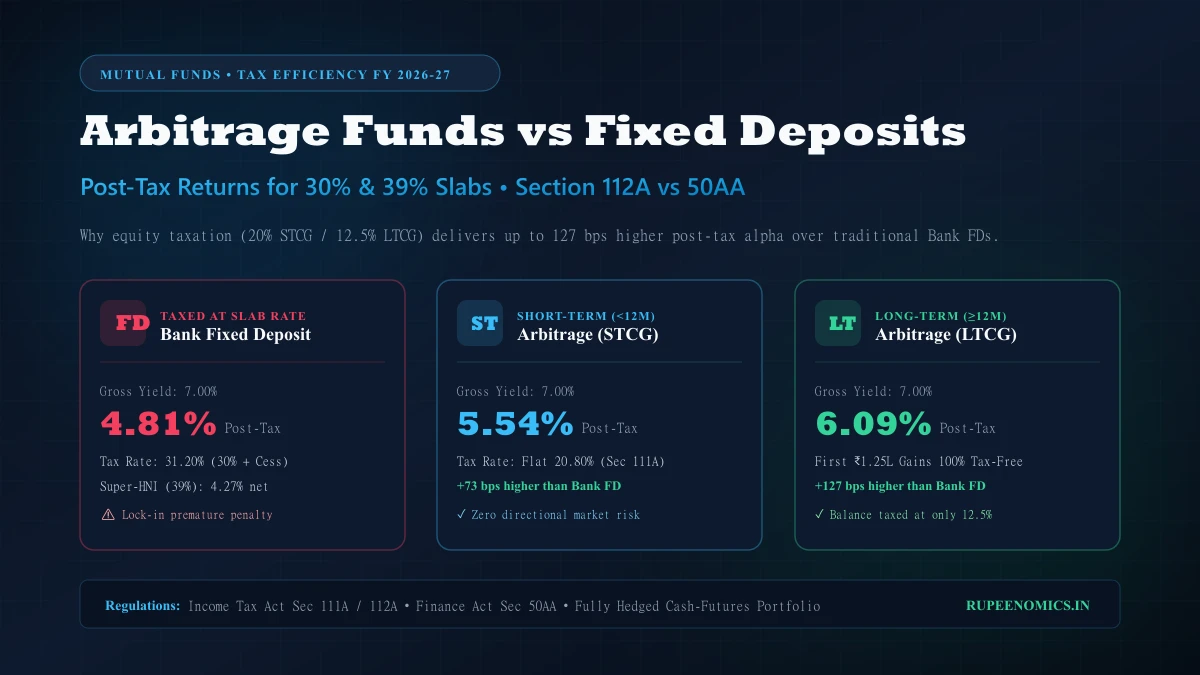
Arbitrage Funds vs Fixed Deposits (FY 2026-27): Post-Tax Returns, Taxation Rules & Low-Risk Parking Strategy
Arbitrage Funds vs Fixed Deposits (FY 2026-27): Post-Tax Returns, Taxation Rules & Low-Risk Parking Strategy Position-0 / Quick Answer: Should you choose an Arbitrage Fund or Bank FD in 2026? For inve…
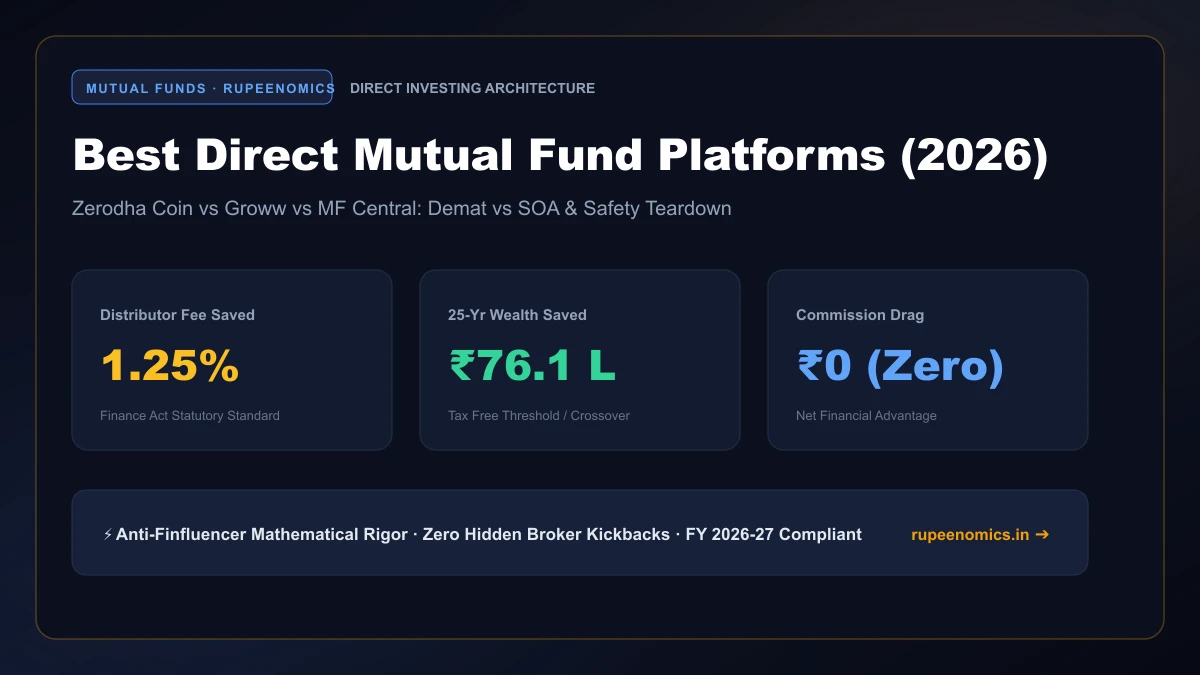
Best Direct Mutual Fund Platforms in India (2026): Zerodha Coin vs Groww vs MF Central
Best Direct Mutual Fund Platforms in India (2026): Zerodha Coin vs Groww vs MF Central If you invest in mutual funds through your bank relationship manager, a traditional broker, or third-party distri…
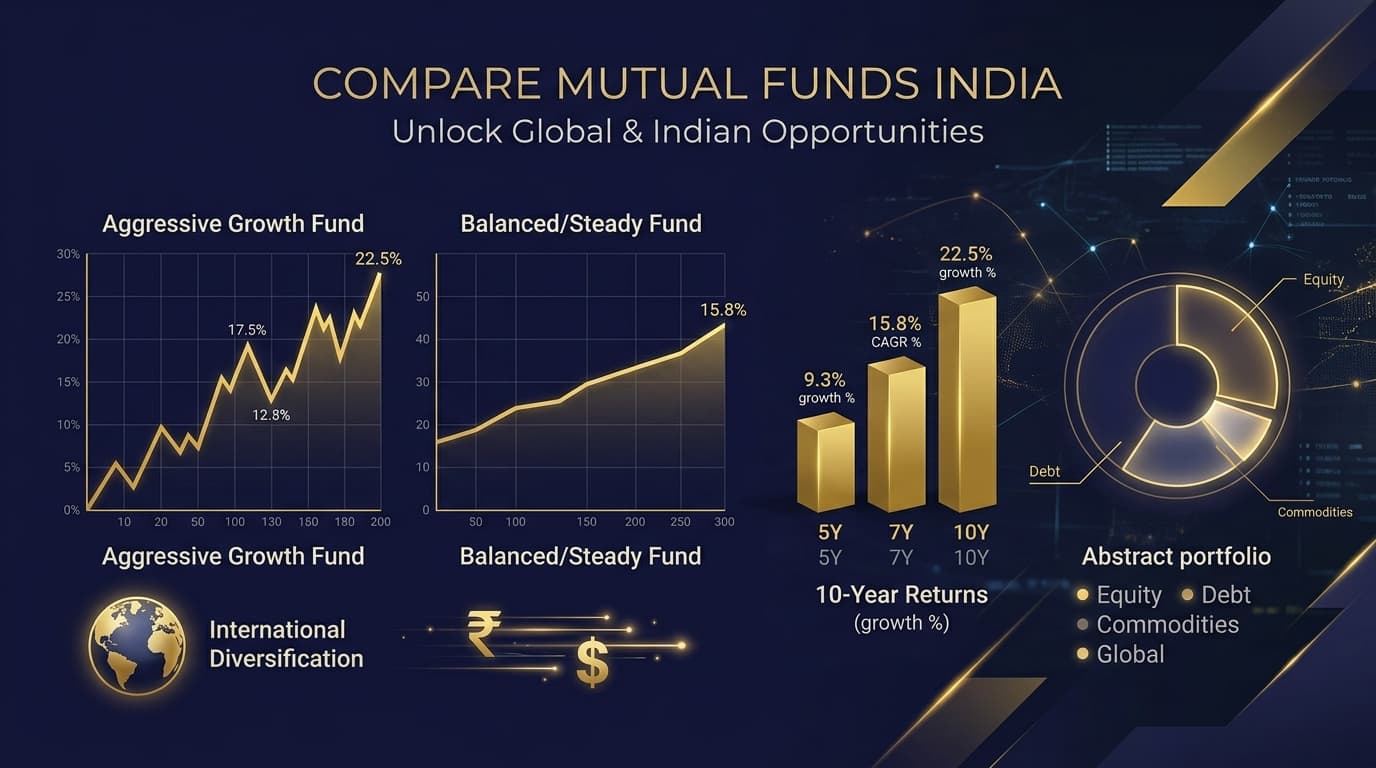
HDFC Flexi Cap vs Parag Parikh Flexi Cap Fund: Which Should You Choose in 2026?
Two of India's most beloved flexi-cap funds — and they couldn't be more different in philosophy, portfolio, and risk. HDFC Flexi Cap is aggressive, India-centric, and cyclical-sector-heavy. Parag P…