Arbitrage Funds vs Fixed Deposits (FY 2026-27): Post-Tax Returns, Taxation Rules & Low-Risk Parking Strategy
Arbitrage Funds vs Fixed Deposits (FY 2026-27): Post-Tax Returns, Taxation Rules & Low-Risk Parking Strategy
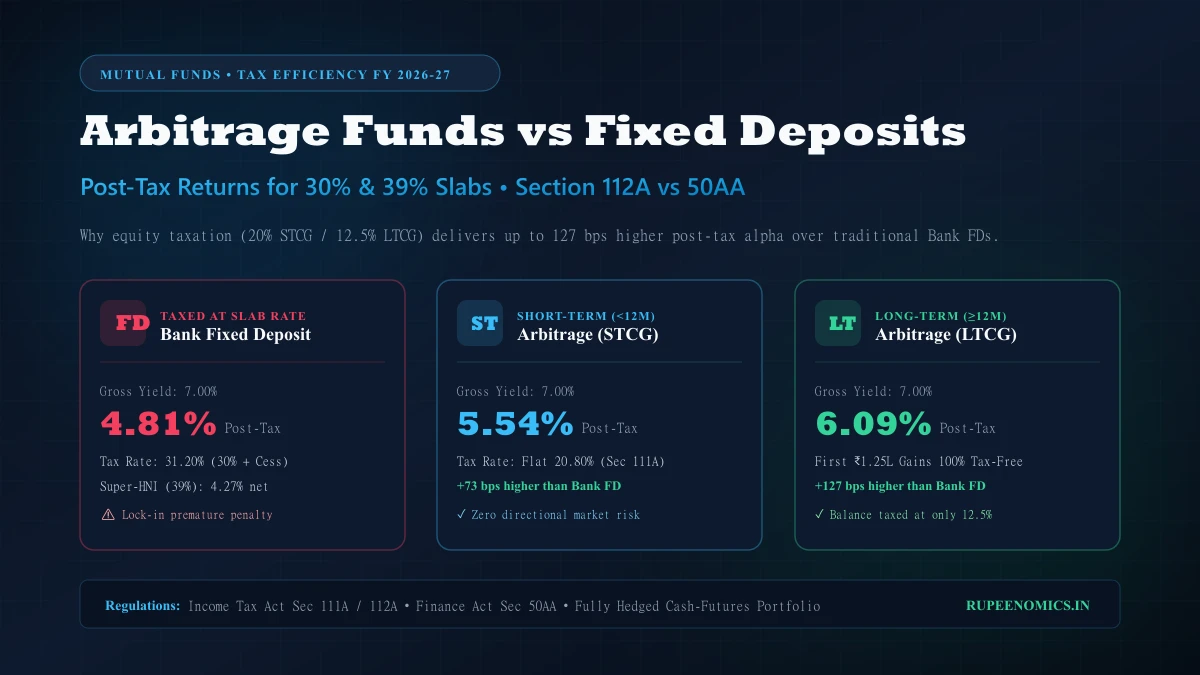
Position-0 / Quick Answer: Should you choose an Arbitrage Fund or Bank FD in 2026? For investors in the 30% and 39% income tax slabs, Arbitrage Funds deliver significantly higher post-tax returns than Bank Fixed Deposits (FDs) and Liquid Funds. Because Arbitrage Funds maintain over 65% in hedged equities (simultaneously buying spot shares and selling stock futures), they are classified as Equity-Oriented Mutual Funds under Indian tax law. While Bank FD interest is taxed at your peak marginal slab rate (up to 31.2% to 39%), Arbitrage Fund gains are taxed at just 20% (Short-Term Capital Gains if held < 12 months) and 12.5% (Long-Term Capital Gains if held > 12 months, with a ₹1.25 Lakh annual tax-free exemption). On a 7.00% gross yield, a 30% slab investor earns 4.81% post-tax in an FD versus 5.54% to 6.09% post-tax in an Arbitrage Fund—unlocking 73 to 127 basis points of risk-free alpha.
1. The 2023 Debt Fund Tax Shock & The Rise of Arbitrage Funds
Prior to April 1, 2023, conservative retail investors and High-Net-Worth Individuals (HNIs) parked surplus liquidity in Debt Mutual Funds (Liquid Funds, Ultra Short Duration Funds) to enjoy indexation benefits after three years.
However, the Finance Act 2023 introduced Section 50AA, which stripped indexation benefits from mutual funds with less than 35% equity exposure. Post-amendment, capital gains from debt funds, liquid funds, and conservative hybrid funds are treated as short-term capital gains and taxed directly at the investor's marginal income tax slab rate.
This regulatory change triggered a massive migration of institutional and retail capital into Arbitrage Mutual Funds. Because arbitrage funds hold $\ge 65%$ of their total portfolio in domestic equity securities, they legally qualify for Equity Taxation under Section 111A and Section 112A of the Income Tax Act, despite operating with near-zero directional market risk.
                          WHERE SHOULD YOU PARK SURPLUS CASH?
                                           │
         ┌─────────────────────────────────┼─────────────────────────────────┐
         ▼                                 ▼                                 ▼
┌───────────────────┐             ┌───────────────────┐             ┌───────────────────┐
│   Bank Fixed Dep. │             │   Liquid / Ultra   │             │   Arbitrage Fund  │
│  Taxed at Slab    │             │   Short Debt MFs  │             │   Equity Taxation │
│  (31.2% - 39.0%)  │             │   Taxed at Slab   │             │  (20% STCG /      │
│  Lock-in penalty  │             │   (Sec 50AA)      │             │   12.5% LTCG)     │
└───────────────────┘             └───────────────────┘             └───────────────────┘
2. How Arbitrage Funds Work: The Cash-Futures Spread
Many first-time mutual fund investors hesitate to allocate to arbitrage funds because they see the word "Equity" and fear stock market volatility.
In reality, arbitrage fund managers do not take directional bets on whether stock prices will rise or fall. Instead, they exploit the mathematically guaranteed pricing disparity between the Cash (Spot) Market and the Derivatives (Futures) Market.
The Mechanics of a Risk-Free Arbitrage Trade:
- Spot Price vs. Future Price: Under normal market conditions (contango), single-stock futures trade at a premium to their spot cash price due to the cost of carry (interest rate differential over the contract's lifetime).
- Simultaneous Execution:
- The fund manager buys 1,000 shares of Reliance Industries in the Cash Market at ₹2,500.
- At the exact same microsecond, the manager sells (shorts) 1 lot (1,000 shares) of Reliance Current-Month Futures at ₹2,515.
- Locked-in Spread: The ₹15 per share difference is a completely hedged, locked-in profit of ₹15,000, irrespective of where the stock price moves.
- Expiry Convergence: On the monthly derivatives expiry day (last Thursday of the month), the futures price must mathematically converge with the cash market spot price:
$$\text{Cash Price at Expiry} = \text{Futures Price at Expiry}$$
- If Reliance surges to ₹2,800: Cash position gains ₹300/share (+₹3,00,000); Futures short position loses ₹285/share (-₹2,85,000). Net Gain = +₹15,000.
- If Reliance crashes to ₹2,000: Cash position loses ₹500/share (-₹5,00,000); Futures short position gains ₹515/share (+₹5,15,000). Net Gain = +₹15,000.
Because every long equity position is 100% neutralized by an equal short futures position, the net equity delta of the portfolio is virtually zero. The remaining 15%–35% of the fund is deployed in high-safety AAA-rated commercial papers, treasury bills (T-Bills), and reverse repos to generate auxiliary accrual yield.
3. Taxation Rules Breakdown: FY 2026-27 (Post-Budget 2024 Amendments)
Enjoyed this post?
Get our weekly digest delivered free.
Following the comprehensive rationalization of capital gains taxes in the Union Budget, here is the exact tax treatment governing Bank FDs, Arbitrage Funds, and Liquid Funds:
| Asset Class / Vehicle | Holding Period | Applicable Income Tax Section | Tax Rate (FY 2026-27) | Surcharge & Cess Impact |
|---|---|---|---|---|
| Bank Fixed Deposit (FD) | Any duration (7 days to 10 years) | Income from Other Sources | Marginal Slab Rate (5% to 30%) | Subject to 4% Health & Education Cess + Surcharge up to 25% (Max rate: 39.00%) |
| Liquid / Debt Mutual Funds | Any duration (Post-April 2023) | Section 50AA | Marginal Slab Rate (5% to 30%) | Taxed identically to Bank FD interest (31.2% to 39.00%) |
| Arbitrage Fund (STCG) | Held for < 12 Months | Section 111A (Equity STCG) | Flat 20.00% | Plus 4% Cess = 20.80% (Surcharge capped at 15%) |
| Arbitrage Fund (LTCG) | Held for $\ge$ 12 Months | Section 112A (Equity LTCG) | Flat 12.50% | First ₹1,25,000 annual gains 100% TAX-FREE; balance taxed at 13.00% (incl. cess) |
4. Post-Tax Yield Comparison: ₹10 Lakh Investment Simulation
To evaluate the real-world post-tax alpha, let us simulate a cash allocation of ₹10,00,000 for a salaried executive or business owner falling under the 30% marginal income tax bracket (effective rate 31.20% including 4% cess).
We assume a benchmark gross return of 7.00% per annum across both instruments:
$$\text{Post-Tax Return} = \text{Gross Return} \times (1 - \text{Effective Tax Rate})$$
| Metric / Parameter | 1-Year Bank Fixed Deposit (FD) | Arbitrage Fund (Redeemed at 6 Months) | Arbitrage Fund (Redeemed at 13 Months) |
|---|---|---|---|
| Initial Principal | ₹10,00,000 | ₹10,00,000 | ₹10,00,000 |
| Gross Annualized Yield | 7.00% | 7.00% | 7.00% |
| Pre-Tax Gains | ₹70,000 | ₹35,000 (half-year) | ₹76,140 |
| Tax Classification | Added to Total Taxable Income | Equity STCG (Sec 111A) | Equity LTCG (Sec 112A) |
| Statutory Tax Rate | 31.20% (30% + 4% cess) | 20.80% (20% + 4% cess) | 13.00% (over ₹1.25L exemption) |
| Taxes Payable | ₹21,840 | ₹7,280 | ₹0.00 (Under ₹1.25L limit) |
| Net Post-Tax Profit | ₹48,160 | ₹27,720 (annualized ₹55,440) | ₹76,140 |
| Effective Post-Tax Return | 4.816% | 5.544% | 7.000% (100% Tax-Free) |
| Post-Tax Alpha vs. Bank FD | Benchmark (0.00%) | +0.728% (+73 bps) | +2.184% (+218 bps) |
For Super-HNIs (Taxable Income > ₹5 Crore):
For high-net-worth investors subject to the highest surcharge bracket, the marginal tax on Bank FD interest escalates to 39.00%.
- Bank FD Post-Tax Yield: $7.00% \times (1 - 0.39) = \mathbf{4.27%}$.
- Arbitrage Fund Post-Tax Yield (STCG): $7.00% \times (1 - 0.239) = \mathbf{5.32%}$.
- Net Wealth Gain: Over 105 basis points of annual post-tax outperformance.
5. Risk, Liquidity & Operational Constraints: The Trade-Offs
While Arbitrage Funds offer undeniable tax superiority, they differ structurally from traditional bank deposits. Understanding these nuances prevents costly behavioral mistakes:
┌────────────────────────────────────────────────────────────────────────┐
│                        ARBITRAGE FUND RISK FACTORS                     │
├──────────────────────────┬─────────────────────────────────────────────┤
│ 1. Spread Compression    │ In severe bear markets or low-volatility    │
│    in Sideways Markets   │ regimes, futures spreads narrow. Annualized │
│                          │ gross yields can temporarily drop to        │
│                          │ 5.5%–6.0%, tracking overnight MIBOR rates. │
├──────────────────────────┼─────────────────────────────────────────────┤
│ 2. Exit Load Windows     │ Most top arbitrage funds levy a 0.25% to    │
│    (15 to 30 Days)       │ 0.50% exit load if redeemed within 15 to    │
│                          │ 30 days. Not suitable for 3-day parking!   │
├──────────────────────────┼─────────────────────────────────────────────┤
│ 3. Sovereign Guarantee   │ Bank FDs carry DICGC insurance protection up│
│    vs. Market NAV        │ to ₹5 Lakh per depositor per bank. MFs have │
│                          │ no sovereign guarantee, though credit risk  │
│                          │ is negligible in top-tier fund houses.      │
└──────────────────────────┴─────────────────────────────────────────────┘
When Does a Bank FD Make More Sense?
- Urgent Cash Needs (< 15 Days): If you require the money within 2 to 14 days (e.g., paying advance tax or credit card bills), the 0.25% exit load in arbitrage funds eliminates the tax advantage. Use a Savings Account or Sweep-in FD.
- Lower Tax Brackets (Nil or 5% Slabs): If your total annual income is below ₹7 Lakh (New Tax Regime rebate under Section 87A), your effective tax rate on FD interest is 0%. A 7.50% Small Finance Bank or PSU Bank FD will beat an arbitrage fund hands down.
6. How to Select the Best Arbitrage Funds in 2026
When choosing an Arbitrage Mutual Fund, avoid chasing recent 1-month trailing returns. Instead, filter using three structural safety criteria:
- Asset Under Management (AUM > ₹5,000 Crore): Larger AUM gives fund managers greater institutional execution power in algorithmic block deals, lowering transaction drag.
- Low Expense Ratio (TER < 0.35% for Direct Plans): High management fees erode the net cash-futures spread. Always select Direct-Growth plans.
- Credit Quality of Debt Allocation: Inspect the monthly portfolio factsheet. Ensure that the unhedged debt portion (15%–35%) is allocated strictly to Sovereign T-Bills, Tri-Party Repos (TREPS), and AAA-rated PSU papers, with zero exposure to credit risk.
Top Category Leaders by Track Record:
- Kotak Equity Arbitrage Fund - Direct Growth (India's largest arbitrage fund, high operational efficiency).
- ICICI Prudential Equity Arbitrage Fund - Direct Growth (Consistent spread capture, strong treasury oversight).
- SBI Arbitrage Opportunities Fund - Direct Growth (Robust institutional risk framework).
- Tata Arbitrage Fund - Direct Growth (Low tracking expense, competitive short-duration returns).
7. Actionable Portfolio Allocation Strategy: The 3-Tier Parking Rule
To maximize yield while maintaining bulletproof liquidity, structure your short-term liquid wealth using the 3-Tier Parking Model:
                               3-TIER LIQUID WEALTH PYRAMID
                                            ▲
                                           / \
                                          /   \
                                         / Tier\
                                        /   1   \  Tier 1: 0 - 15 Days Needs
                                       /─────────\  Sweep-in Bank FD / Savings
                                      /   Tier    \
                                     /     2       \  Tier 2: 15 Days - 3 Months
                                    /───────────────\  Arbitrage Funds (STCG 20%)
                                   /     Tier 3      \
                                  /                   \  Tier 3: 3 Months - 1 Year+
                                 /─────────────────────\ Arbitrage Funds (LTCG 12.5% / Tax-Free)
- Tier 1 (Instant Emergency Cash: 0 to 15 Days):
- Keep 1 month of living expenses in an automated sweep-in bank savings account with instant ATM access.
- Tier 2 (Short-Horizon Buffer: 15 Days to 3 Months):
- Allocate planned payments (quarterly advance tax, school fees, luxury travel) into Direct Arbitrage Funds. Pay only 20% tax instead of 31.2%.
- Tier 3 (Strategic Capital / Dry Powder: 3 Months to 2 Years):
- Park funds waiting for stock market corrections or real estate down payments in Arbitrage Funds. By holding past 12 months, your gains up to ₹1.25 Lakh are entirely tax-free, compounding at maximum efficiency.
Frequently Asked Questions (FAQs)
Q1. Can an Arbitrage Fund deliver negative returns on a given day?
Yes. On rare occasions—such as extreme market volatility near derivatives expiry or rapid shifts in implied volatility—the mark-to-market NAV of an arbitrage fund can drop by 0.01% to 0.03% on an individual day. However, because the underlying positions are fully hedged to maturity, the spread recovers as the expiry date approaches. Over any rolling 1-month or 3-month window, arbitrage funds have historically exhibited zero capital loss.
Q2. Is dividend payout (IDCW) better than Growth option in Arbitrage Funds?
No. Under current tax laws, dividends (IDCW) are added to your personal income and taxed at your marginal slab rate (up to 39%), completely destroying the equity taxation benefit. Always select the Growth option so that your gains are taxed under the favorable Section 111A/112A capital gains rates upon redemption.
Q3. Does Section 80C deduction apply to Arbitrage Funds?
No. Arbitrage funds do not qualify for tax deductions under Section 80C (which applies only to ELSS funds with a 3-year lock-in). The tax advantage of arbitrage funds lies exclusively in the concessionary capital gains rates on profits.
Regulatory References & Authoritative Sources
- Income Tax Department of India, Section 111A (Tax on Short-Term Capital Gains in Equity-Oriented Funds) & Section 112A (Long-Term Capital Gains).
- Finance Act 2023 & Finance Act 2024, Amendments to Section 50AA regarding Debt Mutual Fund Taxation.
- Securities and Exchange Board of India (SEBI), Categorization and Rationalization of Mutual Fund Schemes (Circular SEBI/HO/IMD/DF3/CIR/P/2017/114).
- Association of Mutual Funds in India (AMFI), Monthly Industry AUM & Arbitrage Scheme Data (2026).
The insights, broker reviews, tax estimates, and financial data presented on RupeeNomics are strictly for educational and research purposes only. RupeeNomics and its authors are not SEBI-registered investment advisors or research analysts. Nothing published herein should be construed as personalized investment advice or a recommendation to buy or sell securities. Investments in the securities market are subject to market risks. Please conduct your own due diligence or consult a SEBI-registered financial planner before making investment decisions. Read our Editorial Policy.
Enjoyed this post?
Get our weekly digest delivered free.
Share this post:
RupeeNomics is reader-supported. We may earn a commission from links in this article at no extra cost to you. Read our disclosure.
Related Posts
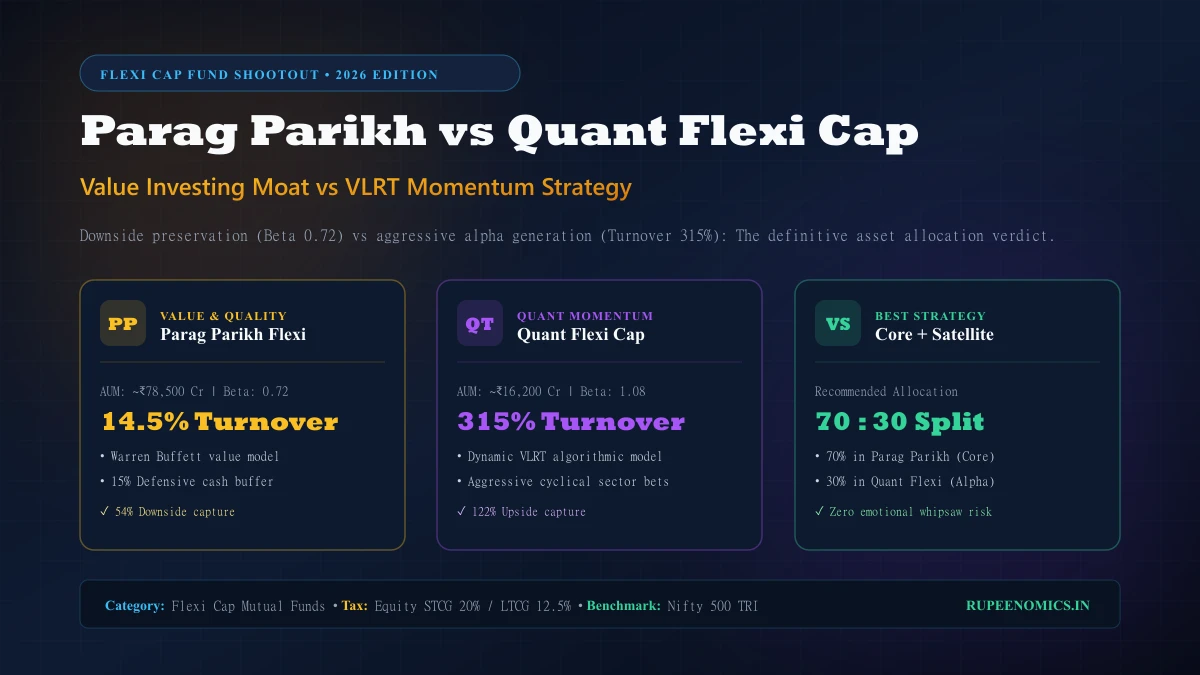
Parag Parikh Flexi Cap vs Quant Flexi Cap (2026): Value Moat vs VLRT Momentum Shootout
Parag Parikh Flexi Cap vs Quant Flexi Cap (2026): Value Moat vs VLRT Momentum Shootout Position-0 / Quick Answer: Which is better — Parag Parikh Flexi Cap or Quant Flexi Cap? The choice between Parag …
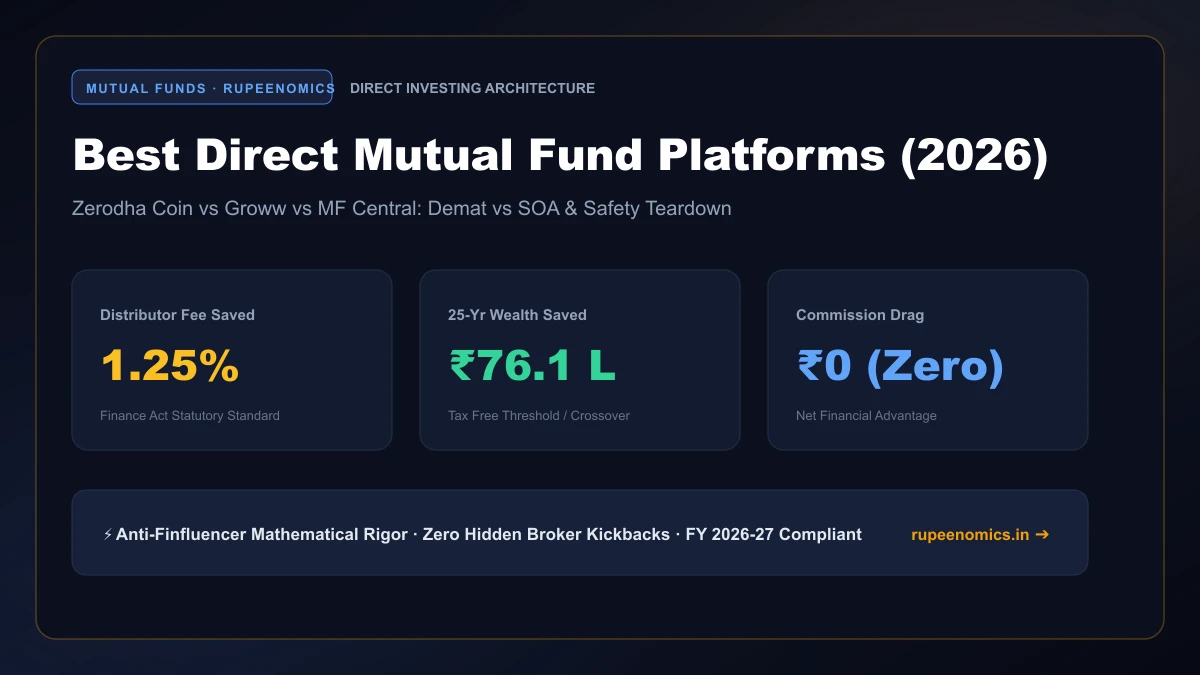
Best Direct Mutual Fund Platforms in India (2026): Zerodha Coin vs Groww vs MF Central
Best Direct Mutual Fund Platforms in India (2026): Zerodha Coin vs Groww vs MF Central If you invest in mutual funds through your bank relationship manager, a traditional broker, or third-party distri…
HDFC Flexi Cap vs Parag Parikh Flexi Cap Fund: Which Should You Choose in 2026?
Two of India's most beloved flexi-cap funds — and they couldn't be more different in philosophy, portfolio, and risk. HDFC Flexi Cap is aggressive, India-centric, and cyclical-sector-heavy. Parag P…