Best Direct Mutual Fund Platforms in India (2026): Zerodha Coin vs Groww vs MF Central
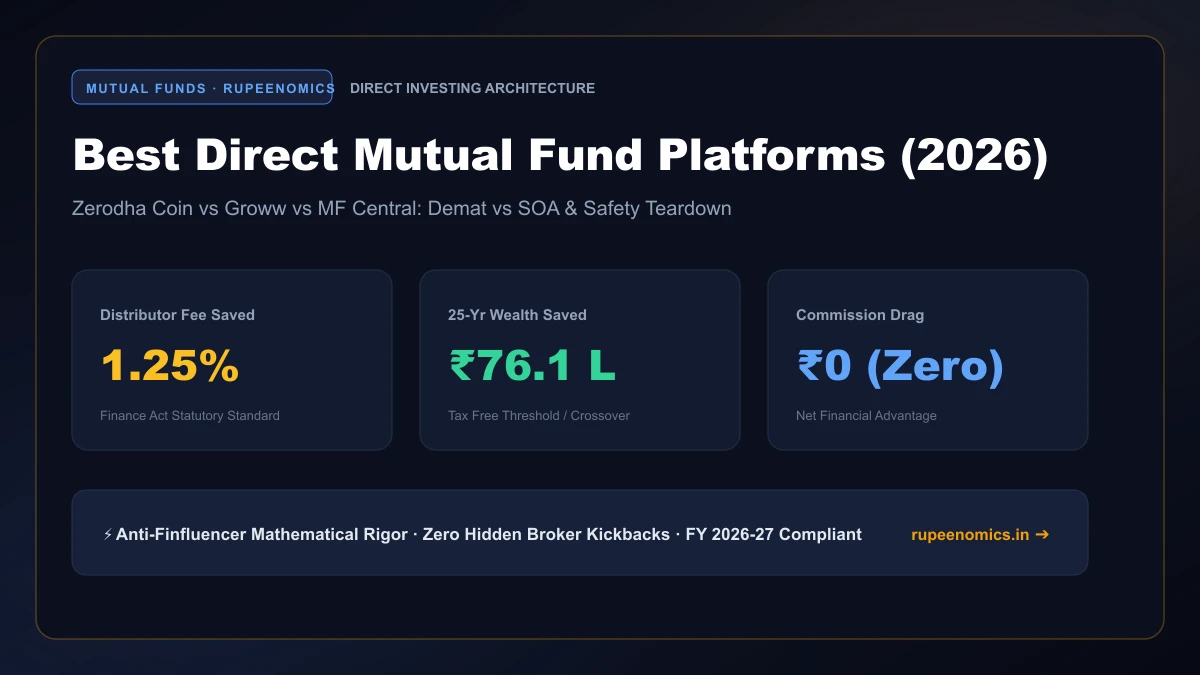
Best Direct Mutual Fund Platforms in India (2026): Zerodha Coin vs Groww vs MF Central
If you invest in mutual funds through your bank relationship manager, a traditional broker, or third-party distributors like Policybazaar or Bajaj Finserv, you are almost certainly investing in Regular Plans.
In a Regular Plan, the fund house quietly deducts 0.75% to 1.50% every single year from your portfolio value to pay trailing commissions to the distributor.
On a ₹25,000 monthly SIP compounding at 12% over 25 years:
- Direct Plan Final Value: ₹4.74 Crore
- Regular Plan Final Value (1% commission): ₹3.98 Crore
- Total Wealth Lost to Middlemen: ₹76.1 Lakhs in pure commission drag.
Switching to a Direct Plan eliminates distributor kickbacks completely. But which platform should you use to execute your Direct SIPs in 2026?
Below is an engineering and fee teardown of the three dominant direct platforms in India: Zerodha Coin, Groww, and MF Central.
1. Quick Feature & Architecture Comparison
| Feature | Zerodha Coin | Groww | MF Central |
|---|---|---|---|
| Holding Format | Demat Units (held via CDSL) | SOA (Statement of Account via BSE StAR MF) | SOA (Direct with CAMS & KFintech RTAs) |
| Direct Plans Supported | 100% Direct Plans | 100% Direct Plans | 100% Direct Plans |
| Transaction Charges | ₹0 (Zero) | ₹0 (Zero) | ₹0 (Zero) |
| Account Maintenance Fee | ₹300/year (for Zerodha Demat) | ₹0 (Zero Life-Long) | ₹0 (Zero Life-Long) |
| DP Charges on Redemption | ₹5.50 per ISIN upon redemption | ₹0 (Zero DP Charges) | ₹0 (Zero DP Charges) |
| SIP Execution Mechanism | Mandate / UPI AutoPay / Coin Balance | UPI AutoPay / OTM Mandate | Net Banking / UPI / NEFT |
| Pledge for Margin Trading | ✅ Yes (Instant pledge for F&O/equity) | ❌ No | ❌ No |
| Non-Financial Requests | Handled through Zerodha Ticket | Handled through Groww Support | ✅ Instant (Bank update, nominee, email change) |
| Regulatory Standing | SEBI Registered Stock Broker | SEBI Registered Stock Broker | Official Joint Initiative of CAMS & KFintech |
2. Zerodha Coin: The Demat Powerhouse
Zerodha Coin was among the pioneers of zero-commission direct mutual fund investing in India. Its defining architectural trait is that units are credited directly to your CDSL Demat Account.
The Advantages:
- Unified Net Worth Dashboard: If you hold stocks, sovereign gold bonds (SGBs), Treasury bills, and mutual funds, everything lives in a single depository account on Zerodha Console.
- Pledge for Collateral Margin: Zerodha allows you to pledge your mutual fund units instantly with a single OTP to receive margin for equity and options trading. Haircuts range from 10% to 20% on top blue-chip funds.
- Strict Order Execution: Order settlement flows directly through the Indian Clearing Corporation Limited (ICCL), guaranteeing transparency.
The Drawbacks:
- Demat Red Tape: If you close your Zerodha account, transferring units to another platform requires submitting a physical DIS (Delivery Instruction Slip) or using CDSL Easiest.
- Nomination & Joint Holding Rigidities: Demat accounts enforce identical primary holders across all assets. You cannot easily set different nominees for different funds.
- ₹5.50 CDSL Redemption Fee: When you redeem units, CDSL charges ₹5.50 + GST per fund script.
3. Groww: The Retail Ease Champion
Enjoyed this post?
Get our weekly digest delivered free.
Groww began purely as a direct mutual fund app before expanding into stocks and lending. It operates on the Statement of Account (SOA) architecture utilizing the BSE StAR MF infrastructure.
The Advantages:
- 100% Zero Fixed Costs: There is no account maintenance charge (AMC), zero account opening fee, and zero DP charge on redemptions.
- Seamless UPI AutoPay Integration: Setting up, pausing, or modifying an SIP takes less than 15 seconds via any UPI app (GPay, PhonePe, Paytm).
- Clean, Frictionless UI: Groww’s interface is built specifically for everyday retail investors who do not trade derivatives or require advanced order types.
- Independent RTA Records: Because your holdings are in SOA format, your units reside directly on the books of CAMS and KFintech. Even if Groww ceased operations tomorrow, your investments remain 100% safe and redeemable directly via the fund house.
The Drawbacks:
- No Collateral Margin: Units cannot be pledged for trading margin.
- Cross-Selling Clutter: In recent years, Groww has aggressively pushed consumer loans, credit lines, and high-risk F&O trading options on its homepage.
4. MF Central: The Unbiased Sovereign Utility
MF Central is not a private fintech startup looking to monetize your financial data. It is the official joint platform created by India’s two registered Registrar and Transfer Agents (RTAs)—CAMS and KFintech—under the mandate of SEBI.
The Advantages:
- Zero Broker Counterparty Risk: You are transacting directly with the infrastructure that actually issues mutual fund units in India. No third-party broker sits between your bank account and the fund house.
- Universal Folio Tracking: MF Central automatically aggregates every mutual fund folio you have ever created in India under your PAN—regardless of whether you invested via Zerodha, Groww, ICICI Direct, or offline agents.
- Instant Non-Financial Service Requests: Need to update your bank account, change your nominee, update your mobile number, or consolidate duplicate folios across 10 fund houses? MF Central executes these modifications centrally across all AMCs with a single digital request.
- Zero Advertisements or Cross-Selling: Pure, distraction-free investing utility with zero financial upsells.
The Drawbacks:
- Utilitarian Interface: The user interface is functional and basic compared to the sleek animations of modern consumer fintech apps.
- No Equity or Stock Tracking: Strictly limited to mutual funds; cannot track your direct equity portfolio or SGBs.
5. Demat vs SOA: Which Holding Architecture Is Safer?
Many investors wonder whether holding mutual funds in Demat form is safer than Statement of Account (SOA):
┌─────────────────────────────────────────────────────────────┐
│                     DEMAT vs SOA COMPASS                    │
├──────────────────────┬──────────────────────────────────────┤
│ Demat Format (Coin)  │ Ideal for Active Traders & Stock     │
│                      │ Investors who want collateral margin │
│                      │ and a unified single portfolio view. │
├──────────────────────┼──────────────────────────────────────┤
│ SOA Format (Groww,   │ Ideal for Long-Term SIP Investors.   │
│ MF Central)          │ Zero AMC, zero DP redemption fees,   │
│                      │ and direct unencumbered RTA access.  │
└──────────────────────┴──────────────────────────────────────┘
Security Verdict: Both models have identical legal security under SEBI oversight. In Demat, your ownership is recorded in CDSL/NSDL depository databases. In SOA, your ownership is recorded directly on the AMC’s books by CAMS/KFintech. Your money never stays in the platform's bank account in either model.
6. The Verdict: Which Platform Should You Choose?
- Choose Zerodha Coin if: You actively buy individual stocks, hold sovereign bonds, and want the ability to pledge your mutual funds for derivative trading margin.
- Choose Groww if: You want a clean, zero-cost mobile app with instant UPI SIP setup and zero annual maintenance fees.
- Choose MF Central if: You value maximum data privacy, want to eliminate fintech intermediary risk, or need to manage multiple legacy folios across different brokers in one unified master dashboard.
Test your exact 25-year compounding wealth creation using our free SIP Compound Interest Calculator.
:::disclaimer
Disclaimer: Mutual fund investments are subject to market risks. Read all scheme-related documents carefully before investing. RupeeNomics maintains commercial partnership tracking links with verified SEBI-registered brokers (Zerodha partner code c=NRH780). Our editorial analysis remains 100% independent and uninfluenced by sponsor arrangements.
:::
The insights, broker reviews, tax estimates, and financial data presented on RupeeNomics are strictly for educational and research purposes only. RupeeNomics and its authors are not SEBI-registered investment advisors or research analysts. Nothing published herein should be construed as personalized investment advice or a recommendation to buy or sell securities. Investments in the securities market are subject to market risks. Please conduct your own due diligence or consult a SEBI-registered financial planner before making investment decisions. Read our Editorial Policy.
Enjoyed this post?
Get our weekly digest delivered free.
Share this post:
RupeeNomics is reader-supported. We may earn a commission from links in this article at no extra cost to you. Read our disclosure.
Related Posts
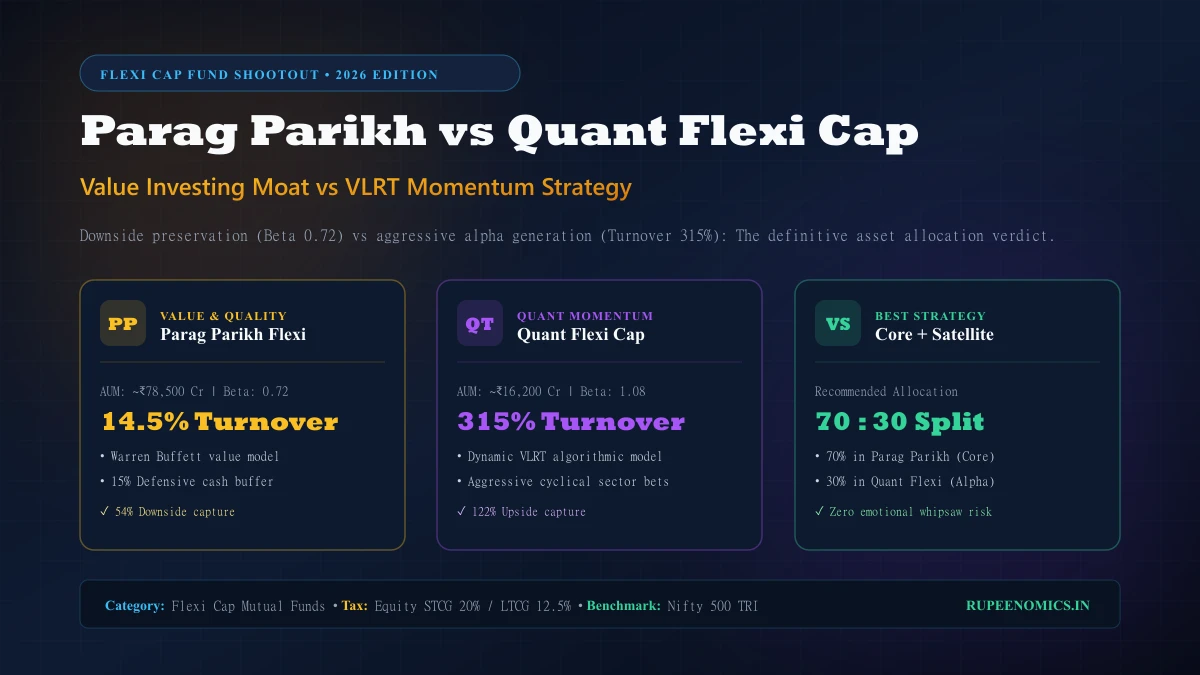
Parag Parikh Flexi Cap vs Quant Flexi Cap (2026): Value Moat vs VLRT Momentum Shootout
Parag Parikh Flexi Cap vs Quant Flexi Cap (2026): Value Moat vs VLRT Momentum Shootout Position-0 / Quick Answer: Which is better — Parag Parikh Flexi Cap or Quant Flexi Cap? The choice between Parag …
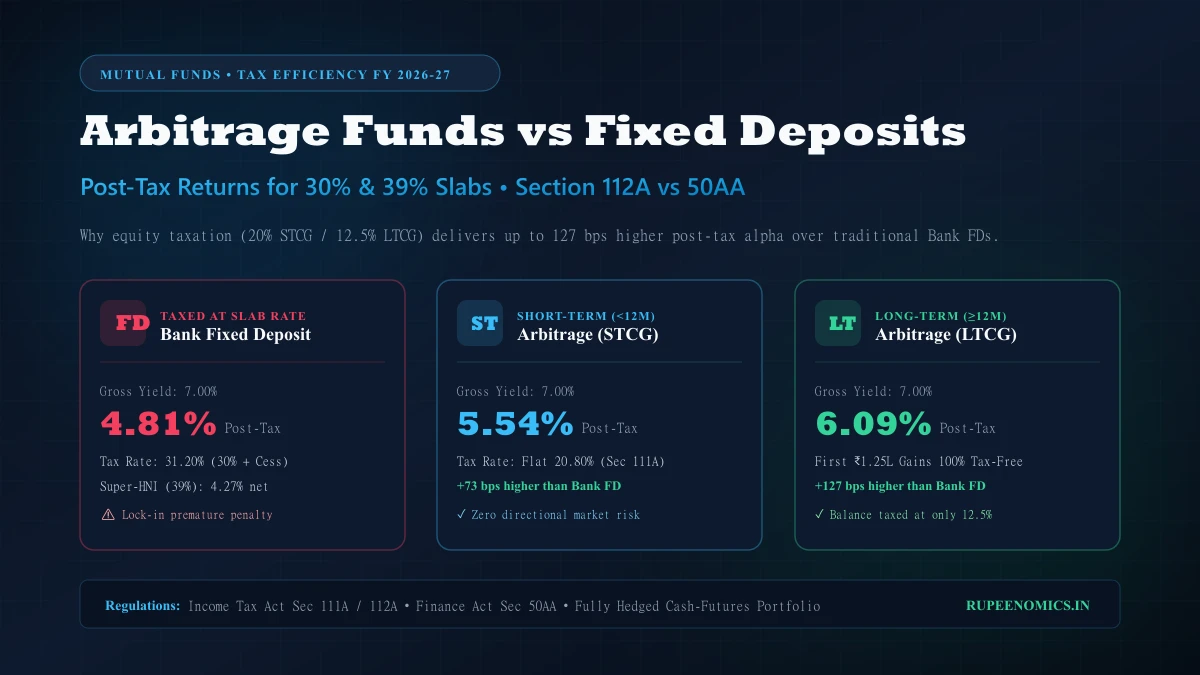
Arbitrage Funds vs Fixed Deposits (FY 2026-27): Post-Tax Returns, Taxation Rules & Low-Risk Parking Strategy
Arbitrage Funds vs Fixed Deposits (FY 2026-27): Post-Tax Returns, Taxation Rules & Low-Risk Parking Strategy Position-0 / Quick Answer: Should you choose an Arbitrage Fund or Bank FD in 2026? For inve…
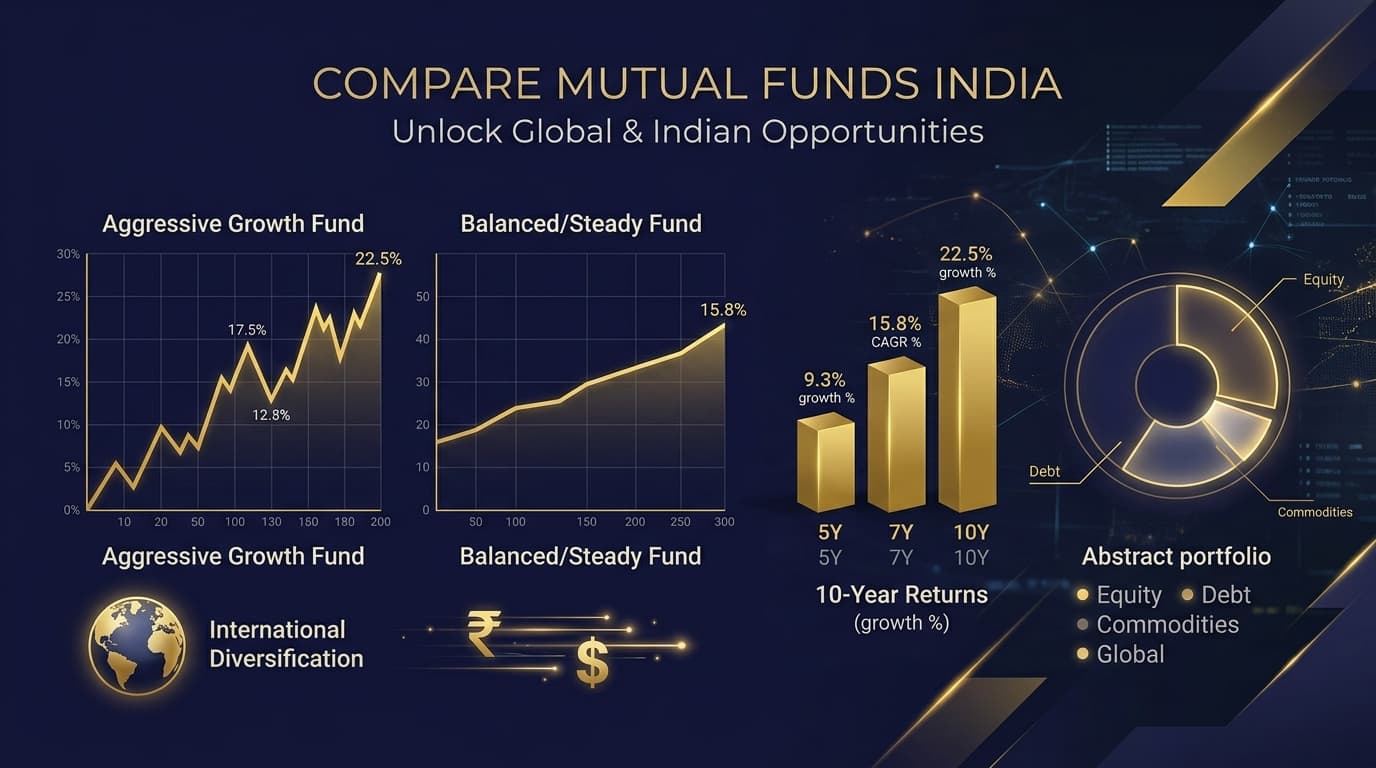
HDFC Flexi Cap vs Parag Parikh Flexi Cap Fund: Which Should You Choose in 2026?
Two of India's most beloved flexi-cap funds — and they couldn't be more different in philosophy, portfolio, and risk. HDFC Flexi Cap is aggressive, India-centric, and cyclical-sector-heavy. Parag P…