NPS Tier 1 vs Tier 2: Complete Tax Benefits Guide under Section 80CCD (1B & 2), Lock-in & Exit Rules
NPS Tier 1 vs Tier 2: Complete Tax Benefits Guide under Section 80CCD (1B & 2), Lock-in & Exit Rules
Regulated by the Pension Fund Regulatory and Development Authority (PFRDA), the National Pension System (NPS) is frequently marketed by banks as a single retirement vehicle. In reality, opening an NPS account creates two fundamentally different accounts under a single Permanent Retirement Account Number (PRAN): Tier 1 (The Pension Trust) and Tier 2 (The Voluntary Savings Facility).
Conflating these two accounts leads to severe financial surprises. Investors who deposit money into Tier 2 expecting an income tax deduction discover that Tier 2 offers zero tax benefits for private citizens. Conversely, savers who park emergency funds into Tier 1 discover their capital is locked until age 60 with stringent withdrawal friction.
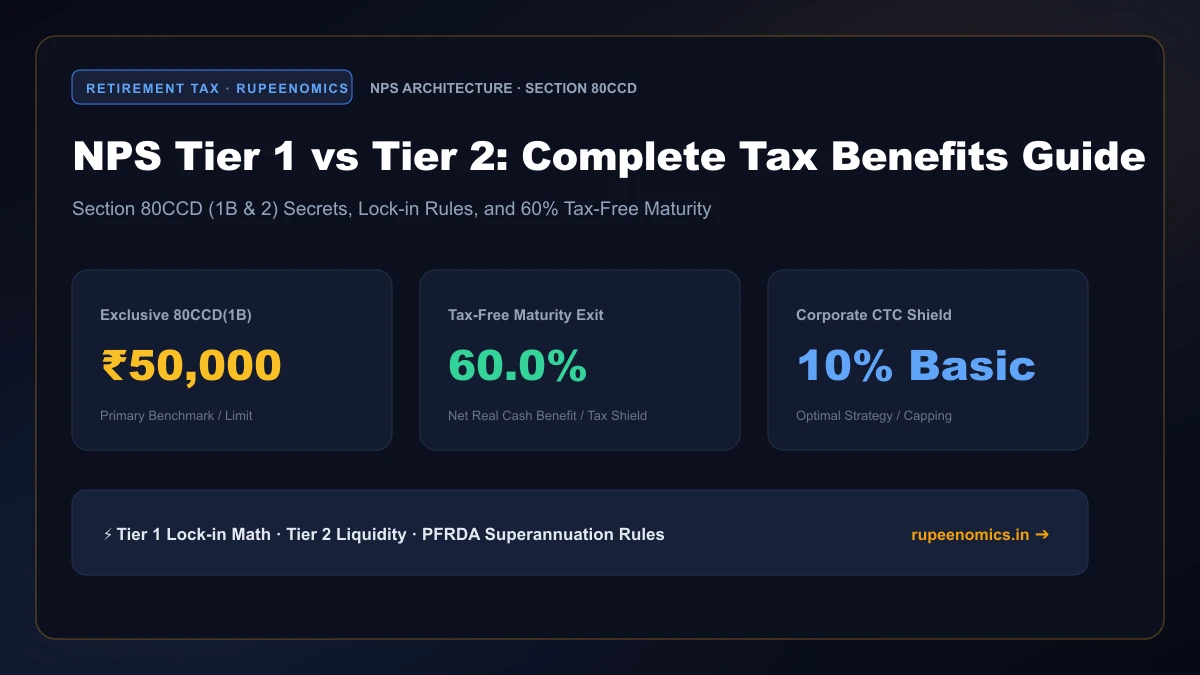
When deployed strategically, however, Section 80CCD(1B) provides an exclusive ₹50,000 tax deduction over and above the Section 80C ceiling, while Section 80CCD(2) enables corporate employees to shelter up to 10% of their basic salary across both Old and New Tax Regimes.
This master guide dissects the architectural differences, tax provisions, asset allocation mechanics, exit taxation, and compounding math of NPS Tier 1 vs. Tier 2 for AY 2026-27.
1. Architectural Blueprint: Tier 1 vs. Tier 2 at a Glance
Before examining the Income Tax Act schedules, understand the structural dichotomy between the two accounts:
                            [Permanent Retirement Account Number (PRAN)]
                                                  │
                 ┌────────────────────────────────┴────────────────────────────────┐
                 ▼                                                                 ▼
      [NPS TIER 1 ACCOUNT]                                              [NPS TIER 2 ACCOUNT]
     (Mandatory Retirement Engine)                                      (Voluntary Liquid Add-On)
                 │                                                                 │
  ├─ Status: Mandatory to open PRAN                                 ├─ Status: Optional (Requires active Tier 1)
  ├─ Minimum Opening: ₹500                                          ├─ Minimum Opening: ₹1,000
  ├─ Annual Minimum: ₹1,000                                         ├─ Annual Minimum: ₹0 (No maintenance fee)
  ├─ Lock-in: Until Age 60                                          ├─ Lock-in: ZERO (Withdraw anytime)
  ├─ Tax Deductions:                                                ├─ Tax Deductions:
  │   ├─ 80CCD(1) [Within ₹1.5L 80C]                               │   └─ ZERO for private employees
  │   ├─ 80CCD(1B) [Exclusive ₹50,000]                             │      (3-Yr lock-in for Central Govt only)
  │   └─ 80CCD(2) [Employer CTC: 10% Basic]                         │
  └─ Exit: 60% Tax-Free Lump Sum + 40% Annuity                      └─ Exit: Fully Taxable as Capital Gains
Comprehensive Comparison Matrix
| Feature | NPS Tier 1 Account | NPS Tier 2 Account |
|---|---|---|
| Account Nature | Core Retirement Pension Trust | Liquid Investment / Savings Account |
| Prerequisite | Primary account (Can be opened independently) | Requires an active Tier 1 PRAN |
| Minimum Initial Deposit | ₹500 | ₹1,000 |
| Minimum Annual Contribution | ₹1,000 per financial year | Nil (No mandatory annual contribution) |
| Liquidity / Lock-in | Strict lock-in until age 60 | 100% Liquid (T+2 withdrawal to bank) |
| Premature Partial Withdrawal | Max 25% of own contributions (After 3 years) | Unlimited anytime with zero penalty |
| Tax Deductions on Investment | Up to ₹2,00,000+ u/s 80CCD(1), (1B), (2) | Nil (No tax deduction for private sector) |
| Maturity / Exit Rules | 60% Lump Sum + 40% Mandatory Annuity | Withdraw entire balance at will |
| Maturity Taxation | 60% Lump Sum is 100% Tax-Free (Sec 10(12A)) | Capital gains taxed at slab / debt rates |
| Fund Management Charges | Ultra-low (0.03% to 0.09% AUM cap) | Ultra-low (0.03% to 0.09% AUM cap) |
2. Tax Deduction Ecosystem: Decoding Section 80CCD
Section 80CCD of the Income-tax Act, 1961 is divided into three distinct operational subsections:
               [Total NPS Tier 1 Potential Tax Shield]
                                 │
     ┌───────────────────────────┼───────────────────────────┐
     ▼                           ▼                           ▼
[Section 80CCD(1)]          [Section 80CCD(1B)]         [Section 80CCD(2)]
Employee Own Contribution   Exclusive Voluntary Window  Employer Contribution
     │                           │                           │
  Up to 10% of Basic Salary   Flat ₹50,000 Deduction     Up to 10% Basic (Private)
     │                           │                       Up to 14% Basic (Govt)
     ▼                           ▼                           │
[Capped inside ₹1.5L 80C]   [Over & Above ₹1.5L 80C]         ▼
 (Competes with EPF/PPF)    (Pure Additional Shield)    [Allowed in BOTH Old &
                                                         New Tax Regimes!]
1. Section 80CCD(1): Employee Contribution (Within Section 80C)
- Allows a deduction for individual contributions to NPS Tier 1.
- Ceiling: Capped at 10% of Salary (Basic + Dearness Allowance) for salaried employees, or 20% of Gross Total Income for self-employed professionals.
- The 80C Bottleneck: This deduction is subsumed within the overarching ₹1,50,000 limit of Section 80CCE. If your EPF contribution, ELSS mutual funds, and children's tuition fees already total ₹1,50,000, Section 80CCD(1) yields zero additional tax savings.
2. Section 80CCD(1B): The Exclusive ₹50,000 Tax Shield
- Introduced via the Finance Act 2015 to incentivize voluntary retirement savings.
- Allows an exclusive, standalone deduction of up to ₹50,000 for contributions to NPS Tier 1.
- The Core Benefit: This is strictly over and above the ₹1,50,000 limit of Section 80C.
- Combined Old Regime Total: By pairing Section 80C (₹1,50,000) with Section 80CCD(1B) (₹50,000), a salaried taxpayer can deduct a total of ₹2,00,000 from gross taxable income.
Real Cash Tax Savings on ₹50,000 Investment under 80CCD(1B):
| Marginal Tax Slab | Statutory Rate + 4% Cess | Real Cash Tax Saved Every Year |
|---|---|---|
| 5% Slab | 5.20% | ₹2,600 |
| 20% Slab | 20.80% | ₹10,400 |
| 30% Slab | 31.20% | ₹15,600 |
| 30% + 10% Surcharge (Income > ₹50L) | 34.32% | ₹17,160 |
| 30% + 15% Surcharge (Income > ₹1 Cr) | 35.88% | ₹17,940 |
Net Cost of Investment: For a corporate employee in the 30% tax bracket, investing ₹50,000 into NPS Tier 1 effectively costs only ₹34,400 from pocket, with the Government funding the remaining ₹15,600 through tax relief.
3. Section 80CCD(2): Employer Contribution (The Corporate Super Weapon)
- Claimed when your corporate employer deposits up to 10% of your Basic Salary + DA directly into your NPS Tier 1 PRAN via payroll restructuring.
- Cross-Regime Privilege: Section 80CCD(2) is one of the very few deductions preserved under the New Tax Regime (Section 115BAC)!
- Combined Employer Limit: Under Section 17(2)(vii), the aggregate employer contribution across EPF, NPS, and approved Superannuation funds is capped at ₹7,50,000 per financial year. Any excess is treated as a taxable perquisite.
3. Tier 2 Account: Why Is It Tax-Disadvantaged?
Enjoyed this post?
Get our weekly digest delivered free.
NPS Tier 2 acts as a low-cost, multi-asset mutual fund. You can deposit money online anytime and initiate redemptions directly into your linked bank account within T+2 working days.
The Tax Reality of Tier 2:
- Zero Entry Tax Deduction: Unlike Tier 1, money deposited into Tier 2 does not qualify for deductions under Section 80C or Section 80CCD for private sector or self-employed individuals.
- Central Government Exception: Under the NPS Tier 2 Tax Saving Scheme, 2020, Central Government employees can claim Section 80C deductions up to ₹1.5L on Tier 2 contributions, subject to a mandatory 3-year lock-in period.
- Withdrawal / Capital Gains Taxation:
- Unlike Tier 1 where 60% of the corpus is tax-free on retirement, Tier 2 gains are fully taxable.
- Because PFRDA regulations do not classify NPS Tier 2 as a domestic mutual fund under the Securities Transaction Tax (STT) regime, redemptions are treated as transfer of capital assets:
- Debt Portfolios (Scheme C & G): Taxed at your marginal income tax slab rates.
- Equity Portfolios (Scheme E): Capital gains taxed based on holding period without indexation benefits.
4. Asset Allocation Engines: Active Choice vs. Auto Choice
Both Tier 1 and Tier 2 allow you to invest across four distinct asset classes managed by institutional Pension Fund Managers (SBI Pension Funds, HDFC Pension, ICICI Prudential Pension, UTI Retirement Solutions):
       [NPS Asset Allocation Architecture]
                        │
          ┌─────────────┴─────────────┐
          ▼                           ▼
   [Active Choice]              [Auto Choice (Life-Cycle)]
(You dictate % manually)     (System rebalances based on age)
          │                           │
  ├─ Scheme E (Equity): Max 75%       ├─ LC75 (Aggressive Life Cycle)
  ├─ Scheme C (Corporate Bonds): 100% ├─ LC50 (Moderate Life Cycle - Default)
  ├─ Scheme G (Govt Securities): 100% └─ LC25 (Conservative Life Cycle)
  └─ Scheme A (Alternative Assets): Max 5%
Active Choice Rules:
- Scheme E (Equity): Up to 75% allocation permitted until age 50. From age 51 onward, the equity ceiling tapers down by 2.5% per year until it hits 50% at age 60.
- Scheme C (Corporate Debt): Up to 100% investment in high-grade corporate debentures and bonds.
- Scheme G (Government Bonds): Up to 100% investment in Central and State Government dated securities and Treasury Bills.
- Scheme A (Alternative Assets): Up to 5% in Real Estate Investment Trusts (REITs), Infrastructure Investment Trusts (InvITs), and Alternate Investment Funds (AIFs).
5. Exit & Withdrawal Architecture: How Does Tier 1 Unwind at Age 60?
The ultimate benchmark of any pension framework is its exit taxation. Prior to 2018, NPS was hindered by an "EET" (Exempt-Exempt-Taxable) structure. Today, it operates as a true EEE (Exempt-Exempt-Exempt) vehicle on lump-sum withdrawals.
                   [NPS Tier 1 Maturity at Age 60]
                                  │
                  [Total Accumulated Corpus: ₹1 Crore]
                                  │
         ┌────────────────────────┴────────────────────────┐
         ▼                                                 ▼
[60% Lump Sum Withdrawal]                         [40% Mandatory Annuity]
        │                                                  │
     ₹60 Lakhs                                         ₹40 Lakhs
        │                                                  │
  100% TAX-FREE                                  Purchased from Annuity Service
 (Under Section 10(12A))                         Provider (LIC, HDFC Life, SBI)
        │                                                  │
  Credit to Bank                                 Monthly Pension Taxable
                                                 at Applicable Slab Rate
1. Normal Superannuation (At Age 60 or Retirement)
- Lump Sum Component: You can withdraw up to 60% of the total accumulated corpus as a lump sum. Under Section 10(12A), this entire 60% withdrawal is 100% exempt from income tax.
- Mandatory Annuity Component: A minimum of 40% of the corpus must be utilized to purchase an immediate annuity from an authorized Annuity Service Provider (ASP). The purchase of the annuity is tax-free; however, the monthly or quarterly pension received from the annuity is taxable as regular salary/pension income at your applicable income tax slab rate.
- Small Corpus Exemption: If your total accumulated Tier 1 corpus is less than or equal to ₹5,00,000, you are permitted to withdraw 100% of the corpus as a tax-free lump sum without purchasing an annuity.
2. Premature Exit (Before Age 60)
- Allowed only after completing 5 years of PRAN membership.
- 80% Mandatory Annuity: You must utilize at least 80% of the corpus to purchase an annuity.
- 20% Lump Sum: Only 20% can be withdrawn as a lump sum (tax-free under Section 10(12A)).
- Small Corpus Threshold: If the total corpus is ≤ ₹2,50,000, 100% lump sum exit is permitted.
3. Partial Withdrawals During Service (Before Age 60)
Under PFRDA guidelines, you can withdraw up to 25% of your own contributions (excluding employer contributions and accrued returns) after 3 years of PRAN opening for specific emergencies:
- Higher education or marriage of children.
- Purchase or construction of a first residential house (unless you already own one).
- Critical medical illnesses (Cancer, Kidney failure, Heart surgery, Organ transplant).
- Treatment of COVID-19 or occupational disability.
- Ceiling: Maximum 3 partial withdrawals across the entire lifecycle, with a minimum 5-year gap between withdrawals. All eligible partial withdrawals under Section 10(12B) are 100% tax-free.
6. Mathematical Compounding Simulation: The ₹50,000 Annual NPS Habit
To illustrate the dual impact of tax shields and low expense ratios, let us simulate an investor who deposits ₹50,000 annually into NPS Tier 1 (75% Equity Class E, 25% Corp Debt Class C) over a 25-year career horizon (Age 35 to 60) assuming an average blended CAGR of 11.5%, compared against an identical equity mutual fund subjected to annual tax drag.
25-Year Wealth Compounding Simulation
[NPS Tier 1: ₹50,000 / Year @ 11.5% Net CAGR]
  ├─ Total Capital Invested (Out of pocket):  ₹8,60,000 (After ₹15,600/yr tax savings)
  ├─ Nominal Capital Invested:                ₹12,50,000
  ├─ Total Accumulated Corpus at Age 60:      ₹68,43,000
  │
  ├─ 60% Tax-Free Lump Sum (Direct Bank):     ₹41,05,800 [ZERO TAX]
  └─ 40% Annuity Corpus (@ 6.5% Annuity Rate):₹27,37,200
         │
         └─ Produces Monthly Pension:        ₹14,826 / month for life
Long-Term Compounding Comparison (25 Years)
| Metric | NPS Tier 1 (80CCD(1B)) | Direct Equity Mutual Fund (No Tax Shield) | Public Provident Fund (PPF) |
|---|---|---|---|
| Annual Outlay | ₹50,000 | ₹50,000 | ₹50,000 |
| Annual Tax Relief (30% Slab) | +₹15,600 (Net cost: ₹34,400) | ₹0 | ₹15,600 (within 80C) |
| Fund Management Expense | 0.05% | 0.75% to 1.10% | 0.00% |
| Assumed Long-Term Return | 11.50% CAGR | 12.00% gross (11.0% net) | 7.10% Tax-Free |
| Total Invested Capital | ₹12,50,000 | ₹12,50,000 | ₹12,50,000 |
| Final Corpus (25 Years) | ₹68,43,000 | ₹58,40,000 | ₹34,15,000 |
| Tax on Withdrawal | 60% Tax-Free (₹41.05L) | 12.5% LTCG above ₹1.25L | 100% Tax-Free (EEE) |
7. Decision Matrix: Who Should Invest in Tier 1 vs Tier 2?
                     [NPS Investment Strategy Decision]
                                     │
           Do you need an extra ₹50,000 tax deduction above 80C?
                                     │
                   ├────── YES ─────► Deposit in TIER 1
                   │                  (Section 80CCD(1B))
                   │
                   └────── NO
                           │
         Can your employer contribute up to 10% basic salary?
                           │
                   ├────── YES ─────► Restructure CTC into TIER 1
                   │                  (Section 80CCD(2) - Tax Free)
                   │
                   └────── NO
                           │
         Do you want a low-cost, liquid debt/equity vehicle?
                           │
                   ├────── YES ─────► Use TIER 2
                   │                  (0.05% fee, but gains taxable)
                   │
                   └────── NO ──────► Stick to Direct Mutual Funds
                                      (Simpler taxation and liquidity)
The RupeeNomics Verdict:
- NPS Tier 1: An absolute no-brainer for anyone in the 30% tax bracket filing under the Old Tax Regime. The ₹15,600 guaranteed immediate tax alpha combined with an institutional 0.05% expense ratio makes it an unbeatable long-term retirement anchor.
- NPS Tier 2: Generally inferior to direct mutual funds for private individuals due to the lack of tax incentives on entry and ambiguous debt capital gains tax treatment on exit. Use Tier 2 only if you require low-cost corporate debt exposure with sovereign custodian oversight.
Disclaimer: This analysis reflects PFRDA guidelines and Income-tax Act provisions applicable to AY 2026-27. Pension returns are market-linked and not guaranteed. Consult a SEBI-registered investment advisor (RIA) before committing long-term retirement capital.
The insights, broker reviews, tax estimates, and financial data presented on RupeeNomics are strictly for educational and research purposes only. RupeeNomics and its authors are not SEBI-registered investment advisors or research analysts. Nothing published herein should be construed as personalized investment advice or a recommendation to buy or sell securities. Investments in the securities market are subject to market risks. Please conduct your own due diligence or consult a SEBI-registered financial planner before making investment decisions. Read our Editorial Policy.
Enjoyed this post?
Get our weekly digest delivered free.
Share this post:
RupeeNomics is reader-supported. We may earn a commission from links in this article at no extra cost to you. Read our disclosure.
Related Posts
Corporate NPS under Section 80CCD(2): The Tax Shield for the 30% Tax Slab
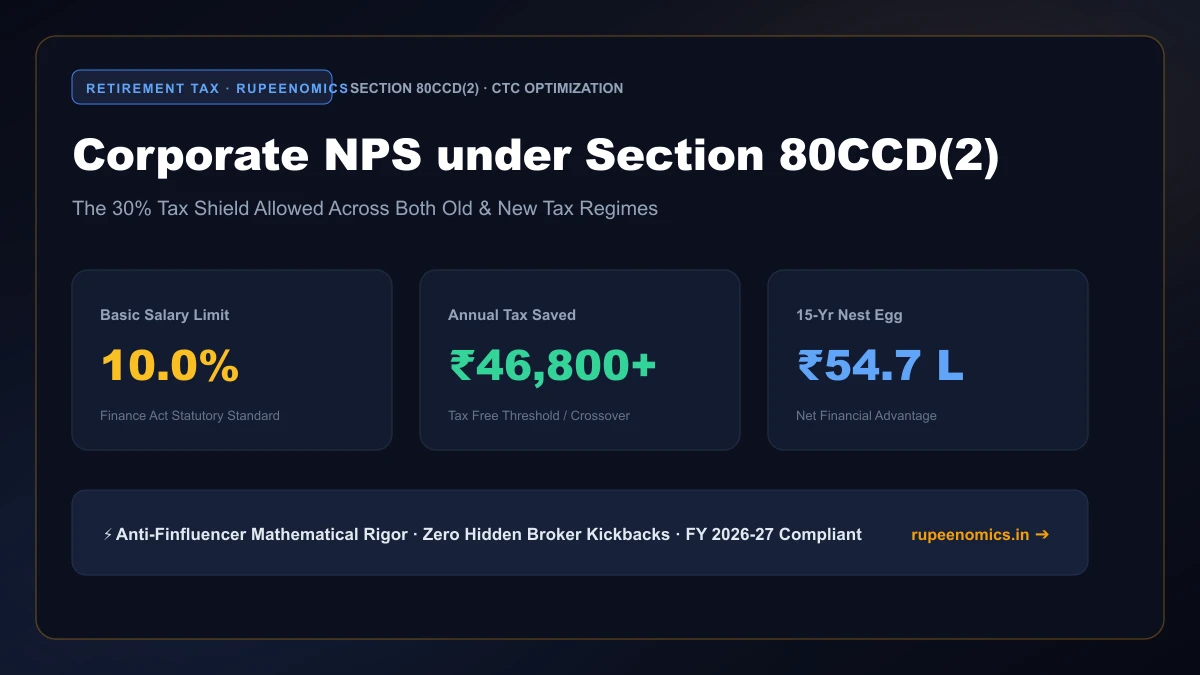
Corporate NPS under Section 80CCD(2): The Tax Shield for the 30% Tax Slab When the New Tax Regime became the default in Indian taxation, millions of salaried corporate employees watched their favorite…

National Pension System (NPS) Master FAQ: Tier-1 vs Tier-2, Section 80CCD(1B) Tax Rules, 60% Tax-Free Lump Sum & Annuity Mandate
National Pension System (NPS) Master FAQ: Tier-1 vs Tier-2, Section 80CCD(1B) Tax Rules, 60% Tax-Free Lump Sum & Annuity Mandate Quick Summary: The National Pension System (NPS) regulated by PFRDA …