Corporate NPS under Section 80CCD(2): The Tax Shield for the 30% Tax Slab
Corporate NPS under Section 80CCD(2): The Tax Shield for the 30% Tax Slab
When the New Tax Regime became the default in Indian taxation, millions of salaried corporate employees watched their favorite deductions vanish: Section 80C (₹1.5 Lakhs), Section 80D (Health Insurance), and House Rent Allowance (HRA) are completely barred under Section 115BAC.
However, Parliament left one massive, high-leverage tax shelter fully intact across both the Old and New Tax Regimes:
Section 80CCD(2) — Employer's Contribution to the National Pension System (Corporate NPS).
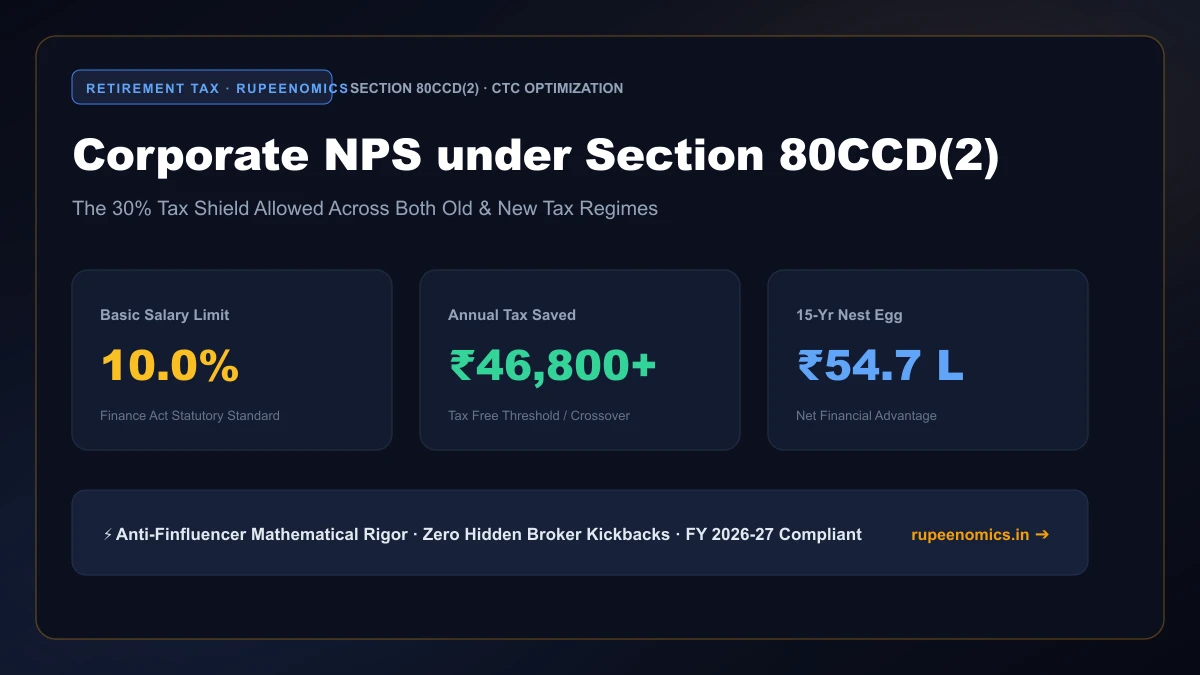
Unlike personal investments in NPS under Section 80CCD(1B) (which is capped at ₹50,000 and blocked in the New Regime), Corporate NPS has no fixed ₹1.5 Lakh or ₹2 Lakh ceiling. It allows salaried employees to divert up to 10% of their Basic Salary directly into their retirement account before tax is computed.
For anyone earning in the 30% tax slab (taxable income above ₹15 Lakhs), Section 80CCD(2) represents an instant, risk-free 31.2% to 39% return on investment purely through legal tax reduction.
1. What is Corporate NPS and How Does It Work?
In a standard retail NPS account, you transfer post-tax salary into your Tier-1 account and claim deductions on your tax return.
In Corporate NPS, your employer registers with the Pension Fund Regulatory and Development Authority (PFRDA) as a corporate entity. You instruct your HR/Payroll department to restructure your Cost-to-Company (CTC):
┌─────────────────────────────────────────────────────────────┐
│                 CORPORATE NPS PAYROLL FLOW                  │
├─────────────────────────────────────────────────────────────┤
│ Gross CTC Component ──> Employer deducts up to 10% of Basic │
│                     ──> Transferred directly to PRAN Tier-1 │
│                     ──> Excluded from taxable salary on Form 16│
│                     ──> Zero income tax deducted at source (TDS)│
└─────────────────────────────────────────────────────────────┘
Because the contribution is categorized as an Employer Contribution, it never touches your bank account as taxable compensation. It bypasses taxable income altogether under Section 80CCD(2).
2. Statutory Limits & Key Rules (FY 2026-27)
To claim this benefit safely without triggering tax notices, you must adhere to three statutory boundaries:
Rule 1: The 10% Basic Salary Ceiling
- Private Sector Corporate Employees: Up to 10% of Basic Salary + Dearness Allowance (DA) per financial year.
- Central & State Government Employees: Up to 14% of Basic Salary + DA.
Rule 2: Valid Across Both Tax Regimes
Section 80CCD(2) is one of the extremely rare deductions explicitly permitted under Section 115BAC(1A) of the New Tax Regime. Whether you opt for the Old Regime or the New Regime, your Corporate NPS deduction remains 100% valid.
Rule 3: The ₹7,50,000 Combined Section 17(2)(vii) Cap
Under Section 17(2)(vii) of the Income Tax Act, the aggregate annual contribution made by an employer toward:
- Recognized Provident Fund (Employer EPF)
- National Pension System (Section 80CCD(2))
- Approved Superannuation Fund
...must not exceed ₹7,50,000 in a financial year. Any excess employer contribution beyond ₹7.5 Lakhs is treated as a perquisite and taxed as regular salary income in the hands of the employee.
3. Mathematical Proof: Tax Savings Across CTC Brackets
Enjoyed this post?
Get our weekly digest delivered free.
Let us calculate the exact tax saved by an employee in the 30% tax bracket (plus 4% cess = 31.2% marginal rate):
Case Study: Salaried Professional with ₹25 Lakh CTC
- Gross CTC: ₹25,00,000
- Basic Salary (40% of CTC): ₹10,00,000
- Maximum 80CCD(2) Allocation (10% of Basic): ₹1,00,000
| Metric | Without Corporate NPS | With Corporate NPS |
|---|---|---|
| Gross Taxable Income | ₹25,00,000 | ₹25,00,000 |
| Standard Deduction | -₹75,000 | -₹75,000 |
| Section 80CCD(2) Deduction | ₹0 | -₹1,00,000 |
| Net Taxable Income | ₹24,25,000 | ₹23,25,000 |
| Income Tax Saved @ 31.2% | ₹0 | ₹31,200 pure cash saved |
| Retirement Corpus Added | ₹0 | ₹1,00,000 in PFRDA funds |
Savings Across Other Income Levels:
- Basic ₹15,00,000 (CTC ~₹35 Lakhs): Contributes ₹1.50 Lakhs → Saves ₹46,800/year.
- Basic ₹20,00,000 (CTC ~₹50 Lakhs): Contributes ₹2.00 Lakhs → Saves ₹62,400/year (Higher if surcharges apply).
- Basic ₹30,00,000 (CTC ~₹75 Lakhs): Contributes ₹3.00 Lakhs → Saves ₹1,03,000/year (with 10% surcharge).
Over a 15-year corporate career, investing ₹1.5 Lakh annually into Corporate NPS compounding at 10.5% CAGR creates a retirement nest egg of ₹54.7 Lakhs, while putting ₹7.02 Lakhs of tax savings directly back into your pocket.
4. Asset Allocation: Where Does the Money Get Invested?
NPS is managed by India's top institutional pension fund managers (SBI Pension Funds, HDFC Pension, ICICI Prudential, UTI, Kotak). You can customize your portfolio through two modes:
Mode A: Active Choice (Recommended for Investors under 45)
You manually choose your asset allocation across four pillars:
- Asset Class E (Equity): Up to 75% in top Indian blue-chip equities (Nifty 50 / Nifty 100).
- Asset Class C (Corporate Bonds): High-rated corporate debt and PSU bonds.
- Asset Class G (Government Securities): Sovereign central and state government bonds with zero default risk.
- Asset Class A (Alternative Assets): Up to 5% in REITs and InvITs.
Mode B: Auto Choice (Life Cycle Funds)
The system automatically reduces equity allocation as you age:
- LC-75 (Aggressive): 75% equity until age 35, gradually declining to 15% by age 55.
- LC-50 (Moderate): 50% equity until age 35, declining to 10%.
- LC-25 (Conservative): 25% equity until age 35, declining to 5%.
5. Exit & Withdrawal Rules at Age 60
The most frequent objection to NPS is the lock-in until age 60. Here is the statutory withdrawal framework governed by PFRDA regulations:
- 60% Lump Sum Withdrawal (100% Tax-Free): At superannuation (age 60), you can withdraw up to 60% of your accumulated corpus as a completely tax-free lump sum under Section 10(12A).
- 40% Mandatory Annuity: At least 40% of the corpus must be used to purchase an immediate annuity from a life insurer (LIC, HDFC Life, ICICI Pru) to generate guaranteed monthly pension income. The annuity pension is taxed as regular income in the year received.
- Corpus ≤ ₹5,00,000: If your total NPS corpus is ₹5 Lakhs or less at age 60, you can withdraw 100% of the amount without purchasing any annuity.
6. How to Set Up Corporate NPS with Your Employer
- Check HR Eligibility: Inquire with your payroll or HR benefits team whether your company is registered as a Corporate POP (Point of Presence) with Protean (formerly NSDL) or KFintech.
- Provide Your PRAN: If you already possess an active 12-digit Permanent Retirement Account Number (PRAN), share your PRAN with HR. If not, generate one online via Protean CRA in 10 minutes using your Aadhaar or PAN.
- Submit the CTC Restructuring Annexure: Sign the consent form opting for 10% (or your chosen percentage) deduction from Basic Salary.
- Verify Form 16: Ensure the employer contribution is properly reflected in Part B of Form 16 under the Section 80CCD(2) deductions column.
Use our Tax Regime Comparison Calculator to see your exact tax liability with and without Section 80CCD(2) Corporate NPS deductions.
:::disclaimer Disclaimer: PFRDA pension rules and Income Tax Act provisions are subject to change. Asset allocations in Asset Class E carry market risks. This guide is for educational financial literacy purposes and does not constitute individual tax or legal advisory. :::
The insights, broker reviews, tax estimates, and financial data presented on RupeeNomics are strictly for educational and research purposes only. RupeeNomics and its authors are not SEBI-registered investment advisors or research analysts. Nothing published herein should be construed as personalized investment advice or a recommendation to buy or sell securities. Investments in the securities market are subject to market risks. Please conduct your own due diligence or consult a SEBI-registered financial planner before making investment decisions. Read our Editorial Policy.
Enjoyed this post?
Get our weekly digest delivered free.
Share this post:
RupeeNomics is reader-supported. We may earn a commission from links in this article at no extra cost to you. Read our disclosure.
Related Posts
NPS Tier 1 vs Tier 2: Complete Tax Benefits Guide under Section 80CCD (1B & 2), Lock-in & Exit Rules
NPS Tier 1 vs Tier 2: Complete Tax Benefits Guide under Section 80CCD (1B & 2), Lock-in & Exit Rules Regulated by the Pension Fund Regulatory and Development Authority (PFRDA), the National Pension Sy…

National Pension System (NPS) Master FAQ: Tier-1 vs Tier-2, Section 80CCD(1B) Tax Rules, 60% Tax-Free Lump Sum & Annuity Mandate
National Pension System (NPS) Master FAQ: Tier-1 vs Tier-2, Section 80CCD(1B) Tax Rules, 60% Tax-Free Lump Sum & Annuity Mandate Quick Summary: The National Pension System (NPS) regulated by PFRDA …