Tax-Loss Harvesting in Mutual Funds & Stocks (FY 2026-27): How to Legally Slash Capital Gains Tax Before March 31
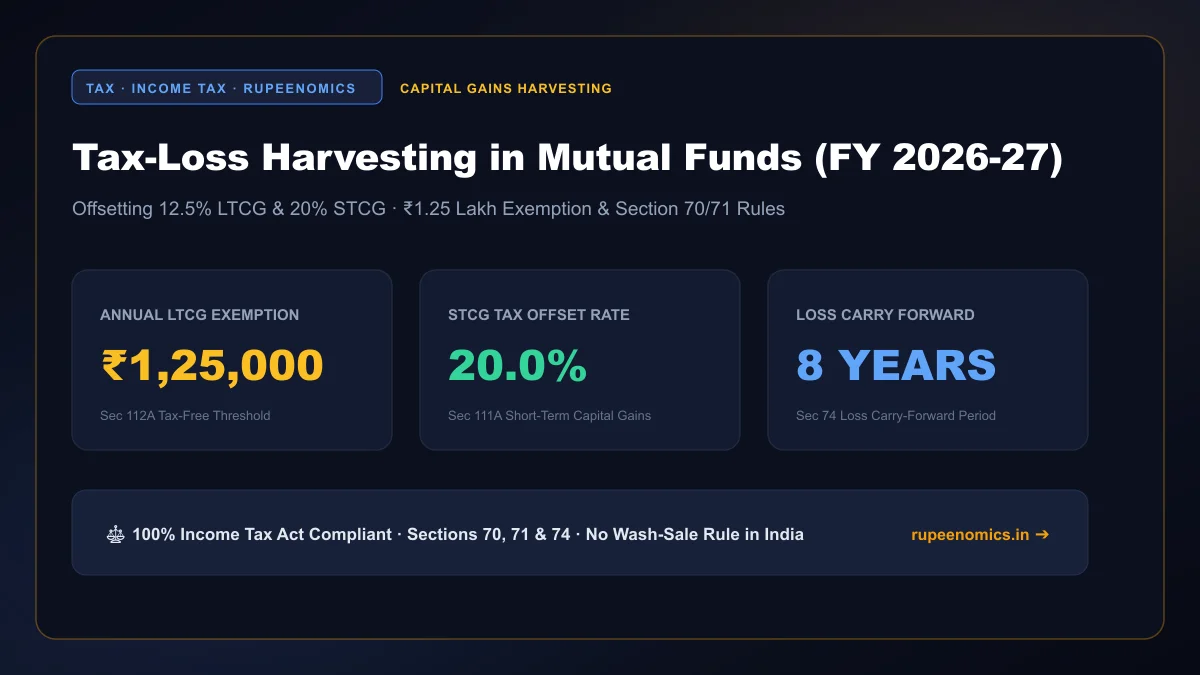
Tax-Loss Harvesting in Mutual Funds & Stocks (FY 2026-27): How to Legally Slash Capital Gains Tax Before March 31
With the statutory hike in capital gains taxation under the Finance Act 2024—pushing Long-Term Capital Gains (LTCG) to 12.5% and Short-Term Capital Gains (STCG) to 20% across Financial Year 2026-27 (Assessment Year 2027-28)—tax drag has become the single largest silent destroyer of compounding wealth for Indian retail investors.
If your portfolio generated ₹4,00,000 in realized equity gains this fiscal year, you could easily owe between ₹34,375 and ₹80,000 in taxes to the Income Tax Department. However, by executing Tax-Loss Harvesting prior to the March 31 financial year cutoff, smart investors can legally reduce their net taxable capital gains to zero, saving tens of thousands of rupees while maintaining identical market exposure.
💡 Position-0 Summary: What is Tax-Loss Harvesting?
## What is Tax-Loss Harvesting and how does it work in India?

Tax-loss harvesting is a legal wealth management strategy where an investor sells loss-making stocks or mutual fund units to realize capital losses, which are then set off against realized capital gains under Section 70 and 71 of the Income Tax Act. In India for FY 2026-27, Short-Term Capital Losses (STCL) can offset both 20% STCG and 12.5% LTCG, while Long-Term Capital Losses (LTCL) can only offset 12.5% LTCG. Crucially, unlike the United States (IRS 30-day Wash-Sale Rule), Indian tax law does not currently prohibit repurchasing the same asset immediately after selling.
1. Capital Gains Tax Landscape (FY 2026-27 Baseline)
Before executing a harvesting strategy, review the operative statutory rates governing listed equities, equity-oriented mutual funds, and ETFs:
| Capital Gain Classification | Holding Period Threshold | Statutory Tax Rate (FY 2026-27) | Annual Tax-Free Exemption Threshold |
|---|---|---|---|
| Short-Term Capital Gains (STCG) under Section 111A | Less than or equal to 12 Months | 20.0% (+ 4% Health & Education Cess = 20.8%) | Nil (Taxed from Rupee One) |
| Long-Term Capital Gains (LTCG) under Section 112A | Greater than 12 Months | 12.5% (+ 4% Health & Education Cess = 13.0%) | ₹1,25,000 per financial year |
| Unlisted Shares / Foreign Equities | Greater than 24 Months | 12.5% (LTCG) / Slab Rate (STCG) | Nil |
2. The Statutory Set-Off Rules: Sections 70, 71 & 74
Enjoyed this post?
Get our weekly digest delivered free.
The Income Tax Act lays down rigid intra-head set-off rules governing which losses can neutralize which gains. Memorize this hierarchy to avoid having your return rejected by the Central Processing Centre (CPC):
                     INCOME TAX SET-OFF MATRIX (INDIA)
                     =================================
                                [REALIZED LOSS]
                                       │
                ┌──────────────────────┴──────────────────────┐
                ▼                                             ▼
     [Short-Term Loss (STCL)]                      [Long-Term Loss (LTCL)]
                │                                             │
        ┌───────┴───────┐                                     │
        ▼               ▼                                     ▼
   Can Offset      Can Offset                            Can ONLY Offset
   [20% STCG]      [12.5% LTCG]                            [12.5% LTCG]
  (Priority 1)    (Priority 2)                           (CANNOT Offset STCG)
The 4 Non-Negotiable Tax Rules:
- Rule 1 (STCL is Versatile): A Short-Term Capital Loss can be set off against both Short-Term Capital Gains (taxed at 20%) and Long-Term Capital Gains (taxed at 12.5%). Always deploy STCL against STCG first to save 20.8% in tax rather than 13%.
- Rule 2 (LTCL is Restrictive): A Long-Term Capital Loss can only be set off against Long-Term Capital Gains. You cannot use an LTCL to offset STCG or salary income.
- Rule 3 (No Inter-Head Set Off): Capital losses cannot be set off against any other head of income (Salary, House Property, Profits & Gains of Business/Profession, or Other Sources).
- Rule 4 (8-Year Carry Forward under Section 74): If your net realized capital loss exceeds your capital gains in FY 2026-27, the unabsorbed loss can be carried forward for 8 consecutive assessment years, provided you file your ITR-2 or ITR-3 on or before the statutory due date (July 31).
3. Real-World Case Study: How Rahul Saved ₹41,600
Consider Rahul, a 32-year-old software architect in Bengaluru investing through Zerodha and Groww:
- In October 2026, Rahul booked ₹2,00,000 in STCG by swinging midcap stocks.
- He also booked ₹2,50,000 in LTCG from an equity index fund held for 3 years.
- His portfolio currently holds an underperforming thematic tech fund showing an unrealized loss of ₹1,50,000 (held for 8 months: Short-Term) and an IT stock showing an unrealized loss of ₹1,00,000 (held for 2 years: Long-Term).
Scenario A: Doing Nothing (No Harvesting)
- STCG Tax: ₹2,00,000 × 20.8% = ₹41,600
- LTCG Tax: (₹2,50,000 - ₹1,25,000 exemption) = ₹1,25,000 taxable × 13.0% = ₹16,250
- Total Tax Due to Govt: ₹57,850
Scenario B: Executing Strategic Tax-Loss Harvesting (March 15, 2027)
- Rahul sells the thematic fund to realize ₹1,50,000 STCL. He immediately redirects the sale proceeds into a diversified flexi-cap fund.
- Rahul sells the IT stock to realize ₹1,00,000 LTCL.
- Net STCG Computation: ₹2,00,000 STCG - ₹1,50,000 STCL = ₹50,000 taxable STCG.
STCG Tax: ₹50,000 × 20.8% = ₹10,400. - Net LTCG Computation: ₹2,50,000 LTCG - ₹1,00,000 LTCL = ₹1,50,000.
Applying the statutory ₹1,25,000 annual exemption: ₹1,50,000 - ₹1,25,000 = ₹25,000 taxable LTCG.
LTCG Tax: ₹25,000 × 13.0% = ₹3,250. - Total Tax Due to Govt: ₹13,650
- Net Cash Saved in Rahul's Pocket: ₹57,850 - ₹13,650 = ₹44,200 (76.4% Tax Reduction!)
4. Does India Have a "Wash-Sale Rule"?
In the United States, the Internal Revenue Service (IRS) enforces the Wash-Sale Rule under 26 U.S. Code § 1091: if you sell a security at a loss and repurchase the exact same security (or a "substantially identical" security) within 30 days before or after the sale, the tax loss is disallowed.
The Indian Regulatory Reality:
The Indian Income Tax Act, 1961 contains NO statutory Wash-Sale Rule.
Section 70 and Section 71 only require that the asset was genuinely sold and settled via a recognized stock exchange (BSE/NSE) with payment of Securities Transaction Tax (STT).
However, prudent wealth managers advise avoiding immediate same-day sell-and-buy on the exact same scrip in the exact same exchange, because:
- Same-day squaring off is treated by broker algorithms as intraday trading (speculative business income), which cannot be set off against delivery capital gains!
- Best Practice: Sell on Day 1 (T-day). Allow delivery payout to clear (T+1 settlement). Repurchase the stock or fund units on Day 2 or Day 3.
- Alternative Proxy Strategy: If you sell HDFC Bank at a loss, immediately buy ICICI Bank or the Nifty Bank ETF on the same day. Your banking sector beta remains unchanged, while the tax loss is 100% locked in.
5. Tax-Gain Harvesting: The ₹1.25 Lakh Free Pass
Tax-loss harvesting gets all the headlines, but Tax-Gain Harvesting is equally potent for long-term compounders.
Under Section 112A, the first ₹1,25,000 of LTCG per financial year is taxed at exactly ZERO percent. If you do not utilize this exemption between April 1 and March 31, it expires forever—it does not accumulate or roll over into the next fiscal year.
TAX-GAIN HARVESTING FLYWHEEL
----------------------------
Step 1: Identify equity MF units with unrealized gains of ~₹1,25,000 (holding > 12 months).
Step 2: Redeem those units before March 31.
Step 3: Pay ₹0 tax (within the statutory ₹1.25L exemption threshold).
Step 4: Re-invest the entire proceeds back into the fund immediately.
Result: Your cost acquisition price resets upwards (stepped-up basis). When you sell 5 years later, your future tax bill is drastically lower!
6. The 5 Cardinal Sins of Tax Harvesting in India
Avoid these common blunders that trigger scrutiny notices from the Income Tax Department:
- Forgetting the AIS / TIS Reconciliation: The Annual Information Statement (AIS) records every single redemption and STT-paid transaction reported by CDSL/NSDL and AMCs. Never file your ITR using estimated figures; always download your Zerodha/Groww Capital Gains Statement and reconcile with your AIS.
- Missing the ITR Deadline (July 31): Under Section 80 read with Section 139(3), if you file a belated ITR after July 31, you lose the legal right to carry forward capital losses to future assessment years!
- Ignoring Exit Loads in Mutual Funds: Liquidating fund units before the 1-year mark might save you tax but incur a 1% exit load, wiping out your tax alpha. Always check the AMC scheme information document.
- Trading F&O Losses as Capital Losses: Derivatives (Futures and Options) are legally classified as Non-Speculative Business Income, NOT capital gains! You cannot set off F&O losses against equity capital gains under Section 70.
- Ignoring Dividend Drag: Tax-loss harvesting resets your unit counts. Ensure your fund distributions are set to "Growth" rather than "IDCW" to prevent dividend taxation at your personal slab rate (up to 39% for high-income earners).
🛠️ Plan Your Tax Optimization:
• Calculate your exact liability: RupeeNomics Old vs New Tax Regime Calculator
• Map your compounding: RupeeNomics Step-Up SIP Calculator
• Related Guide: New Capital Gains Tax Rules FY 2026-27 (LTCG 12.5% & STCG 20%)
The insights, broker reviews, tax estimates, and financial data presented on RupeeNomics are strictly for educational and research purposes only. RupeeNomics and its authors are not SEBI-registered investment advisors or research analysts. Nothing published herein should be construed as personalized investment advice or a recommendation to buy or sell securities. Investments in the securities market are subject to market risks. Please conduct your own due diligence or consult a SEBI-registered financial planner before making investment decisions. Read our Editorial Policy.
Enjoyed this post?
Get our weekly digest delivered free.
Share this post:
RupeeNomics is reader-supported. We may earn a commission from links in this article at no extra cost to you. Read our disclosure.
Related Posts
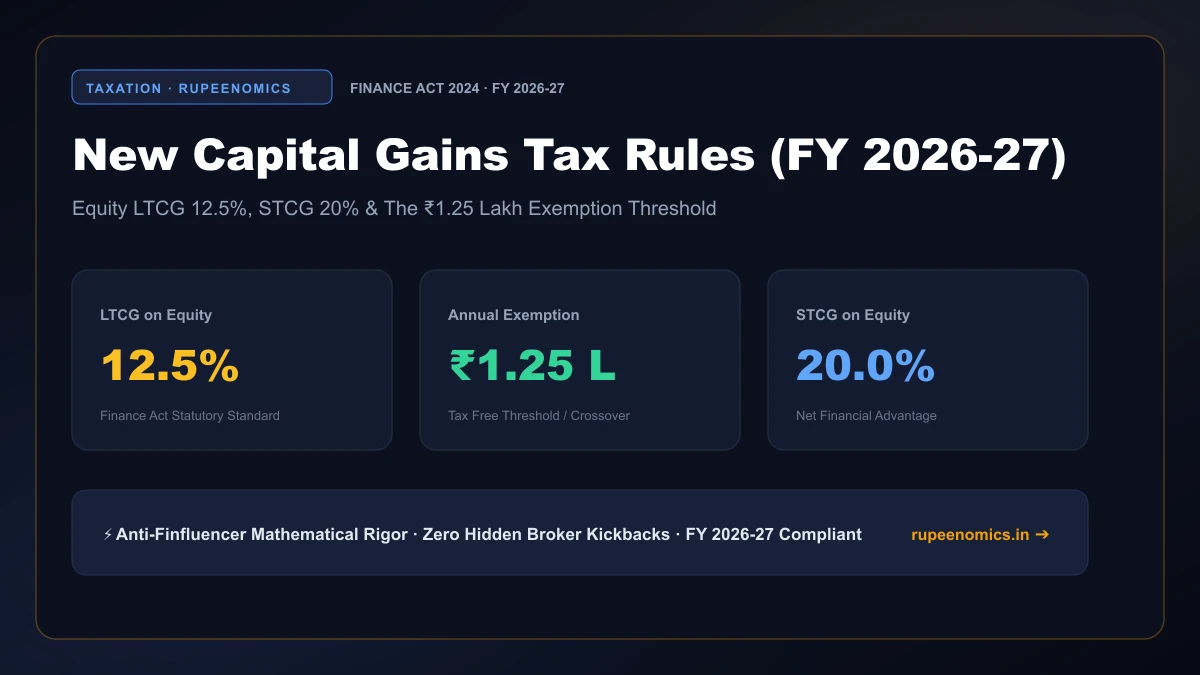
New Capital Gains Tax Rules (FY 2026-27): LTCG 12.5% & STCG 20% on Stocks & Mutual Funds
New Capital Gains Tax Rules (FY 2026-27): LTCG 12.5% & STCG 20% on Stocks & Mutual Funds The taxation of equity investments in India underwent its most consequential structural restructuring under the…
Old Tax Regime vs New Tax Regime 2026-27: Which Saves You More?
Old Tax Regime vs New Tax Regime 2026-27: Which Saves You More? The Finance Act 2024 made the new tax regime the default for individual taxpayers from FY 2024-25 onward. If you did nothing — filed …

Old Tax Regime vs New Tax Regime in India (2026): Breakeven Deductions, Section 80C/80D Analysis & Salary Slabs
Old Tax Regime vs New Tax Regime in India (2026): Breakeven Deductions, Section 80C/80D Analysis & Salary Slabs Quick Summary: Following successive Union Budget enhancements to the New Tax Regime (…