New Capital Gains Tax Rules (FY 2026-27): LTCG 12.5% & STCG 20% on Stocks & Mutual Funds
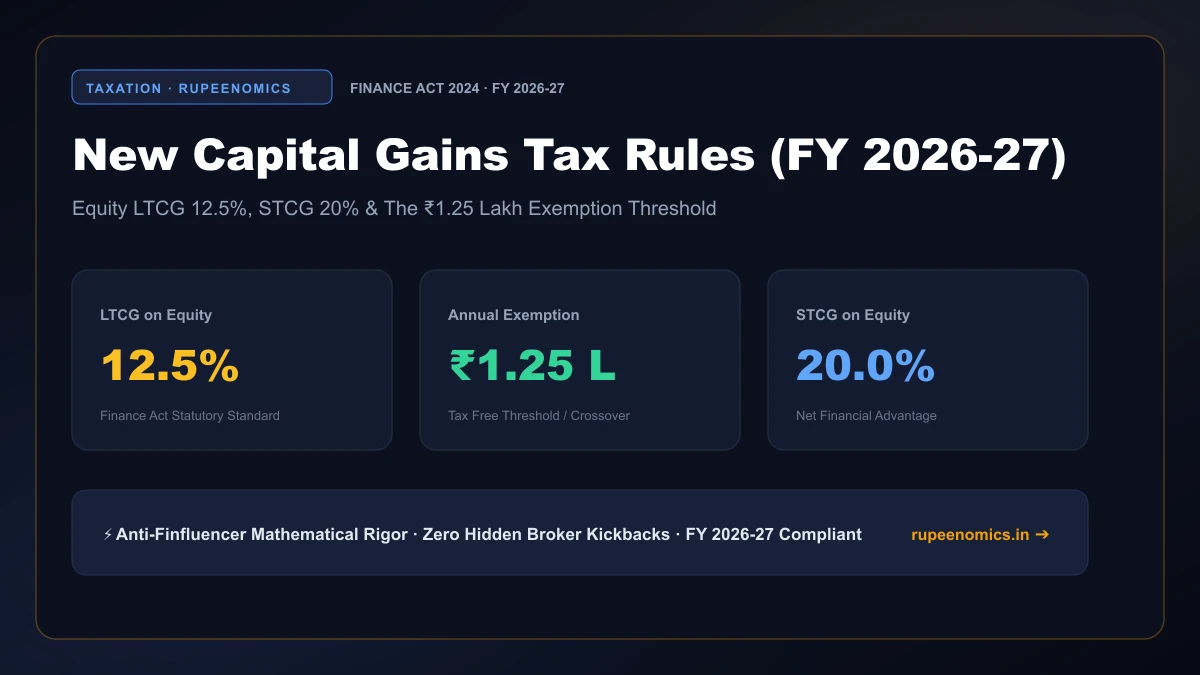
New Capital Gains Tax Rules (FY 2026-27): LTCG 12.5% & STCG 20% on Stocks & Mutual Funds
The taxation of equity investments in India underwent its most consequential structural restructuring under the Finance Act 2024, now fully operative across Financial Year 2026-27 (Assessment Year 2027-28).
For six years between 2018 and mid-2024, Indian equity investors operated under a predictable framework: 10% Long-Term Capital Gains (LTCG) with a ₹1,00,000 annual exemption, and 15% Short-Term Capital Gains (STCG).
That framework has been rewritten. The Government streamlined asset holding classifications and raised headline rates to narrow the gap between financial capital taxation and active business income.
Whether you manage an active direct equity portfolio on Zerodha, run monthly SIPs in mutual funds, or trade listed derivatives, understanding these updated statutory rules is vital to preventing preventable tax drag on your compounding returns.
1. Summary of Capital Gains Tax Rates (FY 2026-27)
The table below outlines the revised statutory tax rates across all major financial asset classes:
| Asset Class | Holding Period for LTCG | Short-Term Capital Gains (STCG) | Long-Term Capital Gains (LTCG) | Annual Exemption Limit |
|---|---|---|---|---|
| Listed Equity Shares & Equity MFs (≥65% domestic equity) | > 12 Months | 20% (u/s 111A) | 12.5% (u/s 112A) | ₹1,25,000 per financial year |
| Unlisted Shares & Private Equity | > 24 Months | Taxed at Applicable Slab Rate | 12.5% (without indexation) | NIL |
| Debt Mutual Funds (Purchased after April 1, 2023) | Any Holding Period | Taxed at Applicable Slab Rate | Taxed at Applicable Slab Rate | NIL |
| Gold & Sovereign Gold Bonds (Secondary) | > 24 Months | Taxed at Applicable Slab Rate | 12.5% (without indexation) | NIL |
| Real Estate (Immovable Property) | > 24 Months | Taxed at Applicable Slab Rate | 12.5% (without indexation)* | NIL |
*Note on Real Estate: Properties acquired prior to July 23, 2024 retain an option to calculate tax at 20% with indexation benefit or 12.5% without indexation, whichever yields a lower tax liability.
2. Equity LTCG: The 12.5% Rate and the ₹1.25 Lakh Annual Exemption
Under Section 112A of the Income Tax Act, gains arising from the transfer of listed equity shares and units of equity-oriented mutual funds held for more than 12 months are classified as long-term capital gains, provided Securities Transaction Tax (STT) has been paid.
Key Provisions:
- The 12.5% Flat Rate: Replaces the legacy 10% rate for all transfers executed on or after July 23, 2024.
- The ₹1,25,000 Annual Exemption: The previous ₹1,00,000 threshold was raised to ₹1,25,000. Capital gains up to this amount across all equity sales in a financial year attract zero tax.
- No Indexation Benefit: LTCG on listed equities has never enjoyed indexation benefits, and that remains unchanged.
- Surcharge Cap: Surcharge on LTCG under Section 112A is statutorily capped at 15%, protecting high-net-worth investors earning above ₹2 Crore from the highest 25% or 37% general surcharges.
Mathematical Example: Selling a ₹15 Lakh Equity Portfolio
Assume an investor invested ₹10,00,000 in diversified equity mutual funds in 2023. In November 2026, the portfolio value is ₹16,00,000. The investor redeems the entire holding.
- Total Sale Consideration: ₹16,00,000
- Cost of Acquisition: ₹10,00,000
- Gross Capital Gain: ₹6,00,000
- Less: Section 112A Exemption: -₹1,25,000
- Net Taxable LTCG: ₹4,75,000
- LTCG Tax @ 12.5%: ₹59,375
- Health & Education Cess @ 4%: ₹2,375
- Total Tax Liability: ₹61,750 (Effective tax on total profit: 10.29%)
Under the old rules (10% tax with ₹1L exemption), the tax would have been ₹52,000 (including cess). The net tax increase on a ₹6,00,000 capital gain is exactly ₹9,750.
3. Equity STCG: The 20% Hike under Section 111A
Enjoyed this post?
Get our weekly digest delivered free.
Short-term capital gains on listed shares and equity mutual funds held for 12 months or less are taxed under Section 111A.
- The tax rate increased from 15% to 20%.
- There is zero exemption threshold for STCG. Every rupee of net short-term gain is taxable from the first rupee.
- However, resident individual taxpayers can adjust any unexhausted basic exemption limit (e.g., ₹3,00,000 under the New Tax Regime or ₹2,50,000 under the Old Regime) against STCG.
Impact on Active Swing Traders
For an investor generating ₹3,00,000 in short-term trading profits annually:
- Legacy Tax (15% + 4% cess): ₹46,800
- New Tax (20% + 4% cess): ₹62,400
- Additional Annual Drag: ₹15,600
This 500-basis-point increase severely penalizes excessive churn and momentum trading, reinforcing the structural advantage of long-term holding.
4. Debt Mutual Funds: The Specified Mutual Fund Rule
Investors often confuse equity LTCG rules with debt mutual funds. Since the Finance Act 2023 amendment (Section 50AA), any mutual fund that invests less than 65% in domestic equity is classified as a "Specified Mutual Fund".
- No LTCG Benefit: Regardless of whether you hold a liquid fund, banking & PSU fund, or corporate bond fund for 3 months or 7 years, gains are treated as deemed short-term capital gains.
- Slab Rate Taxation: Gains are added directly to your taxable income and taxed at your marginal income tax slab rate (e.g., 30% + surcharge + cess for those earning above ₹15 Lakhs).
- Exception for Gold/Arbitrage/International: Funds investing 65%+ in equity derivatives (Arbitrage Funds) maintain full equity taxation status (12.5% LTCG / 20% STCG). Conservative hybrid funds (35%–65% equity) held >24 months enjoy 12.5% LTCG without indexation.
5. Tax-Loss Harvesting: Legal Optimization Strategies
With higher rates, strategic tax-loss harvesting becomes imperative before March 31 of each financial year.
The Set-Off and Carry-Forward Hierarchy
The Income Tax Act mandates strict boundaries on how capital losses can offset capital gains:
┌─────────────────────────────────────────────────────────────┐
│                   SET-OFF MATRIX FY 2026-27                 │
├──────────────────────┬──────────────────────────────────────┤
│ Capital Loss Type    │ Eligible to Offset Against:          │
├──────────────────────┼──────────────────────────────────────┤
│ Short-Term Loss (STCL)│ Both STCG (20%) AND LTCG (12.5%)     │
│ Long-Term Loss (LTCL) │ ONLY LTCG (12.5%) — CANNOT offset STCG│
└──────────────────────┴──────────────────────────────────────┘
Strategic Rules for Investors:
- Prioritize Realizing Short-Term Losses: Since STCL can offset both 20% STCG and 12.5% LTCG, booking paper losses on losing positions held under 12 months creates the highest tax shield.
- Harvest the ₹1.25 Lakh Exemption Every Financial Year: If your portfolio has accumulated unrealized long-term capital gains, sell enough units annually to realize exactly ₹1,25,000 of profit, then immediately repurchase those units (or an equivalent peer fund). This resets your cost basis upward to the current market price without incurring a single rupee of tax.
- Carry Forward Unabsorbed Losses for 8 Assessment Years: If your losses exceed gains in a financial year, you can carry them forward for up to 8 subsequent assessment years, provided you file your Income Tax Return (ITR) on or before the statutory due date (July 31) under Section 139(1).
6. Practical Action Plan for FY 2026-27
- Calculate Year-to-Date Realized Gains: Download your Consolidated Capital Gains Statement from CAMS/KFintech or your broker (Zerodha Console, Groww Reports).
- Track the ₹1,25,000 LTCG Window: If you have booked less than ₹1,25,000 in long-term gains this year, evaluate whether booking gains up to the threshold makes strategic sense for your portfolio.
- Audit Unlisted Holdings: If you hold ESOPs or unlisted startup equity, note that their holding period for LTCG is 24 months, and the tax rate is 12.5% without indexation.
- Use Arbitrage Funds for Liquid Parking: Because debt funds are taxed at your 30% slab rate, high-bracket taxpayers should park 6–12 month emergency surpluses in Arbitrage Funds, where returns are taxed at equity rates (20% if held <1 year; 12.5% over ₹1.25L if held >1 year).
:::disclaimer Disclaimer: The calculations and tax analyses provided in this guide are for educational purposes based on the provisions of the Income Tax Act, 1961 as amended by Finance Act 2024. Tax regulations and judicial interpretations are subject to amendment. Consult a registered Chartered Accountant (CA) or tax professional before making execution decisions. :::
The insights, broker reviews, tax estimates, and financial data presented on RupeeNomics are strictly for educational and research purposes only. RupeeNomics and its authors are not SEBI-registered investment advisors or research analysts. Nothing published herein should be construed as personalized investment advice or a recommendation to buy or sell securities. Investments in the securities market are subject to market risks. Please conduct your own due diligence or consult a SEBI-registered financial planner before making investment decisions. Read our Editorial Policy.
Enjoyed this post?
Get our weekly digest delivered free.
Share this post:
RupeeNomics is reader-supported. We may earn a commission from links in this article at no extra cost to you. Read our disclosure.
Related Posts
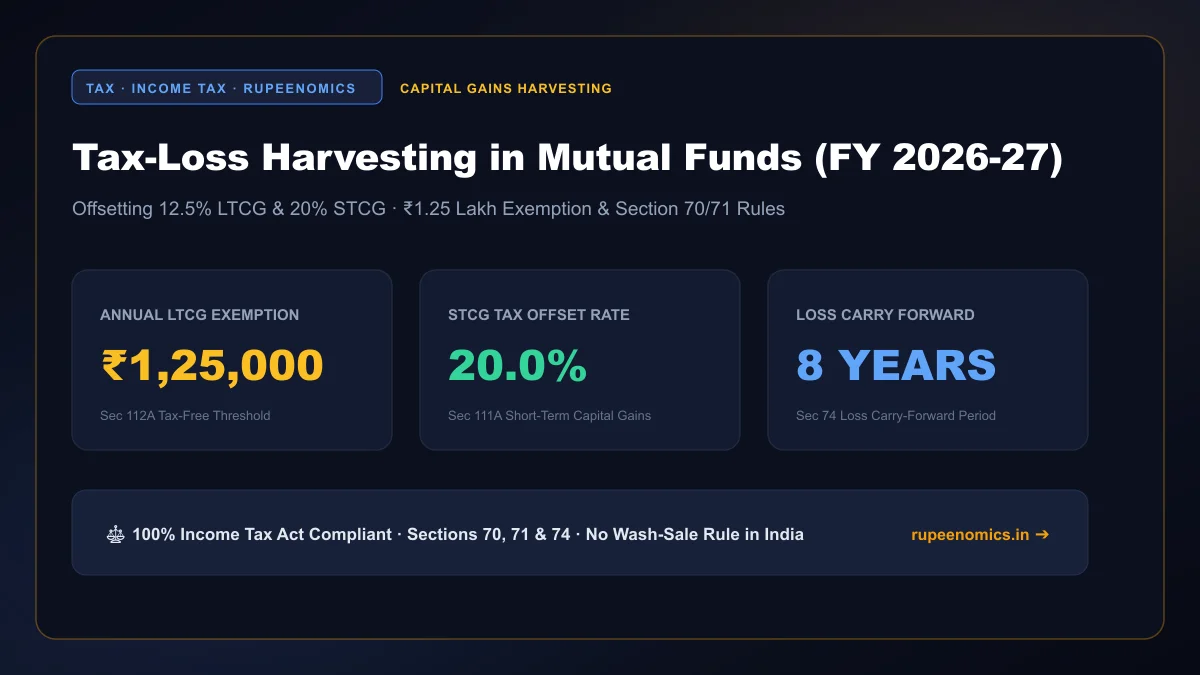
Tax-Loss Harvesting in Mutual Funds & Stocks (FY 2026-27): How to Legally Slash Capital Gains Tax Before March 31
Tax-Loss Harvesting in Mutual Funds & Stocks (FY 2026-27): How to Legally Slash Capital Gains Tax Before March 31 With the statutory hike in capital gains taxation under the Finance Act 2024—pushing L…
Old Tax Regime vs New Tax Regime 2026-27: Which Saves You More?
Old Tax Regime vs New Tax Regime 2026-27: Which Saves You More? The Finance Act 2024 made the new tax regime the default for individual taxpayers from FY 2024-25 onward. If you did nothing — filed …

Old Tax Regime vs New Tax Regime in India (2026): Breakeven Deductions, Section 80C/80D Analysis & Salary Slabs
Old Tax Regime vs New Tax Regime in India (2026): Breakeven Deductions, Section 80C/80D Analysis & Salary Slabs Quick Summary: Following successive Union Budget enhancements to the New Tax Regime (…