Section 80D Health Insurance Tax Deductions: The Complete Guide (Max ₹1,00,000 Limit, Rules & Math)
Section 80D Health Insurance Tax Deductions: The Complete Guide (Max ₹1,00,000 Limit, Rules & Math)
While Section 80C is universally exhausted by EPF and home loan principal repayments, Section 80D of the Income-tax Act, 1961 remains the single most powerful tax shield for middle-class and high-income salaried professionals filing under the Old Tax Regime.
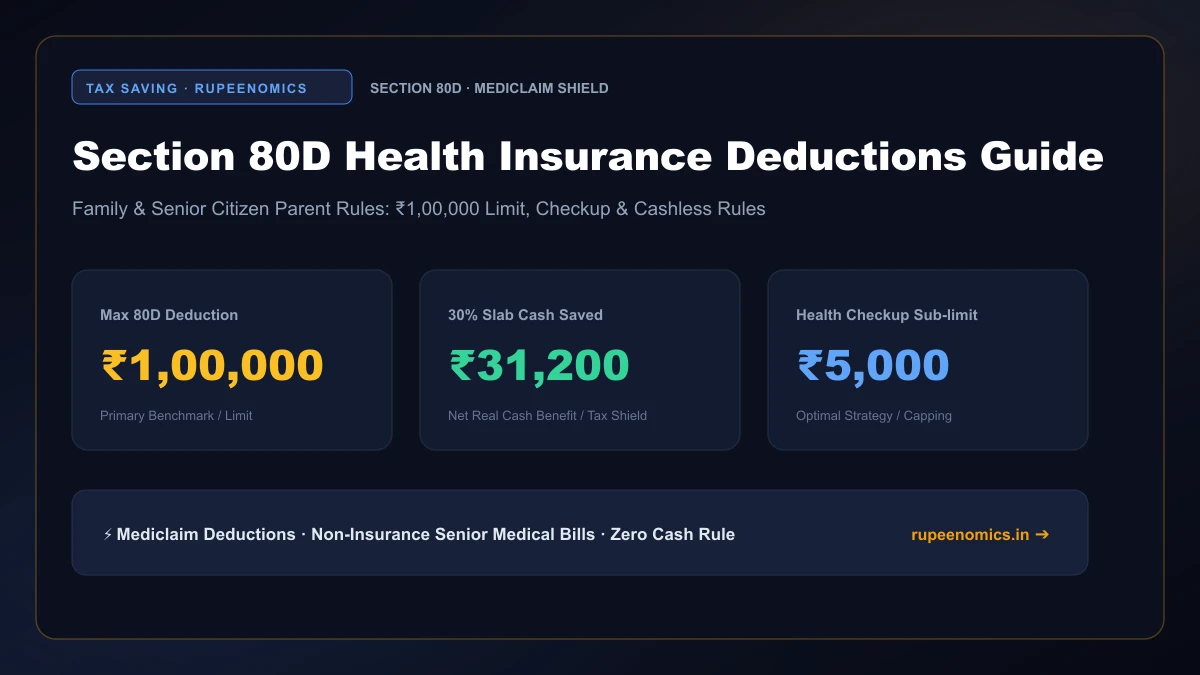
Under Section 80D, a taxpayer can legally claim up to ₹1,00,000 in tax deductions per financial year by structuring health insurance premiums and preventive medical checkups for themselves, their spouse, dependent children, and senior citizen parents. For an individual in the 30% tax bracket (plus 4% cess), claiming the full ₹1,00,000 deduction puts ₹31,200 of hard cash back into their bank account.
Yet, hundreds of thousands of taxpayers face deduction disallowances every assessment cycle due to preventable mistakes: paying premiums in cash, confusing non-dependent parents with dependent siblings, or improperly amortizing multi-year policies.
This comprehensive guide breaks down the legal statutes, deduction tiers, mathematical models, cash rules, and senior citizen medical bills under Section 80D for Financial Year 2025-26 and AY 2026-27.
1. Section 80D Master Deduction Architecture
Section 80D deductions operate across two distinct family silos:
- Family Bucket: Self, Spouse, and Dependent Children.
- Parents Bucket: Parents (Father and Mother, whether dependent or independent).
                            [Section 80D Total Ceiling: ₹1,00,000]
                                              │
              ┌───────────────────────────────┴───────────────────────────────┐
              ▼                                                               ▼
       [Family Bucket]                                                 [Parents Bucket]
(Self + Spouse + Dependent Children)                                   (Father + Mother)
              │                                                               │
     Age Assessment:                                                 Age Assessment:
     Are you or your spouse ≥ 60?                                    Are parents ≥ 60?
              │                                                               │
       ├──────┴──────┐                                                 ├──────┴──────┐
       ▼             ▼                                                 ▼             ▼
      [NO]         [YES]                                              [NO]         [YES]
    ₹25,000       ₹50,000                                           ₹25,000       ₹50,000
       │             │                                                 │             │
  (Includes up to ₹5,000                                          (Includes up to ₹5,000
  Preventive Checkup)                                             Preventive Checkup)
       │             │                                                 │             │
       └──────┬──────┘                                                 └──────┬──────┘
              │                                                               │
              └───────────────────────────────┬───────────────────────────────┘
                                              │
                                              ▼
                             [Sum of Family + Parents Deduction]
                             Case 1: Both Non-Senior   ➔ ₹50,000
                             Case 2: Family Young + Parents Senior ➔ ₹75,000
                             Case 3: Both Seniors      ➔ ₹1,00,000
Statutory Deduction Matrix (FY 2025-26 / AY 2026-27)
| Scenario | Family Bucket (Self, Spouse, Children) | Parents Bucket (Father, Mother) | Maximum Allowable Deduction |
|---|---|---|---|
| Scenario A: Individual & Parents are both below 60 years | ₹25,000 | ₹25,000 | ₹50,000 |
| Scenario B: Individual is below 60, but Parents are Senior Citizens (≥ 60) | ₹25,000 | ₹50,000 | ₹75,000 |
| Scenario C: Individual is Senior Citizen (≥ 60) & Parents are Senior Citizens | ₹50,000 | ₹50,000 | ₹1,00,000 |
| Scenario D: Individual (HUFs / Unmarried) claiming only for Self & Family | ₹25,000 (or ₹50,000 if senior) | Nil | ₹25,000 / ₹50,000 |
Crucial Clarification: Section 80D is only available under the Old Tax Regime. Under the default New Tax Regime (Section 115BAC), deductions under Section 80D are completely eliminated.
2. Deep Dive: The Family Bucket (Self, Spouse, Dependent Children)
To claim the basic deduction of ₹25,000 (or ₹50,000 if you or your spouse is 60 years or older), strict statutory dependency definitions apply.
1. Who is Covered?
- Self: Primary policyholder.
- Spouse: Husband or wife. Can be earning or non-earning; dependency is not required.
- Children: Must be dependent children. If your son or daughter is employed and financially independent, or married, their mediclaim premium cannot be claimed under your Section 80D return.
- Excluded Relatives: You cannot claim Section 80D for brothers, sisters, grandparents, grandchildren, aunts, or uncles, regardless of financial dependency.
2. Preventive Health Checkup Sub-Limit (₹5,000)
Within the ₹25,000/₹50,000 limit, Section 80D(2)(b) allows up to ₹5,000 for preventive health checkups.
- This is not an additional deduction; it is an internal sub-limit.
- Example: If you pay ₹22,000 as annual health insurance premium and spend ₹4,500 on full-body blood work and lipid profiles, your total claim is ₹22,000 + ₹3,000 (capped at the ₹25,000 maximum ceiling) = ₹25,000.
- The Cash Exception: While health insurance premiums must never be paid in cash, preventive health checkup expenses can be paid in cash and remain 100% tax-deductible! Always retain the diagnostic laboratory invoices.
3. The Parents Bucket: Unlocking the ₹50,000 Senior Shield
Enjoyed this post?
Get our weekly digest delivered free.
The parents bucket provides an independent, unlinked deduction ceiling.
Key Rules for Parents:
- Dependency is Not Mandatory: Unlike children, your parents do not need to be financially dependent on you. Even if your father is a retired pensioner earning ₹15 Lakhs annually, if you pay his health insurance premium from your taxable banking account, you can claim the full deduction on your return.
- Age Threshold: A parent is considered a senior citizen if they attain the age of 60 years at any point during the relevant financial year (even on March 31).
- In-Laws are Excluded: You cannot claim Section 80D for your father-in-law or mother-in-law. A married couple should structure payments such that the husband pays for his parents and the wife pays for hers from their respective salary accounts.
4. Medical Expenditure Without Insurance: The Senior Citizen Lifeline
A major crisis in India is that many parents above 70 or 75 years are rejected by commercial health insurance underwriters due to severe pre-existing diseases (cancer, heart disease, diabetes complications).
To resolve this, the government enacted Section 80D(2)(c) & (d):
               [Parent is a Senior Citizen (Age ≥ 60)]
                                 │
                 Does the parent have health insurance?
                                 │
                 ├────── YES ───► Claim Mediclaim Premium (Up to ₹50,000)
                 │
                 └────── NO ────► [Section 80D Medical Expenditure Provision]
                                  Claim actual hospital, pharmacy & doctor bills
                                  (Up to ₹50,000 per financial year)
Statutory Conditions to Claim Medical Expenditure:
- The individual for whom the expense is incurred must be a senior citizen (age 60 or older).
- The senior citizen must not be covered by any existing health insurance policy.
- Allowable expenses include:
- Doctor consultation fees
- Prescription medicines and pharmacy bills
- Diagnostic tests (MRI, CT scans, blood pathology)
- Hospitalization procedures, surgery, and nursing care
- Medical devices (pacemakers, hearing aids, glucose monitors)
- Payment must be made digitally (Netbanking, UPI, Debit/Credit Card). Cash payments are strictly prohibited.
5. Mode of Payment: The Fatal Mistake That Voids Your Claim
Section 80D(2B) contains an unambiguous statutory bar on cash payments:
| Expense Type | Payment Mode Allowed | Payment Mode Disallowed |
|---|---|---|
| Health Insurance Premium (Self & Family) | Cheque, Netbanking, UPI, Credit Card, Debit Card | CASH (Strictly Disallowed) |
| Health Insurance Premium (Parents) | Cheque, Netbanking, UPI, Credit Card, Debit Card | CASH (Strictly Disallowed) |
| Preventive Health Checkup (Family/Parents) | CASH, Cheque, UPI, Cards | None (All modes allowed) |
| Medical Expenditure for Senior Citizens | Cheque, Netbanking, UPI, Cards | CASH (Strictly Disallowed) |
Audit Trap: If you pay an insurance agent ₹28,000 in cash and receive a valid policy document, the Income Tax Department's automated processing system will summarily reject the deduction during Form 16 / ITR processing. The banking trail must link directly to the taxpayer's account.
6. Multi-Year Health Insurance Policies: How to Calculate Deductions
Insurers frequently offer 5% to 15% discounts when you purchase a 2-year or 3-year multi-year mediclaim policy upfront. Under Section 80D(4A), you cannot claim the entire lump-sum premium in the year of payment. You must proportionately spread the deduction across the policy tenure.
The Multi-Year Proportionate Formula
$$\text{Deduction per FY} = \frac{\text{Total Premium Paid}}{\text{Policy Tenure in Years}}$$
Subject to the annual statutory ceiling of ₹25,000 or ₹50,000.
Case Study: 3-Year Family Floater Policy
- Lump Sum Premium Paid in FY 2025-26: ₹60,000
- Policy Tenure: 3 Years (April 2025 to March 2028)
- Annual Deduction Claimable:
$$\frac{₹60,000}{3} = ₹20,000 \text{ per year}$$ - You will claim ₹20,000 in FY 2025-26, ₹20,000 in FY 2026-27, and ₹20,000 in FY 2027-28.
7. Mathematical Tax Savings: How Much Real Cash Do You Save?
Let us calculate the net financial benefit across various salary brackets for an individual claiming the standard ₹75,000 deduction (Self <60 @ ₹25k + Parents ≥60 @ ₹50k):
Net Tax Savings under Old Tax Regime (With 4% Cess)
| Taxable Income Bracket | Marginal Tax Rate (with 4% Cess) | Tax Saved on ₹25,000 (Self) | Tax Saved on ₹50,000 (Parents) | Total Annual Cash Saved (₹75,000) |
|---|---|---|---|---|
| ₹5,00,001 to ₹10,00,000 | 20.80% (20% + 4% Cess) | ₹5,200 | ₹10,400 | ₹15,600 |
| ₹10,00,001 to ₹50,00,000 | 31.20% (30% + 4% Cess) | ₹7,800 | ₹15,600 | ₹23,400 |
| ₹50,00,001 to ₹1 Crore | 34.32% (30% + 10% Surcharge + Cess) | ₹8,580 | ₹17,160 | ₹25,740 |
| Above ₹1 Crore | 35.88% (30% + 15% Surcharge + Cess) | ₹8,970 | ₹17,940 | ₹26,910 |
If you qualify for the maximum ₹1,00,000 deduction (both self and parents are senior citizens), an individual in the 30% tax bracket saves an astonishing ₹31,200 every single year. Over a 10-year horizon, that represents ₹3,12,000 in compounded tax alpha.
8. Critical Comparison: Group Mediclaim (Corporate) vs. Personal Policy
Many corporate employees assume their employer’s group health insurance policy covers their Section 80D requirement.
       [Corporate Group Mediclaim (GMC)] vs [Individual Personal Mediclaim]
                      │                                    │
       Employer pays 100% premium?             You pay premium directly?
                      │                                    │
           ┌──────────┴──────────┐                         │
           ▼                     ▼                         ▼
      [YES]                     [NO]               [100% DEDUCTIBLE]
  Zero 80D Deduction     (Salary deduction for      Up to ₹25,000 / ₹50,000
 (Employer expense)      parental top-up)                  │
                                 │                         │
                                 ▼                         │
                      [DEDUCTIBLE U/S 80D]                 │
                      Shows in Form 16 Part B              │
                                 │                         │
                                 └────────────┬────────────┘
                                              │
                                              ▼
                                   [Taxpayer Benefit Claimed]
- Rule 1: If your employer pays 100% of your GMC premium as a company perk, you cannot claim Section 80D.
- Rule 2: If your employer deducts money from your monthly salary for parental GMC coverage or super top-up plans, that deducted amount is eligible for Section 80D. Ensure your HR includes it in Part B of your Form 16.
9. Top 5 Disallowance Traps & How to Avoid Them
- ❌ Claiming for Non-Dependent Adult Children: Your 24-year-old employed software engineer son cannot be included in your 80D bucket.
- ❌ Cash Receipts for Mediclaim: Paying insurance premiums at branch counters in cash. Always insist on online payment.
- ❌ Double Claiming with Siblings: Two brothers cannot both claim the same ₹50,000 premium paid for their father. If the premium is ₹60,000, Brother A can pay ₹30,000 and Brother B can pay ₹30,000 from their separate bank accounts and claim accordingly.
- ❌ Forgetting GST Deduction: The 18% GST charged on health insurance premiums is part of the total premium and is fully deductible within the Section 80D limit.
- ❌ Filing Under New Tax Regime: Claiming 80D in ITR-1 while choosing the default New Tax Regime. The CPC portal will disallow the deduction and compute tax under Section 115BAC.
10. Summary Section 80D Action Checklist
- Verify whether your total deductions justify filing under the Old Tax Regime.
- Ensure all health insurance premiums are paid via Netbanking, Debit/Credit Card, or UPI.
- Collect 80D tax exemption certificates directly from insurer portals (HDFC ERGO, Star Health, Care, ICICI Lombard).
- Claim up to ₹5,000 for preventive health checkups (keep diagnostic lab bills).
- If senior parents lack insurance, gather hospital, pharmacy, and consultation invoices paid digitally (up to ₹50,000).
- Double-check that children claimed are financially dependent.
Disclaimer: This analysis is based on Section 80D of the Income-tax Act, 1961, and Finance Act amendments applicable to AY 2026-27. Tax laws are subject to legislative changes. Consult a certified financial planner or tax advisor for specific portfolio structuring.
The insights, broker reviews, tax estimates, and financial data presented on RupeeNomics are strictly for educational and research purposes only. RupeeNomics and its authors are not SEBI-registered investment advisors or research analysts. Nothing published herein should be construed as personalized investment advice or a recommendation to buy or sell securities. Investments in the securities market are subject to market risks. Please conduct your own due diligence or consult a SEBI-registered financial planner before making investment decisions. Read our Editorial Policy.
Enjoyed this post?
Get our weekly digest delivered free.
Share this post:
RupeeNomics is reader-supported. We may earn a commission from links in this article at no extra cost to you. Read our disclosure.
Related Posts

10 Best Tax-Saving Investments Under Section 80C in India for 2026 — Ranked & Reviewed
10 Best Tax-Saving Investments Under Section 80C in India for 2026 — Ranked & Reviewed Section 80C of the Indian Income Tax Act remains the cornerstone of tax planning for millions of Indian taxpay…