Super Top-Up Health Insurance vs Base Cover (2026): Deductible Math, Top 5 Plans & How to Get ₹25L Cover for ₹1,200/Month
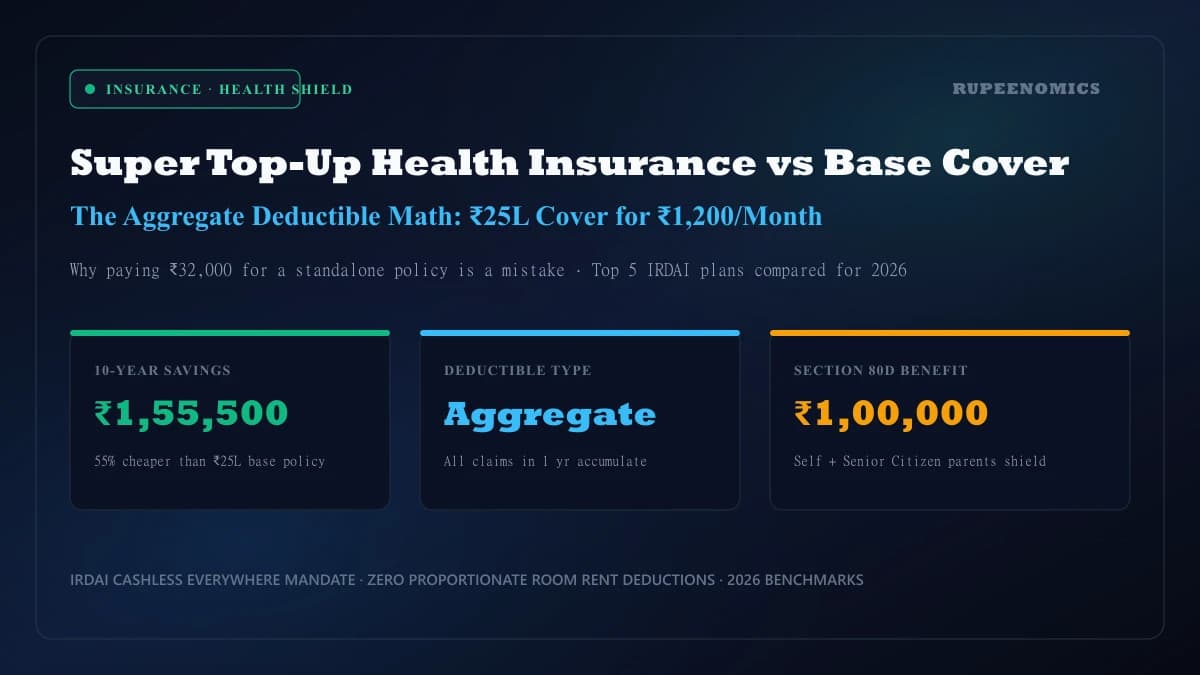
Super Top-Up Health Insurance vs Base Cover (2026): Deductible Math, Top 5 Plans & How to Get ₹25L Cover for ₹1,200/Month
With retail medical inflation in India compounding at 12% to 14% annually, a traditional ₹5,00,000 health insurance policy purchased five years ago is no longer adequate to shield a family from financial catastrophe. In metropolitan corporate hospitals (such as Apollo, Max, Fortis, or Manipal), an intensive care unit (ICU) stay accompanied by major surgery, coronary intervention, or targeted oncology treatment routinely exceeds ₹15,00,000 to ₹25,00,000.
However, when retail policyholders attempt to upgrade their coverage to ₹25 Lakhs or ₹50 Lakhs directly through standard comprehensive base policies, insurance agents quote punishing annual premiums ranging from ₹28,000 to ₹42,000 for a family of three.
There is a legitimate, IRDAI-approved insurance architecture that slashes this annual expense by 55% to 65%: combining a modest Base Health Cover with a high-limit Super Top-Up Health Policy.
This guide deconstructs the mathematical mechanics of aggregate deductibles, highlights the critical difference between standard "Top-Up" and "Super Top-Up" policies, compares the top 5 plans in India for 2026, and outlines the step-by-step cashless claim protocol.
1. The Mathematical Arbitrage: Standalone ₹25L Policy vs Base + Super Top-Up
           [Annual Premium Comparison: 32-Yr-Old Family Floater (2A + 1C)]
                                     │
     ┌───────────────────────────────┴───────────────────────────────┐
     ▼                                                               ▼
[STRATEGY A: Standalone ₹25L Base]            [STRATEGY B: ₹5L Base + ₹20L Super Top-Up]
Comprehensive Base Cover: ₹25,00,000          Base Health Cover (₹5L):        ₹12,400
Zero Deductible                               Super Top-Up Cover (₹20L):       ₹3,850
Annual Premium: ₹31,800                       Total Combined Premium:         ₹16,250
------------------------------------          ------------------------------------------
10-Year Outflow: ₹3,18,000                    10-Year Outflow:                ₹1,62,500
Risk Protection: Identical (₹25L)             NET SAVINGS: ₹1,55,500 (+ SIP Compounding!)
Why are Super Top-Up policies so remarkably cheap?
The answer lies in actuarial probability. In India, roughly 85% to 90% of all hospitalisation claims fall below ₹5,00,000 (dengue, minor surgeries, fractures, basic infections). The probability of an individual claim breaching ₹5,00,000 in any given policy year is statistically under 5% to 7%.
By agreeing to a ₹5,00,000 Deductible, you absorb the high-frequency, low-severity claims (or offload them to your inexpensive base policy or corporate group coverage). The Super Top-Up underwriter only bears the low-frequency, high-severity catastrophic risk—allowing them to price ₹20,00,000 of coverage at a fraction of base policy rates.
2. Regular Top-Up vs Super Top-Up: The Deadly Per-Claim Trap
Many policyholders purchase a "Top-Up" policy assuming it is identical to a "Super Top-Up". This confusion can lead to catastrophic out-of-pocket expenses during a medical emergency.
The fundamental differentiator is how the Deductible is applied:
| Evaluation Parameter | Regular Top-Up Policy | Super Top-Up Policy |
|---|---|---|
| Deductible Application | Per-Claim Basis (Each individual hospitalisation must breach the deductible) | Aggregate Annual Basis (All hospitalisation claims in a policy year accumulate) |
| Claim Scenario 1 (₹4L Bill) | Under ₹5L deductible: ₹0 Paid | Under ₹5L deductible: ₹0 Paid (Accrues ₹4L towards deductible) |
| Claim Scenario 2 in Same Year (₹4L Bill) | Under ₹5L deductible: ₹0 Paid (Treated as fresh single claim!) | Base policy or self pays remaining ₹1L; Super Top-Up pays ₹3L! |
| Multiple Hospitalisation Safety | ❌ Highly Dangerous; fails chronic/relapse treatments | ✅ Completely Safe; functions like a seamless umbrella cover |
| Recommended Choice | ⚠️ Avoid for retail families | 🟢 Mandatory Standard |
Visualizing the Aggregate Deductible in Action:
Imagine you have a ₹5 Lakh Base Policy and a ₹20 Lakh Super Top-Up with a ₹5 Lakh Deductible.
In August, a family member undergoes gallbladder surgery costing ₹3,50,000:
- Base Policy pays: ₹3,50,000.
- Super Top-Up deductible consumed: ₹3,50,000 of ₹5,00,000 (Remaining deductible: ₹1,50,000).
In November of the same policy year, another family member suffers a cardiac emergency costing ₹8,00,000:
- Base Policy pays remaining limit: ₹1,50,000 (Base policy now completely exhausted at ₹5,00,000).
- Total hospital bills incurred this year: ₹3,50,000 + ₹8,00,000 = ₹11,50,000.
- The ₹5,00,000 aggregate deductible has been completely satisfied!
- Super Top-Up triggers automatically and pays the remaining ₹6,50,000!
Under a regular Top-Up policy, the November cardiac claim of ₹8,00,000 would have only paid ₹3,00,000 (₹8L - ₹5L deductible), leaving you to pay ₹3,50,000 out of your own pocket.
3. Top 5 Super Top-Up Health Insurance Plans in India (2026)
Enjoyed this post?
Get our weekly digest delivered free.
We evaluated 14 IRDAI-registered retail super top-up products on claim settlement ratios (CSR), network hospital strength, room rent restrictions, and restoration features:
| Plan Name & Insurer | Incurred Claim Ratio (ICR) | Deductible Choices | Sum Insured Options | Room Rent Limit | Pre/Post Hospitalisation | Key Underwriting Feature |
|---|---|---|---|---|---|---|
| HDFC ERGO my:health Medisure Super Top Up | 82.4% | ₹3L, ₹4L, ₹5L, ₹10L | Up to ₹1 Crore | Single Private A/C Room | 60 Days / 90 Days | Zero medical check-up up to age 55; seamless cashless integration |
| Care Enhance (Care Health) | 88.6% | ₹1L to ₹10L | ₹10L to ₹50L | No Sub-limit / Any Room | 60 Days / 90 Days | Unlimited automatic recharge option; excellent Tier-2 network |
| Niva Bupa Health Recharge | 84.1% | ₹1L to ₹10L | Up to ₹95L | No Sub-limit | 60 Days / 90 Days | Optional critical illness rider; fast paperless digital approval |
| Star Super Surplus | 79.2% | ₹3L, ₹5L, ₹10L, ₹15L | Up to ₹1 Crore | Single Standard A/C Room | 30 Days / 60 Days | Gold Plan offers maternity and organ donor cover |
| Aditya Birla Activ Assure Diamond Super Top Up | 81.5% | ₹2L to ₹10L | ₹5L to ₹50L | Up to Single Room | 30 Days / 60 Days | HealthReturn rewards for active walking steps (up to 30% premium off) |
4. The 4 Non-Negotiable Rules Before Purchasing a Super Top-Up
Before purchasing a Super Top-Up policy to sit atop your existing health cover, verify these four operational checkpoints:
Rule 1: Set the Deductible Equal to or Below Your Base Sum Insured
If your corporate group policy or personal base policy covers ₹5,00,000, your Super Top-Up deductible must be exactly ₹5,00,000 (or lower, such as ₹3,00,000). Never purchase a ₹10,000,000 deductible top-up if your base cover is only ₹5,00,000; doing so creates a dangerous ₹5,00,000 uninsured gap that you must pay out of pocket.
Rule 2: Synchronize Room Rent Clauses
If your base policy restricts room rent to 1% of Sum Insured (e.g. ₹5,000/day on a ₹5L policy), but your Super Top-Up has "No Room Rent Limit", beware of Proportionate Deductions. If you occupy a room costing ₹12,000/day during hospitalisation, the base insurer will deduct 58% across doctor fees, surgery, and diagnostics. While the Super Top-Up will pick up eligible expenses beyond the deductible, non-payable medical consumables and proportional penal charges may spill into your personal pocket. Ensure your base cover has no room rent restrictions or upgrade it.
Rule 3: Align Pre-Existing Disease (PED) Waiting Periods
Under IRDAI's latest regulations, the maximum waiting period for pre-existing conditions is capped at 36 months (down from 48 months). If your base cover is 4 years old (PED fully serviced), but you buy a new Super Top-Up today with a 36-month waiting period, a major hospitalization related to diabetes or hypertension within the next 3 years will only be paid by the base policy up to ₹5L; the Super Top-Up will decline the excess until its 36-month clock expires.
Rule 4: You DO NOT Need to Buy Both Policies from the Same Insurer
A common myth perpetuated by agents is that your Base Policy and Super Top-Up must be with the same insurance company. This is completely false. You can hold an employer group policy with New India Assurance, a retail base policy with ICICI Lombard, and a Super Top-Up with HDFC ERGO. When filing claims, the Second Insurer is legally mandated to honour the claim upon receiving certified copies of the hospital bill and settlement summary from the First Insurer.
5. Maximizing Tax Deductions under Section 80D
Premiums paid towards both Base Health Insurance and Super Top-Up policies are 100% eligible for tax deductions under Section 80D of the Income Tax Act (under the Old Tax Regime):
+------------------------------------------------------------------------------------+
|                      SECTION 80D TAX SHIELD OPTIMIZATION MATRIX                     |
+------------------------------------------------------------------------------------+
  1. Self, Spouse & Dependent Children:
     • Base Premium: ₹14,000 + Super Top-Up Premium: ₹4,000 = ₹18,000 (Cap: ₹25,000)

  2. Senior Citizen Parents (Age 60+):
     • Base Premium: ₹38,000 + Super Top-Up Premium: ₹12,000 = ₹50,000 (Cap: ₹50,000)

  3. Preventive Health Checkup Allowance:
     • Up to ₹5,000 within the overall ceiling.
+------------------------------------------------------------------------------------+
  TOTAL POTENTIAL DEDUCTION: ₹75,000 to ₹1,00,000
  TAX SAVED IN 30% TAX SLAB (+ CESS): UP TO ₹31,200 EVERY YEAR!
+------------------------------------------------------------------------------------+
Even if you have opted for the New Tax Regime (where Section 80D deductions are unavailable), the raw cost efficiency of the Base + Super Top-Up structure remains vastly superior to any standalone mega-policy.
6. How Cashless Claim Settlement Works with Two Insurers
Many policyholders fear that having two different insurance policies means fighting with hospital billing desks during discharge. Follow this standard operating procedure (SOP) for a 100% cashless experience:
[Day of Admission]
├── 1. Present BOTH Base Policy Card and Super Top-Up Card at the Hospital TPA Desk.
└── 2. Request the hospital to register pre-authorization with BOTH insurers simultaneously.

[During Hospitalisation]
├── 3. Base Insurer approves initial pre-auth (e.g. up to ₹5,00,000).
└── 4. Hospital TPA informs Super Top-Up insurer that estimated bill will exceed the deductible.

[At Discharge]
├── 5. Hospital generates final itemized bill (e.g. ₹18,00,000).
├── 6. Base Insurer settles the first ₹5,00,000 and issues a formal Settlement Letter.
├── 7. Hospital TPA transmits the Settlement Letter + Bill copies to Super Top-Up insurer.
└── 8. Super Top-Up Insurer approves the remaining ₹13,00,000 cashless balance!
Under IRDAI's "Cashless Everywhere" initiative, if you notify the hospital and insurer at least 48 hours prior for planned procedures (or within 48 hours for emergency trauma), this dual-pre-auth protocol runs digitally through the National Health Claims Exchange (NHCX).
7. The Final Strategic Verdict
If you currently rely on an employer-provided group health policy of ₹5,00,000, you are one layoff or job transition away from zero medical coverage.
Rather than paying ₹35,000+ for an expensive individual policy:
- Buy a ₹5,00,000 Individual Base Policy with zero room rent limits to anchor your lifetime insurability and PED waiting periods.
- Layer a ₹20,00,000 to ₹95,00,000 Super Top-Up Policy with a ₹5,00,000 aggregate deductible on top.
- Lock in ₹25 Lakh to ₹1 Crore total family healthcare protection for as little as ₹1,200 to ₹1,500 per month.
- Channel the ₹18,000 annual premium savings into an aggressive equity index SIP.
Disclaimer: This analysis is published strictly for educational and financial literacy purposes. Insurance policy wordings, exclusions, waiting periods, and underwriting terms vary by insurer and are governed by individual policy contracts and IRDAI regulations. Always read the policy sales brochure and Key Feature Document (KFD) thoroughly before purchasing.
The insights, broker reviews, tax estimates, and financial data presented on RupeeNomics are strictly for educational and research purposes only. RupeeNomics and its authors are not SEBI-registered investment advisors or research analysts. Nothing published herein should be construed as personalized investment advice or a recommendation to buy or sell securities. Investments in the securities market are subject to market risks. Please conduct your own due diligence or consult a SEBI-registered financial planner before making investment decisions. Read our Editorial Policy.
Enjoyed this post?
Get our weekly digest delivered free.
Share this post:
RupeeNomics is reader-supported. We may earn a commission from links in this article at no extra cost to you. Read our disclosure.
Related Posts

Health Insurance in India Master FAQ: Cashless Everywhere, Portability Rules, Waiting Periods & Room Rent Capping Truth
Health Insurance in India Master FAQ: Cashless Everywhere, Portability Rules, Waiting Periods & Room Rent Capping Truth Quick Summary: In India, medical inflation currently exceeds 12%–14% annually…