Home Loan Prepayment vs Mutual Fund SIP: The Mathematical Truth with Amortisation
Home Loan Prepayment vs Mutual Fund SIP: The Mathematical Truth with Amortisation
Every Indian homeowner with a surplus ₹10,000 to ₹25,000 at the end of the month confronts the identical dilemma:
"Should I prepay my 8.50% home loan to become debt-free sooner, or should I invest that surplus into a diversified equity mutual fund compounding at 12%?"
On superficial finance forums, the standard advice is immediate: "12% investment return is higher than 8.50% borrowing cost. Always invest in the SIP."
That surface-level arithmetic ignores three critical real-world realities of Indian retail finance:
- Front-Loaded Amortisation Physics: In the first 7 years of a 20-year loan, roughly 65% to 75% of every monthly EMI pays interest to the bank, not principal.
- Tax Shield Erosion: Under the New Tax Regime (now default for over 70% of filers), the Section 24(b) ₹2,00,000 home loan interest deduction is completely unavailable. Your borrowing cost is 100% post-tax.
- Risk-Adjusted Certainty: Prepaying an 8.5% loan delivers a guaranteed, risk-free, tax-free return of 8.50%. An equity SIP's 12% CAGR carries volatility, sequence-of-returns risk, and a 12.5% LTCG tax drag.
Below is the complete mathematical model across a ₹50 Lakh home loan to reveal the exact truth.
1. The Baseline Loan Model: ₹50 Lakhs for 20 Years
Let us examine standard borrowing terms from leading public and private lenders (SBI, HDFC Bank, ICICI Bank):
- Loan Principal: ₹50,00,000
- Interest Rate: 8.50% p.a.
- Tenure: 240 Months (20 Years)
- Monthly EMI: ₹43,391
- Total Interest Payable: ₹54,13,879
- Total Cash Paid to Bank: ₹1,04,13,879 (More than double the borrowed principal)
┌─────────────────────────────────────────────────────────────┐
│                 THE ₹50 LAKH 20-YEAR BURDEN                 │
├──────────────────────┬──────────────────────────────────────┤
│ Borrowed Amount      │ ₹50,00,000 (48.0%)                   │
│ Pure Interest Paid   │ ₹54,13,879 (52.0%)                   │
│ Total Outflow        │ ₹1,04,13,879                         │
└──────────────────────┴──────────────────────────────────────┘
Notice that during the first 60 months (Years 1 to 5), of the ₹26,03,460 paid in EMIs, ₹20,53,114 goes purely to bank interest, reducing your ₹50 Lakh principal by just ₹5.5 Lakhs.
2. Scenario A: Extra ₹10,000 Monthly Loan Prepayment
In this scenario, rather than investing, you instruct your bank to add an extra ₹10,000 to your monthly EMI payment (total monthly payment: ₹53,391), with the surplus explicitly tagged for principal prepayment.
The Results:
- Revised Tenure: Reduced from 240 months to 143 months (11.9 years).
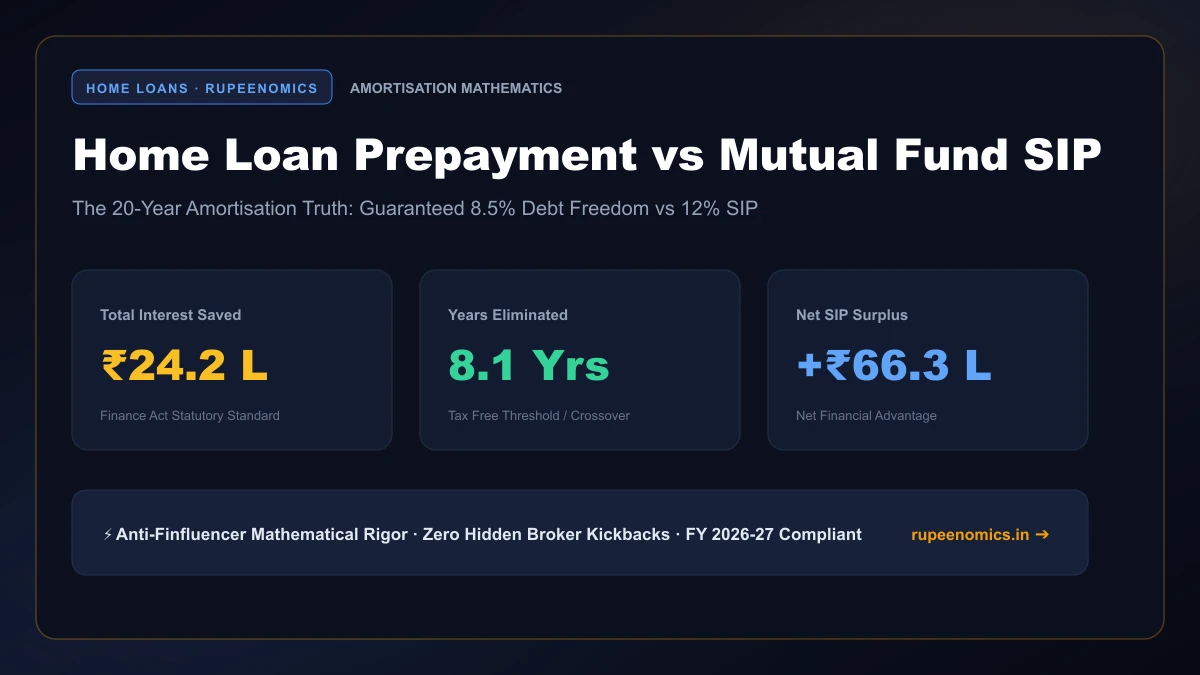
- Years Saved: 8.1 Years of debt eliminated.
- Revised Total Interest: ₹29,86,842.
- Direct Interest Saved: ₹24,27,037 in pure cash.
By committing ₹10,000 per month, you shave nearly a decade off your debt sentence and retain over ₹24 Lakhs of after-tax liquidity that would have flowed directly to bank profit margins.
3. Scenario B: ₹10,000 Monthly Equity SIP (12% CAGR)
Enjoyed this post?
Get our weekly digest delivered free.
In this scenario, you pay only the mandatory EMI of ₹43,391 for the full 20 years. The surplus ₹10,000 is systematically invested into a diversified index fund or flexi-cap fund yielding an expected long-term 12% CAGR.
The Results:
- Total Capital Invested: ₹24,00,000 (₹10,000/mo × 240 months).
- Gross SIP Value after 20 Years: ₹99,91,479 (~₹1.00 Crore).
- Wealth Created (Gross): ₹75,91,479.
- Less LTCG Tax (12.5% on gains above ₹1.25L): -₹9,33,310.
- Net In-Hand Portfolio: ₹90,58,169.
The Mathematical Comparison:
- Net Financial Gain from SIP: +₹90,58,169
- Extra Interest Paid on Loan: -₹24,27,037
- Net Surplus in Favor of SIP: +₹66,31,132
Strictly on a spreadsheet, after paying the entire ₹54.1 Lakh interest on the home loan, the equity SIP investor ends up with approximately ₹66 Lakhs more wealth than the aggressive prepayer.
4. The Hidden Risk Factors Spreadsheets Hide
If the math favors the SIP by ₹66 Lakhs, why does financial guru Dave Ramsey and millions of disciplined homeowners recommend paying off the home loan first?
Risk Factor 1: Sequence of Returns Risk
A 12% mutual fund return is a multi-year compounded average, not a guaranteed straight line. If you face a severe bear market in years 15–18 (such as 2000–2002 or 2008), your equity corpus can plunge 30% to 45% right when you anticipate utilizing it. Meanwhile, the bank's 8.5% interest accrues daily without exception.
Risk Factor 2: Job Security & Emergency Volatility
During macroeconomic downturns or tech restructuring cycles, an ongoing ₹43,391 monthly liability represents severe existential pressure. If you lose your primary salary income, an unencumbered, fully paid-off home provides absolute shelter certainty.
Risk Factor 3: Human Behavioral Leakage
Spreadsheet models assume you will flawlessly invest every single ₹10,000 surplus month-after-month for 240 consecutive months without redeeming a single rupee for vacations, car upgrades, or consumer electronics. In reality, liquid mutual funds are frequently liquidated for discretionary upgrades, whereas loan prepayment permanently locks capital into equity.
5. The Optimal Hybrid Strategy: The 5-Year Prepayment Pivot
You do not need to make an all-or-nothing choice. The mathematically and psychologically superior path for Indian borrowers is the 5-Year Prepayment Pivot:
┌─────────────────────────────────────────────────────────────┐
│                 THE 5-YEAR PREPAYMENT PIVOT                 │
├─────────────────────────────────────────────────────────────┤
│ PHASE 1 (Years 1 to 5):                                     │
│ • Dedicate 70% of surplus to Home Loan Prepayment           │
│ • Dedicate 30% to Equity SIP                                │
│ • Goal: Crush front-loaded interest when debt is highest     │
├─────────────────────────────────────────────────────────────┤
│ PHASE 2 (Years 6 to 20):                                    │
│ • Switch 100% of surplus to Equity Mutual Fund SIPs         │
│ • Loan principal is now small; interest accrual is minimal  │
│ • Equity compounding enters exponential hockey-stick curve  │
└─────────────────────────────────────────────────────────────┘
Why the Pivot Works:
- Breaks the Amortisation Back: Prepaying aggressively in the first 60 months prevents the bank from compounding interest on the highest base.
- Retains Investment Habit: You never stop investing; your SIP runs uninterrupted from Day 1.
- Optimizes Rate Cycles: When RBI repo rates rise (pushing your home loan from 8.5% to 9.5%), channel more to debt. When rates decline, direct more to equities.
6. Decision Matrix: Which Path Should You Choose?
| Your Financial Profile | Recommended Action | Primary Rationale |
|---|---|---|
| Single Earner / High Job Volatility (Early Startups, Sales) | Aggressive Prepayment | Minimizes fixed monthly commitments and eliminates foreclosure risk. |
| Double Income Corporate / Stable Government Job | 100% Equity SIP | Higher risk capacity to ride through market drawdowns and capture the ₹66L compounding spread. |
| Loan Interest Rate > 9.25% | Prepayment First | Guaranteed 9.25%+ tax-free return is mathematically superior to uncertain equity risk premia. |
| New Homeowner in Years 1–5 | The Hybrid Pivot | Eliminates front-heavy bank interest while building initial mutual fund foundation. |
Explore our interactive Home Inverter & Power Calculator and test your exact investment compounding with the SIP Calculator.
:::disclaimer Disclaimer: The scenarios, interest rate assumptions, and investment returns presented in this article are illustrative and based on historical Indian market trends. Individual tax liabilities depend on your chosen tax regime and personal deductions. Please consult a SEBI-registered Investment Adviser (RIA) before altering your debt prepayment schedule. :::
The insights, broker reviews, tax estimates, and financial data presented on RupeeNomics are strictly for educational and research purposes only. RupeeNomics and its authors are not SEBI-registered investment advisors or research analysts. Nothing published herein should be construed as personalized investment advice or a recommendation to buy or sell securities. Investments in the securities market are subject to market risks. Please conduct your own due diligence or consult a SEBI-registered financial planner before making investment decisions. Read our Editorial Policy.
Enjoyed this post?
Get our weekly digest delivered free.
Share this post:
RupeeNomics is reader-supported. We may earn a commission from links in this article at no extra cost to you. Read our disclosure.