CIBIL Credit Score Master FAQ: How to Fix Errors, Drop Credit Utilization & Boost Your Score Past 780+ Fast

CIBIL Credit Score Master FAQ: How to Fix Errors, Drop Credit Utilization & Boost Your Score Past 780+ Fast
Quick Summary: In the Indian financial system, your CIBIL Score (ranging from 300 to 900) determines your loan eligibility, processing fees, and mortgage interest rate concessions across major commercial banks (SBI, HDFC Bank, ICICI Bank). Maintaining a score of 780+ can lower your 20-year home loan interest rate by 25 to 50 basis points, saving over ₹6.5 Lakh in interest payments. This master FAQ covers dispute resolution, credit utilization hacks, and how to rapidly rebuild a damaged credit history.
+---------------------------------------------------------------------------------------------------+
|                        CIBIL CREDIT SCORE COMPUTATION & ENHANCEMENT ENGINE                        |
+---------------------------------------------------------------------------------------------------+
                                                  │
         ┌────────────────────────────────────────┼────────────────────────────────────────┐
         ▼                                        ▼                                        ▼
+──────────────────────────+             +──────────────────────────+             +──────────────────────────+
| PAYMENT HISTORY (35%)    |             | CREDIT UTILIZATION (30%) |             | CREDIT MIX & AGE (35%)   |
| • 100% On-Time Payments  |             | • Total Spends < 30% CUR |             | • Secured vs Unsecured   |
| • Zero Default / DPD Mark|             | • Multi-Card Limit Scale |             | • Oldest Active Card Age |
| • Auto-Debit Setup Active|             | • Mid-Cycle Payments     |             | • Minimal Hard Inquiries |
+──────────────────────────+             +──────────────────────────+             +──────────────────────────+
         │                                        │                                        │
         └────────────────────────────────────────┼────────────────────────────────────────┘
                                                  ▼
+---------------------------------------------------------------------------------------------------+
| SYNTHESIS: Systematic Credit Discipline Pushing CIBIL Score into Prime Tier (780–850 Range)       |
+---------------------------------------------------------------------------------------------------+
❓ Frequently Asked Questions (Master Credit Guide)
1. What is an "Excellent" CIBIL Score in India?
- 780 to 900 (Excellent / Prime): Guarantees instant pre-approved loans, lowest available home loan interest rates (e.g., Repo Linked Lending Rate - RLLR concessions), and maximum credit card approvals.
- 720 to 779 (Good): Standard approval terms for retail credit; minimal interest rate penalties.
- 650 to 719 (Fair / Average): Increased scrutiny, mandatory physical income verification, higher interest rate spreads.
- Below 650 (Poor / High Risk): Loan rejections, mandatory guarantor requirements, high-interest secured loan mandates.
2. What is Credit Utilization Ratio (CUR) and How Do I Optimize It?
Credit Utilization Ratio (CUR) is the percentage of your total available credit limit that you utilize across all your active credit cards in a billing cycle: $$\text{CUR} = \left( \frac{\text{Total Credit Card Spends in Month}}{\text{Total Combined Credit Limit of All Cards}} \right) \times 100$$
- The Golden Rule: Keep your CUR strictly below 30% (ideally below 10%–15%).
- The Mid-Cycle Pre-Payment Hack: If you have a credit card with a ₹1,00,000 limit and spend ₹60,000 in a month, pay off ₹45,000 before your statement generation date. When the bank reports your balance to TransUnion CIBIL on statement date, your reported balance will be only ₹15,000 (15% CUR), boosting your score!
+---------------------------------------------------------------------------------------------------+
|                        MID-CYCLE PRE-PAYMENT CREDIT UTILIZATION HACK                              |
+---------------------------------------------------------------------------------------------------+
 Monthly Spend: ₹60,000 (on ₹1,00,000 Credit Limit)
                 │
         ┌───────┴──────────────────────────────────────────────┐
         ▼                                                      ▼
 [Path A: Wait for Statement Generation]              [Path B: Mid-Cycle Pre-Payment Hack]
 • Statement Generated: ₹60,000                       • Pre-pay ₹45,000 3 days before statement date
 • Bank Reports 60% CUR to CIBIL                      • Statement Generated: ₹15,000
 • CIBIL Score Drops -25 to -40 Points! 📉            • Bank Reports 15% CUR to CIBIL ──► Score Surges! 🚀
+---------------------------------------------------------------------------------------------------+
3. How Do I Remove Wrong Information or Clerical Errors from My CIBIL Report?
If a bank mistakenly reports an overdue payment ("Days Past Due" / DPD flag) or shows a loan that does not belong to you:
- Raise an Online CIBIL Dispute: Log into the official TransUnion CIBIL portal $\to$ Navigate to Credit Report $\to$ Dispute Center $\to$ Raise a Dispute.
- Flag Specific Account: Select the disputed account number and field (e.g., Payment Status / Ownership).
- Statutory 30-Day Resolution: Under RBI guidelines, CIBIL is legally required to verify the dispute with the reporting bank and resolve the discrepancy within 30 calendar days.
- Direct Bank Escalation: Simultaneously email the Principal Nodal Officer (PNO) of the lending bank with your loan closure letter / NOC to expedite rectification.
4. What is a "Settled" vs "Closed" Account Status?
- "Closed" (Positive ✅): The borrower paid the entire principal and interest in full. Enhances credit standing.
- "Settled" (Negative ❌): The borrower failed to repay the full loan, and the bank accepted a discounted one-time compromise settlement. This leaves a severe negative black mark on your credit report for up to 7 years.
- How to Fix a "Settled" Status: Approach the bank, pay the remaining waived balance amount in full, and request the bank to convert your status from "Settled" to "Closed" and issue a clean No Objection Certificate (NOC).
5. Does Checking My Own CIBIL Score Lower It?
NO. Checking your own credit score on CIBIL, CRED, OneScore, or banking portals is classified as a "Soft Inquiry." Soft inquiries have zero negative impact on your credit score and can be checked weekly or monthly with complete safety. (Only "Hard Inquiries"—triggered when a bank checks your score after you formally apply for a new loan or credit card—can temporarily lower your score by 3–8 points).
📊 Summary Reference: CIBIL Score Building Timeline
+---------------------------------------------------------------------------------------------------+
|                         CIBIL RECOVERY & ACCRETION ACTION TIMELINE                                |
+---------------------------------------------------------------------------------------------------+
| Timeframe                    | Action Executed                    | Expected Score Impact         |
+------------------------------+------------------------------------+-------------------------------+
| Month 1 (Immediate)          | Pay all credit cards down to <15%  | +15 to +30 Points             |
| Months 2–3                   | Resolve clerical dispute on portal | +20 to +50 Points (Error Fix) |
| Months 4–6                   | Keep zero hard loan applications   | +10 to +20 Points             |
| Months 6–12                  | 100% on-time auto-debit track rec. | Reaches 780+ Prime Tier       |
+---------------------------------------------------------------------------------------------------+
📌 The Bottom Line & Actionable Credit Checklist
Enjoyed this post?
Get our weekly digest delivered free.
+---------------------------------------------------------------------------------------------------+
|                              TOPIC SLUG ALIGNED ACTIONABLE TAKEAWAYS                              |
+---------------------------------------------------------------------------------------------------+
| Topic Slug                           | Core Actionable Credit Rule                                |
+--------------------------------------+------------------------------------------------------------+
| cibil-credit-score-master-faq        | Check your official CIBIL report quarterly for errors.     |
| credit-score-repair-guide            | Convert "Settled" accounts to "Closed" by paying balance.  |
| credit-utilization-ratio-optimization| Keep monthly card spends below 30% of your total limit.    |
| dispute-resolution-rectification     | File online CIBIL disputes for rapid 30-day statutory fix.|
| loan-eligibility-maximization        | Maintain a mix of 1 secured loan (Home/Auto) + 2 cards.   |
+---------------------------------------------------------------------------------------------------+
📫 Subscribe to India Personal Finance Insights
Get automated credit repair blueprints, loan interest reduction strategies, and financial health checklists delivered to your inbox every week.
Subscribe to RupeeNomics Free Newsletter →
Disclosure: This FAQ is published for educational and financial literacy purposes.
The insights, broker reviews, tax estimates, and financial data presented on RupeeNomics are strictly for educational and research purposes only. RupeeNomics and its authors are not SEBI-registered investment advisors or research analysts. Nothing published herein should be construed as personalized investment advice or a recommendation to buy or sell securities. Investments in the securities market are subject to market risks. Please conduct your own due diligence or consult a SEBI-registered financial planner before making investment decisions. Read our Editorial Policy.
Enjoyed this post?
Get our weekly digest delivered free.
Share this post:
RupeeNomics is reader-supported. We may earn a commission from links in this article at no extra cost to you. Read our disclosure.
Related Posts
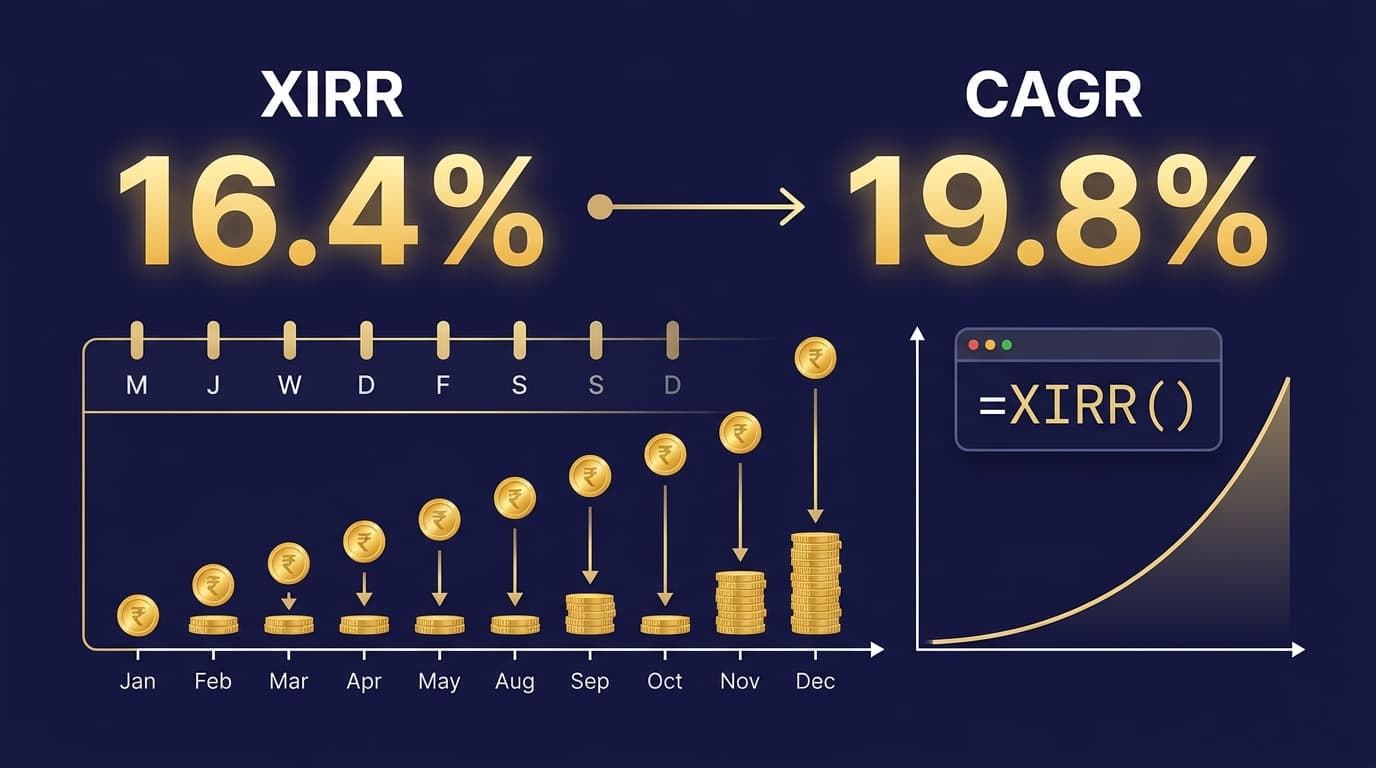
XIRR vs CAGR for SIP Returns: What's the Difference and Which to Use?
You've been doing your SIP for 3 years. The fund's page shows "CAGR: 18%". But when you check your portfolio value, the returns don't feel like 18%. You're not miscalculating — CAGR and XIRR measure f…

Asian Paints Business Model: The Distribution Moat
Asian Paints Business Model: The Distribution Moat, Supercomputers & The Tinting Machine Monopoly Quick Summary: Most investors assume Asian Paints is a chemical manufacturing company. In reality, …

HDFC Bank Business Model: The CASA & Retail Moat
HDFC Bank Business Model: The Low-Cost CASA Engine & Retail Fortress Quick Summary: In commercial banking, money is a commodity. When two banks offer the identical ₹50 lakh home loan or working cap…