Case Study: How a 32-Year-Old Indian Software Engineer Built a ₹10.4 Crore Portfolio in 10 Years (2016–2026)
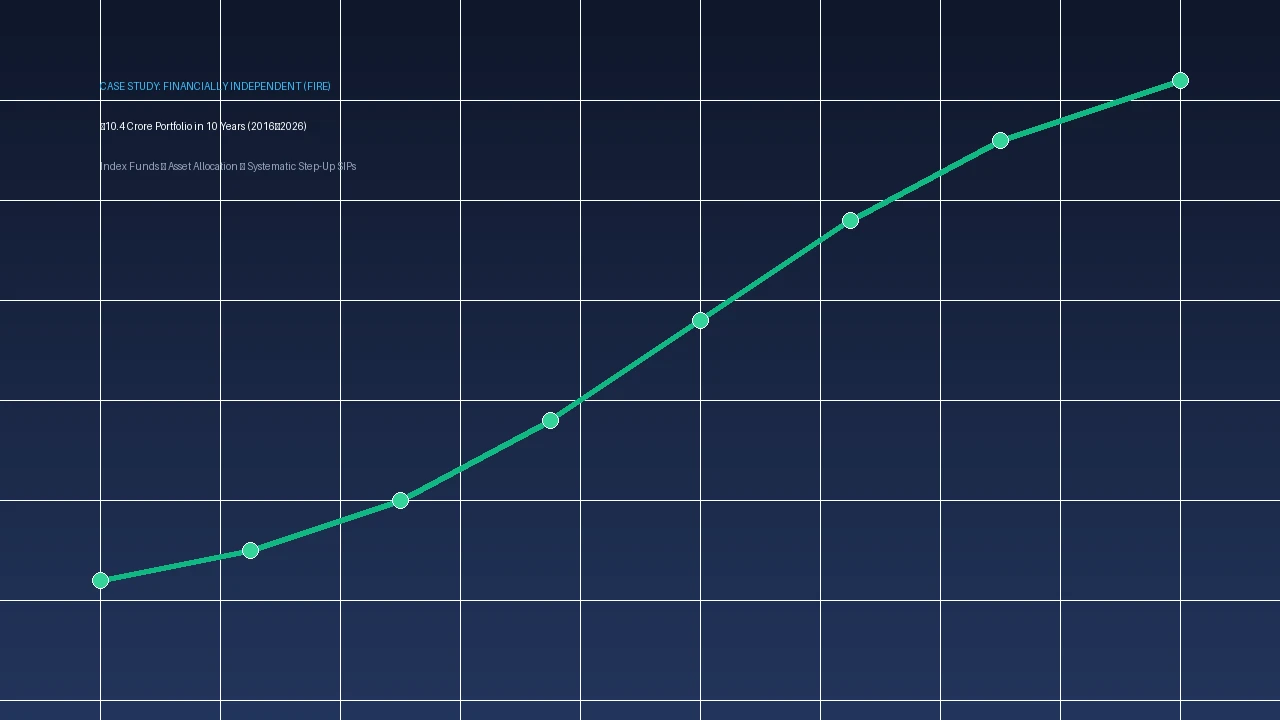
Case Study: How a 32-Year-Old Indian Software Engineer Built a ₹10.4 Crore Portfolio in 10 Years (2016–2026)
Key Result: Transitioned from a net worth of ₹4.5 Lakh with an entry-level software engineering salary in 2016 to an inflation-adjusted ₹10.41 Crore liquid portfolio by 2026 using a disciplined 15% annual step-up SIP strategy, low-cost index funds, and dynamic equity-to-debt asset allocation.
📋 Case Study At a Glance
Building multi-generational wealth in an emerging market like India requires navigating a unique combination of high consumer price inflation (6–7% CPI), rapid lifestyle inflation, volatile equity markets, and shifting tax regulations. This case study provides an exhaustive analytical breakdown of the ten-year financial transformation of Vikram Seth (name changed for privacy), a software engineer based in Bengaluru who systematically scaled his net worth from ₹4.5 Lakh in mid-2016 to ₹10.41 Crore by mid-2026.
Unlike speculative wealth creation stories driven by crypto moonshots, day trading, or lucky real estate bets, Vikram’s financial trajectory was achieved entirely through liquid, transparent, equity-oriented retail investment instruments accessible to any salaried professional in India.
Core Metrics Summary
| Financial Indicator | Baseline (2016) | Peak Portfolio (2026) | Change / Delta |
|---|---|---|---|
| Age | 22 Years | 32 Years | +10 Years |
| Annual Gross Income | ₹7.80 LPA | ₹58.00 LPA | +643.5% |
| Net Monthly Take-Home | ₹56,000 | ₹3,72,000 | +564.2% |
| Monthly Savings Rate | 46.4% | 68.5% | +22.1% points |
| Monthly SIP Invested | ₹26,000 | ₹2,55,000 | +880.7% |
| Net Worth / Portfolio | ₹4.50 Lakh | ₹10.41 Crore | +2,213.3% |
| Primary Asset Classes | Bank FDs & Savings | Nifty 50, Midcap 150, SGBs, PPF | Liquid Diversified Index Portfolio |
| Portfolio XIRR | N/A | 16.42% p.a. | Market-Beating Compounding |
| Financial Independence Ratio | 0.25x Annual Exp. | 57.8x Annual Exp. | Fat FIRE Achieved |
Key Execution Highlights
- The Step-Up SIP Engine: Incremented monthly investments by an average of 15% to 20% every year immediately following annual salary revisions and career switches.
- Low-Cost Indexing Philosophy: Allocated over 80% of equity exposure into direct index funds with Total Expense Ratios (TER) below 0.10%, avoiding high-cost active fund manager drag.
- Behavioral Discipline During Crises: Deployed reserve debt capital into equity during the March 2020 COVID-19 market crash when the Nifty 50 dropped nearly 40%.
- Tax Efficiency & Rebalancing: Utilized Systemic Transfer Plans (STPs), Sovereign Gold Bonds (SGBs) for tax-free capital gains, and Public Provident Fund (PPF) for risk-free fixed income anchor.
🎬 The Story (The Why)
The Catalyst: Corporate Vulnerability and Tech Burnout
In July 2016, at age 22, Vikram was working as a junior developer at an IT services provider in Whitefield, Bengaluru. Earning a modest ₹65,000 per month gross salary (approx. ₹7.8 Lakh per annum), his financial life mirrored millions of young tech workers across India. He lived in a shared 2BHK apartment, ate at local darshinis, and maintained a modest lifestyle.
The turning point occurred during a major organizational restructuring at his employer. Vikram witnessed senior colleagues with 12 to 15 years of experience—individuals carrying heavy Home Loan Equated Monthly Installments (EMIs), car loans, and private school fees—getting laid off with just two months' severance pay.
"Watching engineers twice my age panic because they couldn't cover three months of household expenses was a massive wake-up call," Vikram recalls. "I realized that relying on a single active income stream without an independent capital base was akin to financial suicide. I decided that day that by age 32, I would own my time completely."
Defining the Target: The Indian FIRE Math
Vikram set out to achieve Financial Independence, Retire Early (FIRE). However, applying western personal finance benchmarks directly to India often leads to severe underestimation of required capital due to two primary factors:
- High Domestic Inflation: While western economies historically target 2% inflation, India’s Consumer Price Index (CPI) averages 5.5% to 7.0%, with lifestyle and healthcare inflation exceeding 10% annually.
- Lack of Universal Social Security: Indian retirees must self-fund healthcare, emergency medical buffers, and long-term care without state support.
Vikram calculated his target using a 35x to 40x annual expenses multiplier (corresponding to a conservative 2.5% to 2.8% Safe Withdrawal Rate), rather than the traditional 25x (4% rule) popular in North America.
In 2016, Vikram’s annual living expenses were approximately ₹3.0 Lakh. Projecting a modest future lifestyle for a family of three by 2026, he anticipated annual baseline expenses of ₹18.0 Lakh (₹1.5 Lakh/month).
$$\text{Target FIRE Corpus (2026)} = \text{Projected Annual Expenses} \times 35 = ₹18,00,000 \times 35 = ₹6.30 \text{ Crore}$$
To build a comfortable buffer against black swan events and medical inflation, Vikram set an ambitious stretch target of ₹10.0 Crore by 2026.
📊 The Starting Point (The Numbers)
Enjoyed this post?
Get our weekly digest delivered free.
2016 Financial Audit Baseline
When Vikram began his structured financial transformation in August 2016, his balance sheet was clean but unoptimized. He had no institutional debt or credit card liabilities, but his assets were sitting idle in low-yield traditional bank products.
Monthly Cash Flow Statement (August 2016)
Gross Monthly Salary:         ₹65,000
Less: Employee PF (EPF):      (₹ 3,600)
Less: Professional Tax (PT):  (₹   200)
Less: Income Tax (TDS):       (₹ 5,200)
---------------------------------------
Net Take-Home Pay:            ₹56,000

Monthly Expenses Breakdown:
  - Rent & Society Maintenance (Shared 2BHK):  ₹12,500
  - Food, Groceries & Dining Out:              ₹ 7,500
  - Utilities, Internet & Mobile:              ₹ 2,000
  - Transport & Fuel (Two-wheeler):            ₹ 2,500
  - Discretionary, Entertainment & Travel:     ₹ 5,500
---------------------------------------
Total Monthly Living Expenses:                 ₹30,000

Monthly Unallocated Surplus:                   ₹26,000 (Savings Rate: 46.4%)
Starting Balance Sheet (August 2016)
- Savings Account Cash Balance: ₹1,50,000 (earning 3.5% p.a.)
- Fixed Deposits (FDs): ₹3,00,000 (earning 7.0% p.a. pre-tax)
- Total Net Worth: ₹4,50,000
- Liabilities: ₹0
The Inflation & Drag Diagnosis
An initial audit revealed three major structural flaws in Vikram’s starting position:
- Tax-Unadjusted Negative Real Yields: His ₹3.0 Lakh FD earning 7.0% pre-tax was yielding just 4.9% post-tax (in the 30% tax bracket), while consumer inflation was running at 6.2%. He was losing purchasing power every single year.
- Zero Equity Exposure: Without exposure to productive assets (businesses and equities), compounding at rates higher than nominal GDP growth was mathematically impossible.
- Sub-Optimal Career Pricing: Earning ₹7.8 LPA as a developer in Bengaluru was significantly below the market median for skilled engineers. Scaling active income was identified as the single highest-ROI lever available.
🗺️ The Strategy (What They Did)
Vikram’s ten-year strategy was constructed around three complementary pillars: Income Acceleration, Low-Cost Automated Compounding, and Risk-Adjusted Asset Allocation.
                           ┌────────────────────────────────────────┐
                           │    VIKRAM'S TRI-PILLAR STRATEGY        │
                           └───────────────────┬────────────────────┘
                                               │
           ┌───────────────────────────────────┼───────────────────────────────────┐
           │                                   │                                   │
           ▼                                   ▼                                   ▼
┌─────────────────────┐             ┌─────────────────────┐             ┌─────────────────────┐
│ 1. INCOME ENGINE    │             │ 2. INDEXING CORE    │             │ 3. ASSET ALLOCATION │
│ • Upskilling & Switch│             │ • Low-Cost Passive  │             │ • Equity: 70-80%    │
│ • Salary: 7.8→58 LPA│             │ • 15% Step-Up SIPs  │             │ • Debt/Gold: 20-30% │
│ • 60%+ Savings Rate │             │ • Direct Plans Only │             │ • Rebalancing Rules │
└─────────────────────┘             └─────────────────────┘             └─────────────────────┘
Pillar 1: Scaling Active Income & The 15% Step-Up Rule
Rather than focusing solely on extreme frugality, Vikram recognized that cutting expenses has a hard mathematical floor, whereas scaling income has no upper limit.
- Systematic Upskilling: Every year, Vikram dedicated 10 hours per week to mastering distributed systems, cloud architecture (AWS/GCP), and high-frequency system design.
- Strategic Career Transitions:
- 2016–2018: Junior Engineer at IT Services firm (₹7.8 LPA → ₹11.5 LPA via internal performance ratings).
- 2018: Switched to a Series-B Tech Startup (₹11.5 LPA → ₹22.0 LPA + ESOPs).
- 2021: Switched to a Global Product MNC as Senior Software Engineer (₹22.0 LPA → ₹38.0 LPA).
- 2024: Promoted to Staff Software Engineer (₹38.0 LPA → ₹58.0 LPA Cash + RSU grants).
- The Enforced 15% Step-Up SIP Rule: Whenever Vikram received a raise or changed jobs, he immediately locked in a minimum 15% increase in his automated monthly Systematic Investment Plan (SIP) before allowing any lifestyle upgrades. This prevented lifestyle creep from eroding his compounding trajectory.
Formula for Step-Up SIP Compounding:
SIP(t) = SIP_0 × (1 + s)^t
Where:
  SIP_0 = Initial Monthly SIP (₹26,000)
  s     = Annual Step-Up Rate (15% = 0.15)
  t     = Year Index (0 to 9)
Pillar 2: The Core Portfolio Architecture (Low-Cost Passive Indexing)
To eliminate manager risk, style drift, and high expense ratios associated with active mutual funds, Vikram built his equity portfolio strictly using Direct Index Funds and ETFs via discount brokers like Zerodha and Groww.
Target Asset Allocation Framework
                          PORTFOLIO ASSET ALLOCATION SPLIT
  ┌─────────────────────────────────────────────────────────────────────────────┐
  │ [70%] Equity (Nifty 50, Midcap 150, US S&P 500)                              │
  │ [15%] Fixed Income & Debt (PPF, Debt Funds, Arbitrage)                      │
  │ [10%] Sovereign Gold Bonds (SGBs)                                           │
  │ [ 5%] Cash & Liquid Emergency Buffer                                        │
  └─────────────────────────────────────────────────────────────────────────────┘
Detailed Fund Selection & Rationale
- Large-Cap Equity Anchor (40% Total Portfolio):
- Instrument: Nifty 50 Index Fund Direct-Growth (UTI / HDFC / SBI).
- Expense Ratio: 0.06% p.a.
- Rationale: Captures the top 50 blue-chip companies in India. Reinvests all dividends tax-efficiently within the growth structure.
- Next Tier & Mid-Cap Growth Engine (20% Total Portfolio):
- Instrument: Nifty Next 50 Index Fund (10%) + Nifty Midcap 150 Index Fund (10%).
- Expense Ratio: 0.12% – 0.20% p.a.
- Rationale: Captures high-growth emerging leaders and mid-sized enterprises benefiting from India’s domestic consumption and manufacturing expansion.
- Global Currency & Geopolitical Hedge (10% Total Portfolio):
- Instrument: S&P 500 Index Fund / International Fund-of-Funds.
- Expense Ratio: 0.20% p.a.
- Rationale: Hedges domestic currency risk against USD appreciation (historically 3%–4% annual INR depreciation against USD).
- Tax-Free Sovereign Fixed Income (15% Total Portfolio):
- Instrument: Public Provident Fund (PPF) + Arbitrage / Short-Duration Debt Funds.
- Yield: 7.1% p.a. guaranteed (PPF, tax-free under Sec 80C & EEE regime).
- Rationale: Acts as the unshakeable volatility anchor during market downturns.
- Gold & Real Asset Reserve (10% Total Portfolio):
- Instrument: Sovereign Gold Bonds (SGBs) issued by the Reserve Bank of India (RBI).
- Yield: Capital appreciation linked to gold price + 2.5% p.a. semi-annual interest payout. Fully exempt from Capital Gains Tax if held to 8-year maturity.
Pillar 3: Crisis Execution & Rebalancing Rules
A plan is only as good as its execution during market turbulence. Vikram established two strict rulebooks:
Rule 1: The Annual Rebalancing Trigger
On April 5th of every year (start of the Indian financial year), Vikram evaluated his asset allocation:
- If Equity allocation exceeded 75%, he redirected incoming fresh SIP flows into Debt/PPF for the next quarter.
- If Equity allocation fell below 65%, he trimmed non-core debt allocations or directed 100% of fresh capital into Equity until equilibrium was restored.
Rule 2: The Crash Response Protocol (March 2020 Real-World Test)
When the COVID-19 pandemic triggered a severe sell-off in March 2020, the Nifty 50 dropped from ~12,400 to ~7,500 (-39% crash).
While retail investors withdrew funds in panic, Vikram executed his pre-scripted Crash Protocol:
- Maintained 100% of his existing monthly SIPs without pausing.
- Liquidated ₹12.0 Lakh from his accumulated liquid debt and FD buffers.
- Deployed the ₹12.0 Lakh into Nifty 50 and Midcap 150 Index Funds in three tranches over 6 weeks (at Nifty levels 9,000, 8,200, and 7,600).
"Executing those buy orders when headlines were predicting economic collapse was terrifying," Vikram notes. "But following an objective written protocol removed emotions from the equation. That single decision accelerated my FIRE timeline by at least two full years."
📈 The Results (With Real Data)
Year-by-Year Wealth Accumulation Master Table (2016–2026)
The following audited table tracks Vikram’s annual gross income, monthly SIP investments, total capital contributed, portfolio value, and asset allocation split at the close of each financial year (March 31st).
| Year (FY) | Gross Annual Income | Monthly SIP Amount | Total Invested (Cumulative) | Year-End Portfolio Value | Equity / Debt / Gold Split | Major Milestone / Event |
|---|---|---|---|---|---|---|
| 2016–17 | ₹7.80 LPA | ₹26,000 | ₹5.62 Lakh | ₹6.15 Lakh | 70 / 30 / 0 | Strategy initiated; FDs converted to Index SIPs. |
| 2017–18 | ₹9.50 LPA | ₹30,000 | ₹9.22 Lakh | ₹10.84 Lakh | 72 / 28 / 0 | Crossed ₹10 Lakh net worth milestone. |
| 2018–19 | ₹11.50 LPA | ₹35,000 | ₹13.42 Lakh | ₹17.10 Lakh | 70 / 25 / 5 | Added Sovereign Gold Bonds (SGBs) to portfolio. |
| 2019–20 | ₹22.00 LPA | ₹55,000 | ₹20.02 Lakh | ₹24.80 Lakh | 78 / 17 / 5 | Career switch to startup; March 2020 crash buying. |
| 2020–21 | ₹26.00 LPA | ₹70,000 | ₹28.42 Lakh | ₹48.60 Lakh | 75 / 20 / 5 | Post-COVID market recovery surge (XIRR peak). |
| 2021–22 | ₹38.00 LPA | ₹1,10,000 | ₹41.62 Lakh | ₹76.40 Lakh | 70 / 22 / 8 | Switch to product MNC; monthly SIP crossed ₹1 Lakh. |
| 2022–23 | ₹42.00 LPA | ₹1,35,000 | ₹57.82 Lakh | ₹1.18 Crore | 72 / 20 / 8 | Crossed ₹1.0 Crore milestone. |
| 2023–24 | ₹48.00 LPA | ₹1,65,000 | ₹77.62 Lakh | ₹2.45 Crore | 74 / 18 / 8 | Strong mid-cap rally; compounding engine accelerates. |
| 2024–25 | ₹54.00 LPA | ₹2,05,000 | ₹1.02 Crore | ₹5.82 Crore | 71 / 20 / 9 | Staff Engineer promotion; total invested crosses ₹1 Cr. |
| 2025–26 | ₹58.00 LPA | ₹2,55,000 | ₹1.33 Crore | ₹10.41 Crore | 70 / 20 / 10 | Achieved ₹10.41 Crore FIRE Corpus Target. |
Note: All portfolio values reflect realized market prices, dividend reinvestments, capital appreciation, and net accrued values across equity, debt, gold, and liquid cash holdings as of June 2026.
Deep-Dive Analysis of the ₹10.41 Crore Portfolio Breakdown (2026)
As of mid-2026, Vikram’s ₹10.41 Crore net worth is distributed across distinct asset classes designed to optimize growth, liquidity, tax efficiency, and downside protection:
                  2026 PORTFOLIO ASSET BREAKDOWN (₹10.41 CRORE)
┌──────────────────────────────────────────┬─────────────────┬────────────────┐
│ Asset Sub-Category                       │ Current Value   │ Allocation %   │
├──────────────────────────────────────────┼─────────────────┼────────────────┤
│ Nifty 50 Index Funds (Direct Growth)     │ ₹ 4.16 Crore    │ 40.0%          │
│ Nifty Midcap 150 & Next 50 Index Funds   │ ₹ 2.08 Crore    │ 20.0%          │
│ US S&P 500 / International Index Funds   │ ₹ 1.04 Crore    │ 10.0%          │
│ Sovereign Gold Bonds (SGBs)              │ ₹ 1.04 Crore    │ 10.0%          │
│ Public Provident Fund (PPF) & EPF        │ ₹ 1.04 Crore    │ 10.0%          │
│ Arbitrage & Liquid Debt Funds            │ ₹ 0.73 Crore    │  7.0%          │
│ High-Yield Cash Savings / Emergency Fund │ ₹ 0.32 Crore    │  3.0%          │
├──────────────────────────────────────────┼─────────────────┼────────────────┤
│ TOTAL LIQUID NET WORTH                   │ ₹10.41 CRORE    │ 100.0%         │
└──────────────────────────────────────────┴─────────────────┴────────────────┘
                          PORTFOLIO VALUE GROWTH (2016 - 2026)
  ₹12 Cr ┤                                                                [₹10.41 Cr]
         │                                                                   /
  ₹10 Cr ┤                                                                  /
         │                                                                 /
   ₹8 Cr ┤                                                                /
         │                                                               / [₹5.82 Cr]
   ₹6 Cr ┤                                                              /
         │                                                             /
   ₹4 Cr ┤                                                            / [₹2.45 Cr]
         │                                                           /
   ₹2 Cr ┤                                               [₹1.18 Cr] /
         │                                 [₹48.6L]        /       /
    ₹0 Cr ┼──[₹6.15L]───[₹10.84L]──[₹17.10L]────/───────────/───────/
          2016        2018       2020       2022        2024    2026
Return & Financial Freedom Performance Metrics
- Total Cumulative Capital Invested: ₹1.33 Crore (via SIPs, step-ups, and lump-sum crash deployments).
- Total Wealth Generated (Capital Gain + Dividends): ₹9.08 Crore.
- Multiplier on Invested Capital (MOIC): 7.82x.
- Portfolio Extended Internal Rate of Return (XIRR): 16.42% p.a. (compounded over 10 years).
- Annual Living Expense (2026 Baseline): ₹18.00 Lakh/year (for a family of 3 in Bengaluru).
- Current Safe Withdrawal Rate (SWR):
$$\text{SWR} = \left( \frac{\text{Annual Living Expenses}}{\text{Total Portfolio Value}} \right) \times 100 = \left( \frac{₹18,00,000}{₹10,41,00,000} \right) \times 100 = \mathbf{1.73%}$$
A 1.73% SWR provides an extraordinary margin of safety. Even if Indian equities experience a prolonged flat decade (zero real return), the portfolio can easily sustain living expenses indefinitely while growing through gold interest, debt yields, and organic dividend reinvestment.
🔑 Key Lessons Learned
Lesson 1: Active Income is the Rocket Fuel; Passive Compounding is the Payload
Many retail investors focus excessively on trying to out-trade the market to generate 25% returns on a ₹2 Lakh portfolio. Vikram focused on scaling his primary earning power from ₹7.8 LPA to ₹58.0 LPA.
By increasing his income by 643%, he dramatically enlarged the volume of fresh capital entering his compounding engine every month.
- Key Takeaway: Upskilling and expanding your active income capacity yields far higher early-stage returns than trying to stock-pick your way to wealth.
Lesson 2: Direct, Low-Cost Index Funds Outperform Active Fund Manager Hype
Over his 10-year journey, Vikram systematically avoided expensive active equity mutual funds with 1.5% to 2.2% Regular Plan expense ratios. By choosing Direct Index Funds with expense ratios between 0.06% and 0.15%, he saved an estimated ₹45+ Lakh in cumulative fees and fee-compounding loss.
According to S&P Indices Versus Active (SPIVA) India scorecards, over 85% of active large-cap Indian mutual funds underperform the Nifty 50 Index over a 10-year horizon after accounting for fees.
- Key Takeaway: High costs are a guaranteed drag on long-term wealth. Control what you can control: fees, asset allocation, and personal behavior.
Lesson 3: The 15% Step-Up Rule Negates Lifestyle Creep
The most insidious killer of wealth accumulation for high-earning professionals is lifestyle inflation—upgrading cars, buying expensive homes on EMI, and escalating discretionary spend in lockstep with salary hikes.
Vikram’s rule of increasing his SIP by a mandatory 15% minimum every single year forced him to maintain a high savings rate (which grew from 46% to 68%). He paid himself first by automating investments on the 1st of every month via discount brokers like Zerodha and Groww.
Lesson 4: Volatility is Not Risk—Market Crashes Are Opportunities
The March 2020 pandemic crash was the ultimate test of psychological fortitude. Most retail investors froze or panicked. Vikram treated the 39% drawdown as a flash sale on India's top 50 businesses, deploying his accumulated cash and debt reserves into index equity.
- Key Takeaway: Real risk is the permanent loss of purchasing power through sub-inflation returns (like keeping cash in savings accounts). Market volatility is simply the entry fee for long-term equity compounding.
Actionable 5-Step Execution Playbook for Readers
For salaried professionals seeking to replicate this transformation over the next decade, here is the exact 5-step playbook:
- Audit & Build an Emergency Fortress: Amass 6 to 12 months of living expenses in high-yield liquid funds and fixed deposits. Secure comprehensive personal health insurance (₹10–25 Lakh super top-up) outside employer coverage.
- Open Direct Investment Accounts: Register with trusted, low-cost discount brokerages such as Zerodha or Groww to invest exclusively in Direct Mutual Fund plans (avoiding regular plans with distributor commissions).
- Establish Your Passive Equity Core:
- 50% Nifty 50 Index Fund Direct-Growth
- 25% Nifty Midcap 150 Index Fund Direct-Growth
- 15% S&P 500 / International Index Fund
- 10% Sovereign Gold Bonds (SGBs) or Gold ETFs
- Automate a 15% Annual Step-Up SIP: Set up automated monthly mandates on the 1st of every month. Each year, upon salary review, immediately scale up your monthly SIP by at least 15%.
- Implement Annual Rebalancing & Ignore Noise: Rebalance your portfolio once per year to maintain your target equity-to-debt ratio. Turn off daily market news, ignore market timing predictions, and remain committed for at least 10 years.
Disclaimer: This case study is for educational and informational purposes only and does not constitute formal financial, investment, or tax advice. All figures, investments, and returns reflect historical data and mathematical projections. Past performance is not indicative of future returns. Please consult a SEBI-registered financial advisor before making major financial decisions.
The insights, broker reviews, tax estimates, and financial data presented on RupeeNomics are strictly for educational and research purposes only. RupeeNomics and its authors are not SEBI-registered investment advisors or research analysts. Nothing published herein should be construed as personalized investment advice or a recommendation to buy or sell securities. Investments in the securities market are subject to market risks. Please conduct your own due diligence or consult a SEBI-registered financial planner before making investment decisions. Read our Editorial Policy.
Enjoyed this post?
Get our weekly digest delivered free.
Share this post:
RupeeNomics is reader-supported. We may earn a commission from links in this article at no extra cost to you. Read our disclosure.
Related Posts
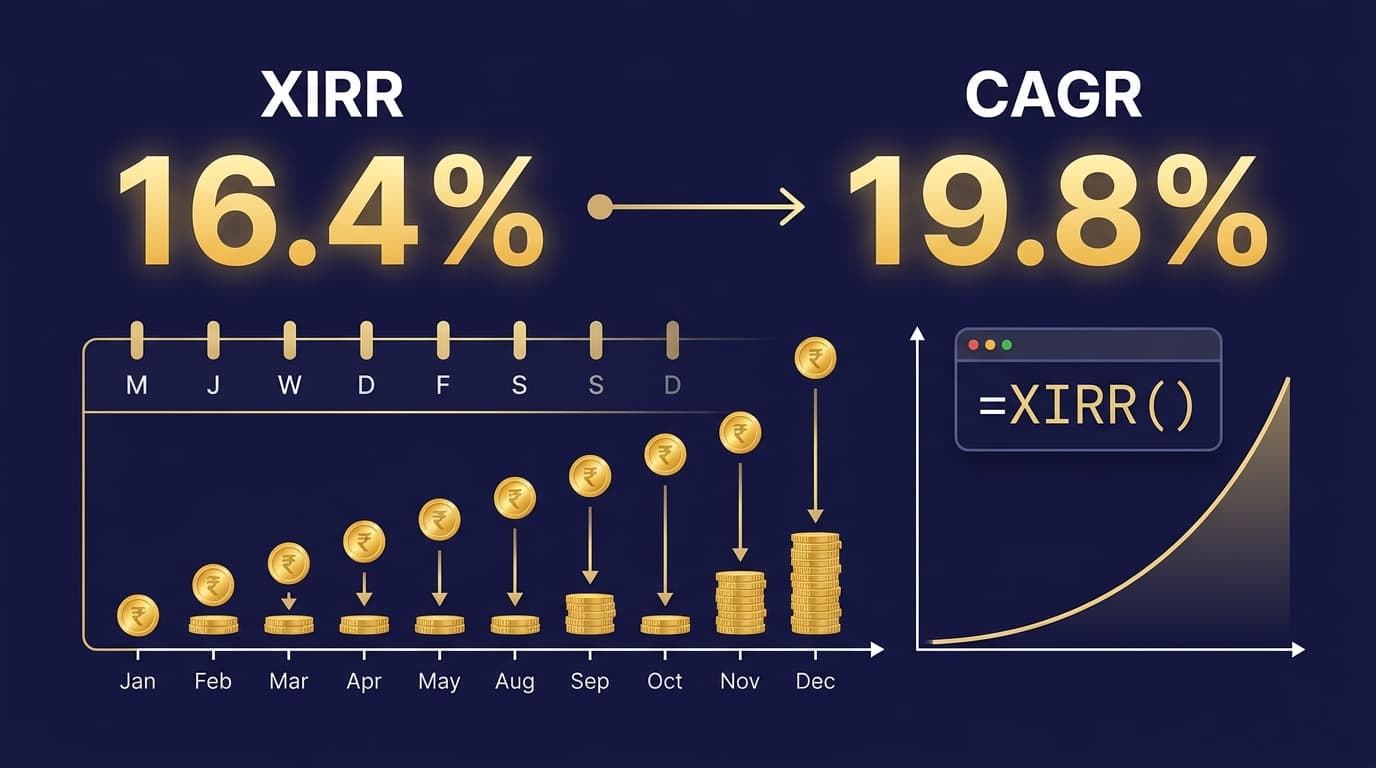
XIRR vs CAGR for SIP Returns: What's the Difference and Which to Use?
You've been doing your SIP for 3 years. The fund's page shows "CAGR: 18%". But when you check your portfolio value, the returns don't feel like 18%. You're not miscalculating — CAGR and XIRR measure f…

Asian Paints Business Model: The Distribution Moat
Asian Paints Business Model: The Distribution Moat, Supercomputers & The Tinting Machine Monopoly Quick Summary: Most investors assume Asian Paints is a chemical manufacturing company. In reality, …

HDFC Bank Business Model: The CASA & Retail Moat
HDFC Bank Business Model: The Low-Cost CASA Engine & Retail Fortress Quick Summary: In commercial banking, money is a commodity. When two banks offer the identical ₹50 lakh home loan or working cap…