High-Interest Savings Accounts in India (2026): Safety, Small Finance Banks & The ₹5 Lakh DICGC Limit
High-Interest Savings Accounts in India (2026): Safety, Small Finance Banks & The ₹5 Lakh DICGC Limit
Keeping substantial cash balances in a traditional savings account at India's "Big Four" commercial banks (SBI, HDFC Bank, ICICI Bank, and Axis Bank) is a guaranteed method of losing purchasing power. With headline savings account rates pegged at a dismal 2.70% to 3.00% per annum and retail CPI inflation fluctuating between 4.5% and 5.5%, every ₹1,00,000 left idle in a major bank suffers an effective negative real return of -2.0% every single year.
In response, a growing cohort of Small Finance Banks (SFBs)—including AU Small Finance Bank, Equitas Small Finance Bank, Ujjivan, and Suryoday—alongside aggressive private lenders like IDFC FIRST Bank, heavily market high-yield savings accounts advertising rates as high as 7.00% to 7.50%.
For salaried professionals and conservative wealth builders, this raises two critical questions:
- Are these high-yield challenger banks actually safe, or could you face a PMC Bank / Yes Bank style crisis?
- How does the RBI’s ₹5,00,000 DICGC insurance guarantee protect your capital in practice?
This guide breaks down the legal architecture of deposit insurance in India, exposes the "incremental slab" marketing gimmick, and details the optimal 3-bucket cash allocation strategy for 2026.
1. High-Yield Savings Accounts vs Big-4 Commercial Banks
           [Annual Real Yield Comparison on ₹5,00,000 Balance]
                                    │
    ┌───────────────────────────────┴───────────────────────────────┐
    ▼                                                               ▼
[Traditional Big-4 Bank]                               [High-Yield Challenger / SFB]
Nominal Rate: 3.00%                                    Blended Nominal Rate: 6.75%
Inflation (CPI): 5.00%                                 Inflation (CPI): 5.00%
Tax (30% Slab): -0.90%                                 Tax (30% Slab): -1.72% (post 80TTA)
Net Real Yield: -2.90% (WEALTH DECAY)                  Net Real Yield: +0.03% (CAPITAL PRESERVED)
Statutory Interest Rate Comparison Matrix (FY 2026-27)
| Bank Category & Institution | Base Savings Rate (Up to ₹1L) | Peak Savings Rate (High Balances) | Peak Rate Balance Threshold | Fixed Deposit (1-Year) | DICGC Insured? |
|---|---|---|---|---|---|
| State Bank of India (SBI) | 2.70% | 3.00% | ₹10 Crore+ | 6.80% | ✅ Yes (₹5 Lakhs) |
| HDFC Bank / ICICI Bank | 3.00% | 3.50% | ₹50 Lakhs+ | 6.60% – 6.90% | ✅ Yes (₹5 Lakhs) |
| IDFC FIRST Bank | 3.00% | 7.00% | ₹10 Lakhs to ₹50 Lakhs | 7.50% | ✅ Yes (₹5 Lakhs) |
| AU Small Finance Bank | 3.50% | 7.25% | ₹10 Lakhs to ₹5 Crore | 7.75% | ✅ Yes (₹5 Lakhs) |
| Equitas Small Finance Bank | 3.50% | 7.50% | ₹5 Lakhs to ₹5 Crore | 8.20% | ✅ Yes (₹5 Lakhs) |
| Suryoday Small Finance Bank | 3.75% | 7.75% | ₹15 Lakhs to ₹5 Crore | 8.60% | ✅ Yes (₹5 Lakhs) |
The Incremental Slab Rate Illusion: Never assume that putting ₹5,00,000 into a bank advertising "7.50% interest" means your entire ₹5,00,000 earns 7.50%. Banks calculate interest on a progressive tiered slab basis, exactly like income tax slabs. For example, if a bank pays 3.5% on the first ₹1 Lakh and 7.0% on balances between ₹1 Lakh and ₹5 Lakhs, your blended effective rate on a ₹3,00,000 balance is merely 5.83%, not 7.0%. Always calculate the blended yield on your specific intended balance.
2. Regulatory Safety: How the RBI DICGC Shield Works
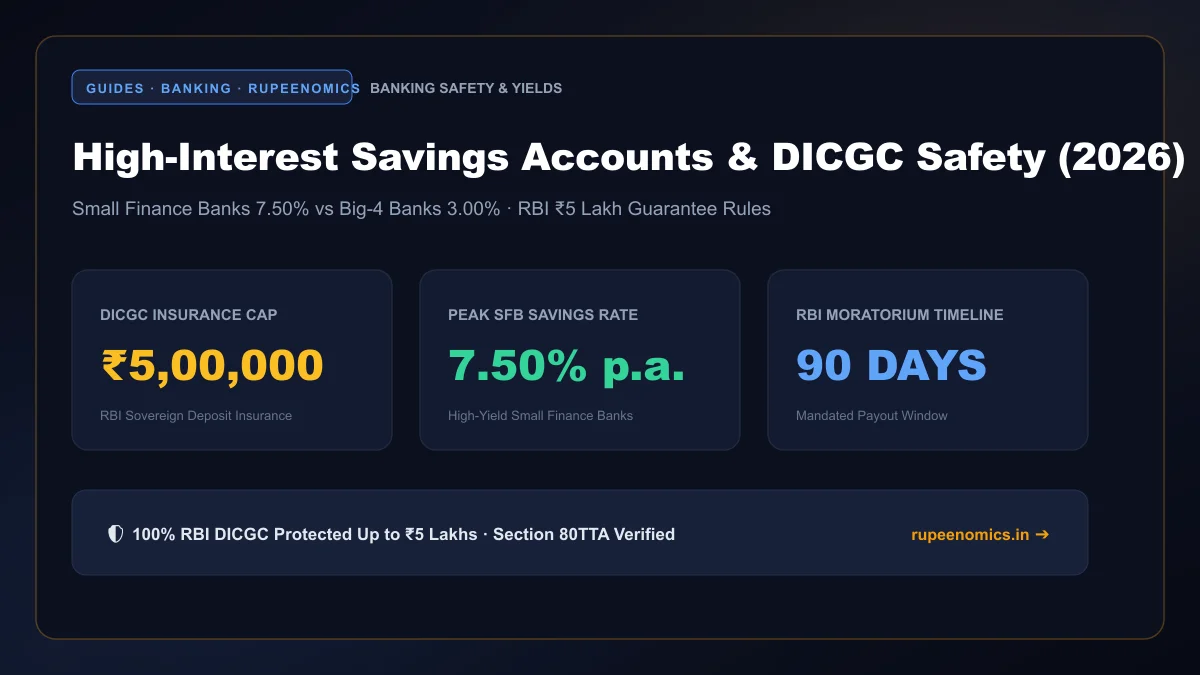
Every scheduled bank in India—whether it is a state-owned giant like SBI, an established private lender like HDFC, a foreign bank like Citibank, or a Small Finance Bank licensed under Section 22 of the Banking Regulation Act—is legally covered by the Deposit Insurance and Credit Guarantee Corporation (DICGC), a wholly owned subsidiary of the Reserve Bank of India.
                      [RBI DICGC PROTECTION STRUCTURE]
                                     │
           ┌─────────────────────────┴─────────────────────────┐
           ▼                                                   ▼
   [What IS Insured]                                   [What is NOT Insured]
   • Savings Bank Accounts                             • Mutual Funds & Debt Funds
   • Current Accounts                                  • Corporate Fixed Deposits (NBFCs)
   • Fixed Deposits (FDs)                              • Peer-to-Peer (P2P) Lending
   • Recurring Deposits (RDs)                          • Credit Society Deposits (Unregulated)
   (Principal + Accrued Interest)
Key Legal Rules Governing DICGC Insurance:
- The ₹5,00,000 Statutory Limit: Under Section 16 of the DICGC Act, if an insured bank fails or is placed under an RBI moratorium, each depositor is guaranteed repayment of up to ₹5,00,000 (Rupees Five Lakhs). This threshold covers both principal and accrued interest. If you have ₹4,80,000 in principal and ₹35,000 in accrued interest (Total: ₹5,15,000), the DICGC pays exactly ₹5,00,000; the remaining ₹15,000 must wait for bank liquidation recoveries.
- Cumulative Single-Bank Rule: All deposits held across all branches of the same bank are aggregated together. Having ₹2.5 Lakhs in an MG Road branch and ₹3.0 Lakhs in an Airport Road branch of the same bank means your total exposure is ₹5.5 Lakhs—leaving ₹50,000 uninsured.
- The 90-Day Payout Mandate (DICGC Amendment Act 2021): Prior to 2021, depositors had to wait years for a failed bank’s liquidation proceedings to conclude before receiving insurance payouts. Under the Deposit Insurance and Credit Guarantee Corporation (Amendment) Act, 2021, depositors are legally guaranteed their payout within 90 days from the date the RBI imposes directions or a moratorium. In the first 45 days, the bank collects depositor claims; in the subsequent 45 days, DICGC verifies and transfers the funds directly to the depositor’s alternate bank account.
3. How to Legally Insure More Than ₹5 Lakhs in One Bank
Enjoyed this post?
Get our weekly digest delivered free.
A little-known clause in DICGC regulation states that the ₹5,00,000 insurance limit applies per depositor in the same right and in the same capacity.
By changing the legal ownership capacity, an individual or a family can safely insure significantly more than ₹5,00,000 within a single high-yielding bank:
[LEGAL OWNERSHIP COMBINATIONS IN A SINGLE BANK]
1. Individual Account (Name: Rajesh)                 ──► Insured up to ₹5,00,000
2. Joint Account (1st: Rajesh, 2nd: Priya)           ──► Insured up to ₹5,00,000 (Distinct Capacity)
3. Joint Account (1st: Priya, 2nd: Rajesh)           ──► Insured up to ₹5,00,000 (Distinct Capacity)
4. Sole Proprietorship Account (Rajesh Trading Co.)  ──► Counted with Individual Account #1
5. HUF Account (Rajesh as Karta)                     ──► Insured up to ₹5,00,000 (Distinct Legal Entity)
─────────────────────────────────────────────────────────────────────────────────
TOTAL LEGALLY INSURED CAPACITY IN ONE BANK:              ₹20,00,000 (100% RBI Protected)
The Joint Account Sequence Matters:
In banking jurisprudence, a joint account where Partner A is the primary holder and Partner B is the secondary holder is legally distinct from an account where Partner B is the primary holder and Partner A is secondary. Under DICGC guidelines, each of these combinations constitutes a separate legal capacity, entitling each to its own independent ₹5,00,000 insurance shield.
4. The Tax Drag: Section 80TTA vs Marginal Tax Slabs
While high savings interest rates look attractive on paper, income tax can severely erode your net return:
Section 80TTA Rules for Salaried Individuals:
- Under Section 80TTA, interest earned from savings bank accounts up to ₹10,000 per financial year is 100% tax-free for individuals under 60 years of age (applicable under both Old and New Tax Regimes).
- For senior citizens (age 60+), Section 80TTB provides a much wider deduction limit of ₹50,000 per financial year, which covers both savings account interest and fixed deposit interest.
- The Surcharge Hazard: Once your total savings account interest exceeds ₹10,000, every additional rupee is added directly to your taxable income and taxed at your marginal slab rate (30% + 4% Cess = 31.2%, or up to 39% if subject to high-income surcharges).
Post-Tax Return Shootout on ₹10 Lakhs Emergency Corpus
| Investment Instrument | Pre-Tax Interest Rate | Annual Interest | Tax Deduction (80TTA) | Tax Payable (30% Slab) | Post-Tax Annual Income | Effective Post-Tax CAGR |
|---|---|---|---|---|---|---|
| Big-4 Bank Savings (HDFC/ICICI) | 3.00% | ₹30,000 | ₹10,000 | ₹6,240 | ₹23,760 | 2.38% |
| High-Yield SFB Savings Account | 7.00% (Blended) | ₹68,500 | ₹10,000 | ₹18,252 | ₹50,248 | 5.02% |
| Arbitrage Mutual Fund (Equity Tax) | 7.10% (Gross Yield) | ₹71,000 | N/A (Capital Gains) | ₹0 (Under ₹1.25L LTCG Exemption) | ₹71,000 | 7.10% |
| Treasury Bills (91-Day T-Bills) | 6.75% | ₹67,500 | None | ₹21,060 | ₹46,440 | 4.64% |
Why Arbitrage Funds Beat High-Yield Savings for High Earners: If your emergency fund or idle liquidity exceeds ₹10,000 annual interest and you sit in the 30% tax bracket, Arbitrage Mutual Funds provide a superior post-tax parking vehicle. Under post-Budget 2024 capital gains tax rules, equity arbitrage funds held for over 12 months qualify as Long-Term Capital Gains (LTCG) taxed at only 12.5%, with an annual exemption of up to ₹1,25,000. For short-term holdings under 12 months, STCG is capped at 20%—significantly lower than the 31.2% to 39% slab rate applied to savings bank interest.
5. The Prudent 3-Bucket Cash Allocation Strategy
Rather than concentrating all liquidity into a single bank or taking unnecessary solvency risks for an extra 100 basis points, follow this three-bucket liquidity blueprint:
[THE PRUDENT 3-BUCKET LIQUIDITY FRAMEWORK]
┌────────────────────────────────────────────────────────────────────────┐
│ BUCKET 1: Operational Liquidity (1 Month Expenses — ₹50,000 to ₹1L)   │
│ • Bank: Tier-1 Commercial Giant (HDFC Bank / ICICI Bank / SBI)         │
│ • Priority: 99.99% UPI server uptime, widespread ATMs, salary credit. │
├────────────────────────────────────────────────────────────────────────┤
│ BUCKET 2: High-Yield Emergency Buffer (3–6 Months — Up to ₹4.5 Lakhs) │
│ • Bank: High-Yield Small Finance Bank (AU SFB / Equitas / IDFC FIRST)  │
│ • Priority: Earn 7.00%+ blended yield while strictly capped below     │
│   the ₹5 Lakh DICGC principal + interest insurance threshold.         │
├────────────────────────────────────────────────────────────────────────┤
│ BUCKET 3: Wealth Storage & Surplus Liquidity (>₹5 Lakhs)               │
│ • Vehicle: Arbitrage Funds or Sovereign T-Bills via RBI Retail Direct │
│ • Priority: Tax optimization (12.5% LTCG) & zero counterparty risk.   │
└────────────────────────────────────────────────────────────────────────┘
Frequently Asked Questions (FAQ)
Are Small Finance Banks (SFBs) regulated by the RBI the same way as commercial banks?
Yes, completely. Small Finance Banks operate under identical prudential norms as scheduled commercial banks. They are mandated to maintain Cash Reserve Ratio (CRR) of 4.5% and Statutory Liquidity Ratio (SLR) of 18.0%. In fact, regulatory scrutiny on SFBs is arguably stricter: 75% of their adjusted net bank credit must go to Priority Sector Lending (PSL), and minimum capital adequacy ratio (CAR) is set at 15% (compared to 11.5% for major commercial banks).
What happens if I have ₹10 Lakhs in one bank and it fails?
Under the DICGC Act, you will receive exactly ₹5,00,000 within 90 days. The remaining ₹5,00,000 is placed on the bank’s liquidation register. If the bank’s assets are successfully recovered by the liquidator, you may receive portions of the remaining balance over subsequent years, but there is zero sovereign guarantee for any amount exceeding ₹5 Lakhs.
Does the ₹5 Lakh limit apply separately to Savings Accounts and Fixed Deposits in the same bank?
No. All deposits held in your name in the same capacity within the same bank are clubbed together. If you hold a Savings Account with ₹2,00,000 and a Fixed Deposit of ₹4,00,000 in the same bank, your total balance is ₹6,00,000. In the event of a failure, DICGC will insure only ₹5,00,000; the remaining ₹1,00,000 is uninsured.
Does the bank deduct TDS on savings account interest?
No. Under Section 194A of the Income Tax Act, banks do NOT deduct TDS on savings bank account interest, regardless of how much interest you earn. However, this does not mean the interest is tax-free. You are legally required to report total savings account interest under "Income from Other Sources" when filing your annual ITR.
Definitive Verdict
- Do not leave idle cash in Big-4 banks earning 2.70%–3.00%: You are losing 2% to 3% annually in real purchasing power after factoring in inflation and tax drag.
- Cap each Small Finance Bank relationship at ₹4.5 Lakhs: Keeping principal around ₹4.0 to ₹4.5 Lakhs ensures that accumulated quarterly interest never breaches the ₹5,00,000 DICGC safety boundary.
- For emergency corpuses exceeding ₹5 Lakhs, transition to Arbitrage Funds: You capture identical 7.0%+ yields while shielding your returns from punitive 30% slab taxation.
The insights, broker reviews, tax estimates, and financial data presented on RupeeNomics are strictly for educational and research purposes only. RupeeNomics and its authors are not SEBI-registered investment advisors or research analysts. Nothing published herein should be construed as personalized investment advice or a recommendation to buy or sell securities. Investments in the securities market are subject to market risks. Please conduct your own due diligence or consult a SEBI-registered financial planner before making investment decisions. Read our Editorial Policy.
Enjoyed this post?
Get our weekly digest delivered free.
Share this post:
RupeeNomics is reader-supported. We may earn a commission from links in this article at no extra cost to you. Read our disclosure.