Groww vs Zerodha: Which Platform is Better for Stocks & Mutual Funds? (2026)
Groww vs Zerodha: Which Platform is Better for Stocks & Mutual Funds? (2026)
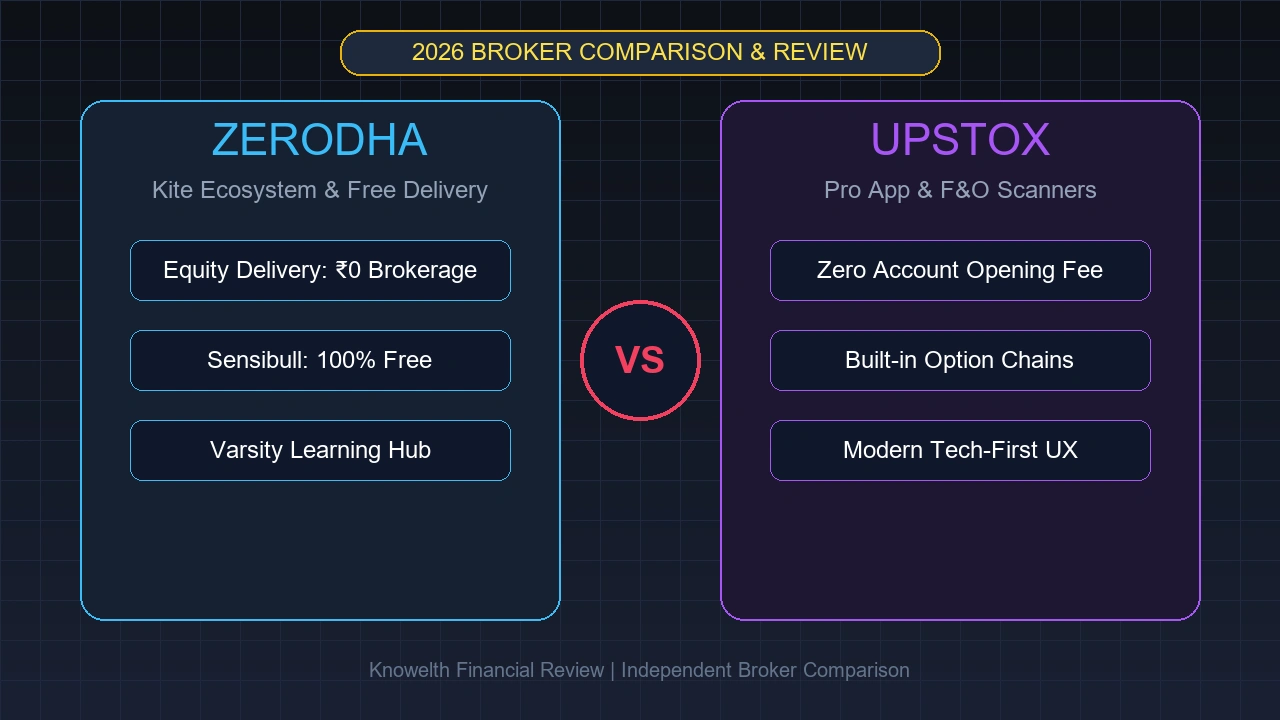
Bottom Line Up Front: Zerodha is the overall winner for active stock traders, options traders, and long-term equity investors due to zero brokerage on equity delivery, free access to Sensibull Pro (saving ₹15,000+/year), advanced order types (GTT, Iceberg, Basket Orders), and lower MTF interest rates. On the other hand, Groww is the superior choice for absolute beginners, passive SIP investors, and mutual fund enthusiasts who want a lifetime free AMC demat account, zero account opening fees, and a frictionless, all-in-one mobile app.
Quick Comparison Table
| Feature / Metric | Groww | Zerodha (Kite) | Edge / Winner |
|---|---|---|---|
| Target Audience | Beginners, Mutual Fund SIP Investors | Active Stock Traders, F&O & Long-Term Investors | Depends on User |
| Account Opening Fee | ₹0 (100% Free Onboarding) | ₹200 (Equity + F&O) | Groww |
| Annual Maintenance Charge (AMC) | ₹0 (Lifetime Free) | ₹300/year (Billed ₹75/quarter) | Groww |
| Equity Delivery Brokerage | ₹20 per trade or 0.05% (whichever lower) | ₹0 (100% Free Forever) | Zerodha |
| Equity Intraday Brokerage | ₹20 per trade or 0.05% (whichever lower) | ₹20 per trade or 0.03% (whichever lower) | Zerodha |
| Futures & Options (F&O) | Flat ₹20 per executed order | Flat ₹20 per executed order | Tie |
| Direct Mutual Funds | Commission-free (Direct NAV) | Coin (Commission-free, Direct NAV) | Groww (Slicker UX) |
| DP Charges (Per Debit Order) | ₹13.50 + GST per ISIN/day | ₹13.00 + GST per ISIN/day | Zerodha |
| Options Analytics Suite | Native Basic Option Chain | Sensibull Pro (100% Free) | Zerodha |
| Margin Trading Facility (MTF) | ~14.95% p.a. (~0.041% daily) | ~14.6% p.a. (~0.04% daily) | Zerodha |
| Order Execution Features | GTT, Regular, AMO | GTT, Iceberg, Basket, Cover Orders | Zerodha |
| Educational Ecosystem | Groww Academy & Digest | Zerodha Varsity (Gold Standard) | Zerodha |
| App Ratings (Play Store / App Store) | 4.5★ / 4.6★ | 4.4★ / 4.6★ | Tie |
| Overall Score | ⭐⭐⭐⭐½ (4.6/5) | ⭐⭐⭐⭐⭐ (4.9/5) | Zerodha |
📋 Groww — Full Review
Overview
Founded in 2016 by ex-Flipkart executives (Neeraj Singh, Harsh Jain, Lalit Keshre, and Ishan Bansal), Groww started as a direct mutual fund distribution platform. Over the past decade, it has rapidly evolved into India's largest discount brokerage by active investor count, boasting over 10+ million registered users. Groww's core philosophy centers on radical simplicity: removing complex jargon, clean visual design, and enabling financial onboarding in under five minutes.
Key Strengths
- Zero Account Opening & Zero Lifetime AMC: Groww charges ₹0 to open an account and maintains a strict zero AMC policy for life. Investors face no maintenance drain on idle portfolios or small SIP accounts.
- Frictionless Mutual Fund Investing: Groww remains arguably the best platform in India for mutual fund discovery, comparison, and automated SIP setup. Users can track external portfolios (via CAS upload) alongside native investments seamlessly.
- Modern & Clean UI/UX: The mobile app interface is clutter-free, highly intuitive, and tailored for users with zero prior trading experience.
- All-in-One Financial Hub: Enables users to invest in Indian Stocks, Direct Mutual Funds, US Stocks, Fixed Deposits, Gold, and apply for IPOs within a single unified app.
- Instant Digital Onboarding: Aadhaar-linked paperless e-Sign allows users to start investing within 5 to 10 minutes.
Key Weaknesses
- Delivery Brokerage Fees: Unlike Zerodha, Groww charges up to ₹20 per trade (or 0.05%) on long-term equity delivery transactions, which accumulates into significant costs for active portfolio builders.
- Limited Advanced Order Features: Lacks advanced professional order types such as Iceberg orders, Basket orders for multi-leg option execution, and automated trailing stop-losses.
- Basic Charting & Analytical Tools: While functional for casual investors, day traders find the chart customizations and indicator depth inferior to dedicated trading platforms.
Pricing & Fees Breakdown
| Fee Category | Charge / Fee | Notes |
|---|---|---|
| Account Opening Fee | ₹0 | Free digital onboarding |
| Annual Maintenance Charge (AMC) | ₹0 | Lifetime free demat account |
| Equity Delivery Brokerage | ₹20 or 0.05% (whichever lower) | Applied on every buy/sell delivery order |
| Equity Intraday Brokerage | ₹20 or 0.05% (whichever lower) | Per executed intraday order |
| Equity Futures & Options (F&O) | Flat ₹20 per order | Applied per executed F&O order |
| Depository Participant (DP) Fee | ₹13.50 + 18% GST | Charged per stock debit per day |
| Call & Trade Fee | ₹50 per order | Charged if order placed via support desk |
Best For
Groww is best for: Absolute beginners, young working professionals starting their wealth creation journey through Systematic Investment Plans (SIPs), and long-term investors who prioritize zero fixed annual fees and a clean mobile interface.
→ Open a Free Demat Account with Groww (Affiliate Partner — ₹0 AMC)
📋 Zerodha — Full Review
Enjoyed this post?
Get our weekly digest delivered free.
Overview
Launched in 2010 by Nithin and Nikhil Kamath, Zerodha is the pioneer of discount stock broking in India. By introducing a flat ₹20 brokerage model when traditional brokers charged 0.50% per trade, Zerodha single-handedly reshaped the Indian retail broking landscape. Operating with over 7+ million active traders and processing over 15% of daily Indian market volumes, Zerodha stands out for its bootstrapped independence, zero aggressive push notifications, and engineering excellence.
Key Strengths
- Zero Brokerage on Equity Delivery: Zerodha offers 100% free brokerage on long-term stock investing. Investors buying equity shares for delivery pay zero commissions, ensuring maximum compounding.
- Free Sensibull Pro Subscription: All Zerodha account holders get free, unlimited access to Sensibull Pro (valued at ₹15,000+/year), unlocking advanced options strategy builders, Open Interest (OI) heatmaps, and options Greeks calculators.
- Kite Trading Engine & Console Analytics: Kite is globally recognized for its lightning speed, micro-frontend architecture, minimalist aesthetic, and custom TradingView/ChartIQ charting options. Console provides in-depth trade diagnostics, tax reports, and P&L breakdown.
- Zerodha Varsity Ecosystem: Varsity is India's most comprehensive, free financial education platform, offering structured learning modules from basic market concepts to advanced quantitative trading strategies.
- Advanced Order Capabilities: Full support for Good Till Triggered (GTT) orders (valid for 1 year), Iceberg orders to minimize market impact on big orders, and Basket Orders for simultaneous multi-leg executions.
Key Weaknesses
- Upfront Account Opening Fee: Requires a one-time setup fee of ₹200 for Equity and F&O account activation.
- Annual Maintenance Charges (AMC): Standard accounts incur ₹300 per year (billed quarterly at ₹75). However, accounts holding under ₹50,000 in portfolio value qualify for zero AMC under BSDA guidelines.
- No Direct US Stock Investing: Unlike Groww, Zerodha currently does not offer direct US stock investing from its primary platform.
Pricing & Fees Breakdown
| Fee Category | Charge / Fee | Notes |
|---|---|---|
| Account Opening Fee | ₹200 | One-time fee for Equity & F&O |
| Annual Maintenance Charge (AMC) | ₹300 / year | Billed ₹75 quarterly (BSDA relief available) |
| Equity Delivery Brokerage | ₹0 (Free) | 100% free delivery brokerage forever |
| Equity Intraday Brokerage | ₹20 or 0.03% (whichever lower) | Per executed intraday trade |
| Equity Futures & Options (F&O) | Flat ₹20 per order | Per executed F&O contract order |
| Depository Participant (DP) Fee | ₹13.00 + 18% GST | Lowest standard DP debit charge |
| Call & Trade Fee | ₹50 per order | Charged if order executed via dealer |
Best For
Zerodha is best for: Active stock traders, technical chartists, options and futures traders, and serious long-term investors who trade frequently enough that Zerodha's zero delivery brokerage easily outweighs the annual ₹300 AMC.
→ Open an Account with Zerodha (Free Sensibull Pro included)
🔬 Head-to-Head: Deep Dive Comparisons
1. User Interface & Mobile App Experience
When comparing app usability, Groww and Zerodha target fundamentally different user mindsets:
- Groww UI: Designed like a modern fintech shopping app. It features a bright white/dark aesthetic, prominent search bars, curated stock collections (e.g., "Top Gainers", "High Dividend Yield"), and simple visual pie charts for mutual fund portfolio allocations. Navigating through SIP setup, IPO bidding, or mutual fund switching takes just two taps.
- Zerodha Kite UI: Built specifically for speed, precision, and clutter-free execution. Kite avoids pushy promotional banners, external pop-ups, or distracting stock recommendations. Users get multi-chart viewports, fast keyboard shortcuts on web, customizable watchlists with live depth data, and seamless toggling between ChartIQ and TradingView libraries.
Winner: Groww for absolute beginners; Zerodha for active traders and serious chart analysts.
2. Pricing, Brokerage & Hidden Costs
While both platforms promote discount pricing, the actual cost impact depends heavily on your transaction frequency and investment style:
- Long-Term Delivery Investors: If you purchase ₹50,000 worth of stocks 4 times a month:
- On Groww: You pay ₹20 x 4 = ₹80 per month = ₹960 per year in brokerage fees.
- On Zerodha: You pay ₹0 in delivery brokerage, but pay ₹300 in annual AMC. Total cost = ₹300 per year. Zerodha saves you ₹660/year.
- Occasional SIP Investors (Mutual Funds Only):
- On Groww: ₹0 AMC + ₹0 mutual fund brokerage = ₹0 Total Cost.
- On Zerodha (Coin): ₹300 AMC (if total holding exceeds BSDA limits) + ₹0 mutual fund brokerage = ₹300 Total Cost. Groww is 100% free.
Winner: Zerodha for stock delivery investors; Groww for zero-AMC mutual fund investors.
3. Mutual Funds & Passive Investing
Both platforms offer Direct Mutual Funds, meaning you pay zero distributor commissions (saving 0.5%–1.5% annually compared to Regular plans):
- Groww Mutual Funds: Allows you to invest directly, set up automated UPI auto-pay mandates for monthly SIPs, and track external funds via Consolidated Account Statement (CAS) imports. Units are held in folio form, making it easy to manage directly with Asset Management Companies (AMCs) if needed.
- Zerodha Coin: Holds mutual fund units in Demat format within your CDSL demat account. This allows you to pledge mutual fund units as collateral for trading margin. However, demat holding requires using Zerodha's app for redemption or switching.
Winner: Groww due to superior fund comparison tools, external portfolio tracking, and non-demat flexibility.
4. Advanced Trading Tools & F&O Features
For active derivatives traders, platform tools directly impact profitability:
- Zerodha Ecosystem: Equips traders with Sensibull Pro (completely free), enabling multi-leg option strategy creation, automated delta/theta risk tracking, and real-time open interest shifts. Furthermore, Zerodha provides Iceberg orders (splitting large orders into smaller chunks to prevent slippage) and Basket Orders (executing up to 20 legs simultaneously).
- Groww F&O Suite: Includes an integrated Option Chain and basic OI analysis. While functional for buying simple call or put options, it lacks institutional-grade strategy execution, custom payoff diagrams, and multi-leg order staggering.
Winner: Zerodha by a landslide.
5. Educational Resources & Platform Reliability
- Education: Zerodha Varsity is widely regarded as the gold standard in Indian financial education. It features comprehensive modules, interactive quizzes, and certified courses with zero paywalls or advertisements. Groww provides helpful beginner articles and videos via Groww Academy, but lacks the depth of Varsity.
- Platform Stability: Both brokers experience server congestion during extreme market volatility (such as election result days or black swan market crashes). However, Zerodha's lightweight infrastructure and micro-frontend architecture give it faster average execution times during high-volume trading hours.
Winner: Zerodha.
🎯 Who Should Choose What?
Choose Groww if:
- You are an absolute beginner making your first investment in the stock market.
- Your primary goal is building long-term wealth through Direct Mutual Fund SIPs.
- You want a 100% free account with zero AMC fees for life.
- You prefer a simple, clean mobile app that feels intuitive from day one.
- You want to apply for IPOs and invest in US stocks within the same app.
Choose Zerodha if:
- You buy and sell individual stocks for equity delivery and want zero brokerage fees.
- You trade Futures & Options (F&O) or Intraday equity regularly.
- You want free access to premium trading tools like Sensibull Pro (saving ₹15,000/year).
- You utilize advanced order types like GTT, Iceberg, and Basket Orders.
- You value deep financial education via Zerodha Varsity and detailed tax reporting via Console.
Choose Neither if:
- You require a traditional bank-integrated 3-in-1 account (Savings + Trading + Demat) with dedicated relationship manager support — in which case, consider bank-backed alternatives like ICICI Direct or HDFC SKY.
❓ Frequently Asked Questions
Q: Is Groww really 100% free with zero hidden maintenance charges?
A: Yes. Groww charges ₹0 for account opening and ₹0 for lifetime Annual Maintenance Charges (AMC). However, Groww charges a brokerage fee of ₹20 or 0.05% (whichever is lower) per executed order on equity delivery and intraday stock trades, alongside government-mandated taxes (STT, GST, Stamp Duty) and DP charges when selling shares.
Q: Can I transfer my mutual funds or stock holdings from Groww to Zerodha?
A: Yes, you can transfer stock holdings between Groww and Zerodha online using CDSL Easiest or offline via Delivery Instruction Slip (DIS). For mutual funds, if held in demat form, they can be transferred via CDSL. If held in statement/folio form on Groww, they can be rematerialized into demat units to appear in Zerodha Coin.
Q: Why does Zerodha charge a ₹300 AMC while Groww offers zero AMC?
A: Zerodha charges a flat ₹300 annual AMC to maintain an ad-free, debt-free, bootstrapped business model that does not monetize user data or push third-party loans. In exchange, Zerodha provides ₹0 brokerage on equity delivery, saving active investors significantly more money over time than the ₹300 AMC fee.
Q: Which platform is safer for keeping high-value stock portfolios?
A: Both Zerodha and Groww are registered Depository Participants (DPs) with CDSL (Central Depository Services Limited) and regulated by SEBI. When you buy stocks on either platform, your securities are held safely in your name directly with CDSL, not on the broker's balance sheet. Even if either company faced financial distress, your stock ownership remains 100% secure with the national depository.
📌 The Verdict
When choosing between Groww and Zerodha, the decision comes down to your personal investment strategy:
- For Mutual Fund Investors & Beginners: Groww is the clear winner. Its lifetime zero AMC, zero account opening fees, and effortless SIP management make it the most welcoming entry point into Indian personal finance.
- For Active Traders & Stock Investors: Zerodha remains the undisputed king of Indian broking. Zero delivery brokerage, free Sensibull access, Kite's execution speed, and Varsity's educational depth make it worth far more than its small ₹300 annual fee.
Our final recommendation: If you are starting with SIPs, begin with Groww. When you are ready to build a serious stock portfolio or trade F&O, open a Zerodha account for maximum savings and professional trading tools.
→ Start Investing with Groww — Zero AMC Account (Ideal for Mutual Fund SIPs)
→ Start Trading with Zerodha — Free Sensibull Pro (Ideal for Zero Delivery Brokerage)
📬 Stay Updated
We continuously monitor fee changes, app updates, and regulatory developments for both Zerodha and Groww.
Subscribe to our weekly newsletter for raw financial breakdowns →
Disclosure: This post contains affiliate links. We earn a small referral commission if you open an account through our links, at zero additional cost to you. All reviews are independent, data-backed, and unbiased.
Last verified: July 21, 2026. Pricing and features are verified against official SEBI disclosures and official broker fee schedules.
The insights, broker reviews, tax estimates, and financial data presented on RupeeNomics are strictly for educational and research purposes only. RupeeNomics and its authors are not SEBI-registered investment advisors or research analysts. Nothing published herein should be construed as personalized investment advice or a recommendation to buy or sell securities. Investments in the securities market are subject to market risks. Please conduct your own due diligence or consult a SEBI-registered financial planner before making investment decisions. Read our Editorial Policy.
Enjoyed this post?
Get our weekly digest delivered free.
Share this post:
RupeeNomics is reader-supported. We may earn a commission from links in this article at no extra cost to you. Read our disclosure.
Related Posts
Best Demat Account in India 2026: Zerodha vs Groww vs Angel One vs Upstox — Full Comparison
Best Demat Account in India 2026: Zerodha vs Groww vs Angel One vs Upstox — Full Comparison Choosing the wrong demat account in India costs you money every single year — through hidden charges, poor e…

Top 7 Demat Accounts in India for 2026 — Fee Comparison & Rankings
Top 7 Demat Accounts in India for 2026 — Fee Comparison & Rankings Quick Summary: For most Indian retail investors and traders, Zerodha remains the best overall Demat account due to its rock-solid …
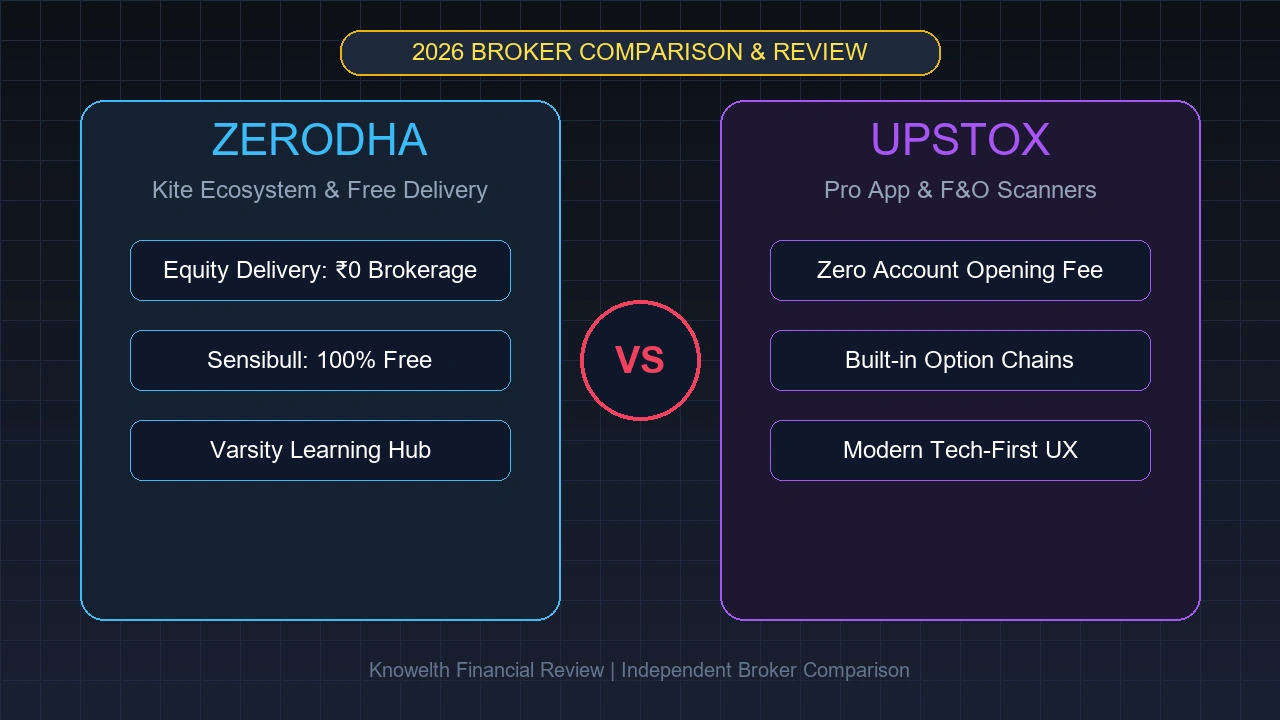
Zerodha vs Angel One vs 5paisa: Fee Comparison for Active Traders (2026)
Zerodha vs Angel One vs 5paisa: Fee Comparison for Active Traders (2026) Bottom Line Up Front: For active traders in 2026, Zerodha remains the gold standard for platform uptime, chart execution spe…