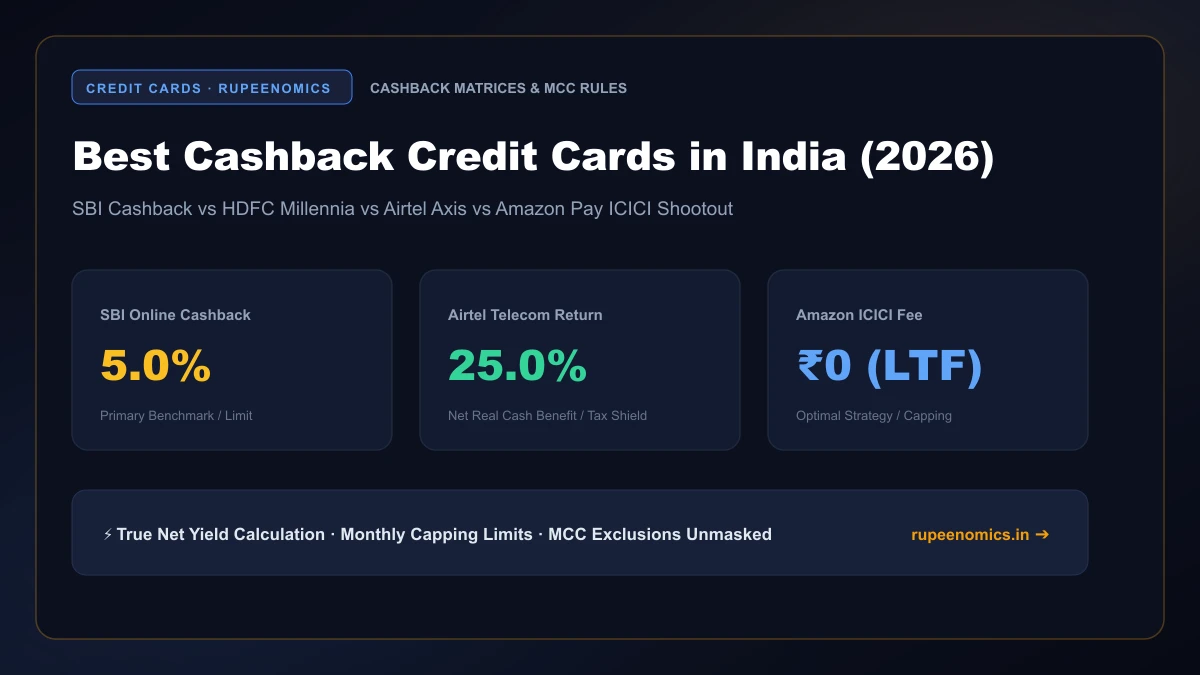
Best Cashback Credit Cards in India (2026): SBI Cashback vs HDFC Millennia vs Airtel Axis vs Amazon Pay ICICI
Best Cashback Credit Cards in India (2026): SBI Cashback vs HDFC Millennia vs Airtel Axis vs Amazon Pay ICICI
Credit card reward programs in India have suffered brutal devaluations over the past two years. Airline miles have been pegged to dynamic pricing, reward point conversion ratios have been slashed, and milestone vouchers are buried under labyrinthine terms.
For 95% of salaried Indian consumers, pure, unadulterated cashback credited directly to your statement is infinitely superior to complex reward miles. With direct cashback, there are no catalogue markups, no redemption convenience fees, and zero point expiration risks.
However, selecting the "best" cashback credit card is no longer as simple as picking the card with the boldest headline percentage. Banks now use subtle structural barriers—Merchant Category Code (MCC) exclusions, monthly category cashback caps, and aggressive annual fee structures—to suppress real-world yields. A card advertising "5% cashback" can easily deliver a miserable 1.4% net yield once fee-drag and spend caps are computed.
This teardown provides a mathematical, anti-finfluencer comparison of India's four heavyweight cashback cards for 2026: SBI Cashback, HDFC Millennia, Airtel Axis Bank, and Amazon Pay ICICI.
1. The Heavyweight Contenders: Executive Comparison
                         [The 2026 Cashback Landscape]
                                       │
        ┌───────────────────┬──────────┴──────────┬───────────────────┐
        ▼                   ▼                     ▼                   ▼
 [SBI Cashback]     [HDFC Millennia]      [Airtel Axis]      [Amazon Pay ICICI]
 5% Online Everywhere 5% on 10 Partners    25% Airtel / 10% Util   5% on Amazon
  (Cap: ₹5,000/mo)    (Cap: ₹1,000/mo)     (Capped per silo)     (Uncapped LTF)
        │                   │                     │                   │
   Fee: ₹999 + GST     Fee: ₹1,000 + GST     Fee: ₹500 + GST       Fee: ₹0 (LIFETIME)
Statutory Feature Matrix (Verified for 2026)
| Parameter | SBI Cashback Card | HDFC Millennia Card | Airtel Axis Bank Card | Amazon Pay ICICI Card |
|---|---|---|---|---|
| Joining / Annual Fee | ₹999 + 18% GST (₹1,179) | ₹1,000 + 18% GST (₹1,180) | ₹500 + 18% GST (₹590) | ₹0 (Lifetime Free - LTF) |
| Annual Fee Waiver Spend | ₹2,00,000 in previous year | ₹1,00,000 in previous year | ₹2,00,000 in previous year | No waiver needed (Zero fee) |
| Primary Online Cashback | 5.0% on almost ALL online spends | 5.0% on 10 partner merchants only | 10.0% on Zomato, Swiggy, BigBasket | 5.0% on Amazon India (Prime) / 3% (Non-Prime) |
| Monthly Cashback Cap | ₹5,00,0 per month (₹1 Lakh spend) | ₹1,00,0 per month (₹20,000 spend) | ₹500 per month on food/grocery | No Cap (Unlimited Cashback) |
| Utility / Telecom Bills | 1.0% (Online utilities excluded) | 1.0% | 25% on Airtel (Cap: ₹250/mo) + 10% Utilities (Cap: ₹250/mo) | 2.0% on Amazon Pay bill recharges |
| Offline Spend Cashback | 1.0% (Uncapped) | 1.0% (Part of ₹1,000 wallet cap) | 1.0% (Uncapped) | 1.0% (Uncapped) |
| Cashback Settlement | Auto-credited to statement within 2 days of bill | CashPoints (Must redeem manually via NetBanking) | Auto-credited to statement in next billing cycle | Auto-credited as Amazon Pay Balance monthly |
| Airport Lounge Access | Zero (Completely eliminated) | 1 domestic visit/quarter (Spend ₹1 Lakh/quarter) | Zero (Devalued) | Zero (None) |
2. In-Depth Teardown: Contender by Contender
1. SBI Cashback Credit Card: The Uncontested Online King
Launched by SBI Cards, this card disrupted the Indian banking industry by offering flat 5% cashback on virtually any online merchant—regardless of whether it was Amazon, Flipkart, Myntra, Nykaa, MakeMyTrip, or a niche Shopify store.
Strengths:
- Merchant Agnostic: Unlike HDFC Millennia which restricts 5% to 10 specific partners, SBI Cashback gives 5% on flight tickets booked via airline portals, train tickets on IRCTC (app), apparel on boutique stores, and electronics on manufacturer portals.
- Massive ₹5,000 Monthly Cap: To exhaust the ₹5,000 cashback cap, you must spend ₹1,00,000 online in a single billing cycle. For 98% of households, this cap is effectively infinite.
- Frictionless Statement Credit: You never have to log into an archaic portal to redeem points. The cashback is subtracted directly from your statement total.
Weaknesses & Gotchas:
- High Annual Fee: ₹999 + GST. If you spend less than ₹2 Lakhs annually, you must absorb a ₹1,179 fee drag.
- Devaluation on Utilities & Offline: In 2023, SBI Card stripped cashback on merchant category codes for utilities, education, school fees, and wallet reloads.
2. HDFC Millennia: The Conservative Partner Specialist
HDFC's flagship cashback offering targets loyal users of India's dominant digital monopolies: Amazon, Flipkart, Swiggy, Zomato, BookMyShow, Cult.fit, Myntra, Sony LIV, Tata CLiQ, and Uber.
Strengths:
- Low Fee Waiver Barrier: The annual fee of ₹1,000 is waived at ₹1,00,000 annual spend (half the requirement of SBI and Axis).
- Milestone Benefit: ₹1,000 gift voucher on spending ₹1 Lakh each calendar quarter.
- Offline & Other Spends: Earns 1% CashPoints on all other retail transactions.
Weaknesses & Gotchas:
- Strangling ₹1,000 Monthly Cap: The 5% partner cashback is strictly capped at 1,000 CashPoints per calendar month. This means your 5% return ceases the moment you spend ₹20,000 on Amazon or Swiggy in a month. Any spend above ₹20k earns zero partner bonus.
- Manual Redemption Friction: Points do not credit automatically. You must login to HDFC NetBanking, navigate to Cards > Enquire > Redeem CashPoints. Points expire after 2 years.
3. Airtel Axis Bank Credit Card: The Utility & Living Cost Assassin
Co-branded between Axis Bank and telecom giant Bharti Airtel, this card is not an e-commerce shopping card—it is an essential living cost destroyer.
Strengths:
- 25% on Telecom / Wi-Fi: Unbelievable 25% cashback on Airtel mobile recharges, DTH, and Airtel Black / Xstream Fiber broadband payments via the Airtel Thanks App (Capped at ₹250/month = ₹1,000 spend).
- 10% on Electricity, Water, Gas Bills: 10% cashback on utility bill payments processed through the Airtel Thanks App via Bharat Bill Payment System (BBPS) (Capped at ₹250/month = ₹2,500 spend).
- 10% on Swiggy, Zomato, BigBasket: Outstanding 10% return on everyday food and grocery deliveries (Capped at ₹500/month = ₹5,000 spend).
- Modest Annual Fee: Only ₹500 + GST.
Weaknesses & Gotchas:
- Siloed Cashback Caps: Each category has its own rigid ceiling. Once you spend ₹2,500 on utilities or ₹5,000 on food delivery, your cashback collapses to 1%.
- Axis Devaluation Risk: Axis Bank frequently changes terms and merchant exclusions without lengthy advance notices.
4. Amazon Pay ICICI Bank Credit Card: The Indestructible Baseline
Co-branded between ICICI Bank and Amazon India, this is universally regarded as India's greatest entry-level credit card.
Strengths:
- True Lifetime Free (LTF): Absolutely zero joining fee, zero annual fee, zero maintenance fee forever. There is no spend target to hit.
- Uncapped 5% on Amazon: If you hold an active Amazon Prime membership, you earn 5% cashback on every rupee spent on Amazon India, with zero monthly limits. If you buy a ₹1.5 Lakh laptop, you get ₹7,500 back.
- Seamless Amazon Pay Credit: Earnings are deposited directly as Amazon Pay balance every month, immediately usable for electricity bills, Uber rides, Swiggy orders, or offline QR merchants.
Weaknesses & Gotchas:
- Low Return Outside Amazon: Yields only 1% on retail spends outside Amazon, and 2% on Amazon Pay bill payments.
- Prime Dependency: Drops from 5% to 3% if your Prime membership lapses.
3. The Fine Print Trap: Merchant Category Code (MCC) Exclusions
Enjoyed this post?
Get our weekly digest delivered free.
Banks do not reward transactions based on what you bought; they reward based on the 4-digit Merchant Category Code (MCC) transmitted by the payment gateway. If a transaction falls under an excluded MCC, you receive 0% cashback.
                           [Your Online / Offline Transaction]
                                            │
                                  [Payment Gateway MCC]
                                            │
               ┌────────────────────────────┴────────────────────────────┐
               ▼                                                         ▼
    [Eligible MCCs (Retail / Food)]                           [Excluded MCCs (Zero Cashback)]
  ├─ MCC 5311: Department Stores                           ├─ MCC 6513: Rent Payments (Surcharge!)
  ├─ MCC 5411: Grocery Stores                              ├─ MCC 5541 / 5542: Fuel Stations
  ├─ MCC 5812: Restaurants & Dining                        ├─ MCC 9399 / 9311: Income Tax / Govt Fees
  ├─ MCC 5732: Consumer Electronics                        ├─ MCC 8211 / 8220: School / College Tuition
  └─ MCC 5651: Apparel & Clothing                          ├─ MCC 6540: Digital Wallet Reloads
                                                           └─ MCC 5094 / 5944: Gold & Jewellery
The Universal Exclusion Matrix (All 4 Cards)
| Category | Typical MCC Codes | SBI Cashback | HDFC Millennia | Airtel Axis | Amazon Pay ICICI |
|---|---|---|---|---|---|
| Rent Payments | 6513 | 0% + 1% Fee | 0% + 1% Fee | 0% + 1% Fee | 0% + 1% Fee |
| Fuel Purchases | 5541, 5542 | 0% (Surcharge waiver) | 0% (Surcharge waiver) | 0% (Surcharge waiver) | 0% (Surcharge waiver) |
| Wallet Loading (Paytm/Mobikwik) | 6540 | 0% | 0% | 0% | 0% |
| Government & Income Tax | 9399, 9311 | 0% | 0% | 0% | 0% |
| School & College Tuition | 8211, 8220 | 0% | 0% | 0% | 0% |
| Gold Bullion & Jewellery | 5094, 5944 | 0% | 0% | 0% | 1% |
| Insurance Premiums | 6300 | 0% | 1% (Cap ₹1,000) | 1% | 2% (via Amazon Pay) |
4. Mathematical Spend Simulation: Fee-Drag vs. Real Net Yield
To calculate the true mathematical winner, we model three realistic monthly expenditure profiles, subtracting annual fees and factoring in all monthly category caps.
Household Spend Breakdown (Monthly):
- Groceries & Food (Swiggy / Zomato / Instamart): ₹8,000
- Utility Bills (Electricity, Water, Gas): ₹3,000
- Telecom & Fiber Broadband (Airtel): ₹1,200
- General Online Shopping (Amazon / Flipkart / Apparel): ₹12,000
- Offline Retail & Fuel: ₹6,000
- Total Monthly Spend: ₹30,200 (Annual: ₹3,62,400)
Annual Net Yield Shootout (₹3.62 Lakhs Annual Spend)
[Profile: ₹30,200 Monthly / ₹3.62L Annual Spend]

Card 1: SBI Cashback Card
  ├─ Online Shopping (₹12,000 @ 5%):           ₹600 / mo
  ├─ Online Food & Grocery (₹8,000 @ 5%):       ₹400 / mo
  ├─ Telecom & Utilities (₹4,200 @ 0%):         ₹0 / mo (Excluded)
  ├─ Offline Spends (₹6,000 @ 1%):              ₹60 / mo
  ├─ Gross Annual Cashback:                     ₹12,720
  ├─ Annual Fee:                                ₹0 (Waived at ₹2L spend)
  └─ NET ANNUAL RETURN:                         ₹12,720 (Net Yield: 3.51%)

Card 2: Airtel Axis Bank Card
  ├─ Telecom (₹1,200 @ 25% capped at ₹250):     ₹250 / mo
  ├─ Utilities (₹3,000 @ 10% capped at ₹250):   ₹250 / mo
  ├─ Food/Grocery (₹8,000 @ 10% capped at ₹500):₹500 / mo
  ├─ Online Shopping (₹12,000 @ 1%):            ₹120 / mo
  ├─ Offline Spends (₹6,000 @ 1%):              ₹60 / mo
  ├─ Gross Annual Cashback:                     ₹14,160
  ├─ Annual Fee:                                ₹0 (Waived at ₹2L spend)
  └─ NET ANNUAL RETURN:                         ₹14,160 (Net Yield: 3.91%)

Card 3: HDFC Millennia Card
  ├─ Partner Online (₹15,000 @ 5%):             ₹750 / mo
  ├─ Other Spends (₹15,200 @ 1%):               ₹152 / mo
  ├─ Gross Annual Cashback:                     ₹10,824
  ├─ Annual Fee:                                ₹0 (Waived at ₹1L spend)
  └─ NET ANNUAL RETURN:                         ₹10,824 (Net Yield: 2.98%)

Card 4: Amazon Pay ICICI Card
  ├─ Amazon Shopping (₹12,000 @ 5% Prime):      ₹600 / mo
  ├─ Amazon Pay Utilities (₹4,200 @ 2%):        ₹84 / mo
  ├─ Other Spends (₹14,000 @ 1%):               ₹140 / mo
  ├─ Gross Annual Cashback:                     ₹9,888
  ├─ Annual Fee:                                ₹0 (Lifetime Free)
  └─ NET ANNUAL RETURN:                         ₹9,888 (Net Yield: 2.73%)
5. The Optimal Strategy: The "Unbeatable 2-Card Combo"
No single credit card in India can optimize every merchant code. The highest mathematical yield is achieved by carrying an optimized two-card portfolio:
                       [The RupeeNomics 2-Card Stack]
                                      │
            ┌─────────────────────────┴─────────────────────────┐
            ▼                                                   ▼
  [Airtel Axis Bank Card]                            [SBI Cashback Card]
 (The Living Expense Engine)                         (The Online Shopping Engine)
            │                                                   │
  ├─ Airtel Broadband & Mobile (25%)                 ├─ All Amazon & Flipkart (5%)
  ├─ Electricity & Gas Bills (10%)                   ├─ Flights, Hotels & IRCTC (5%)
  └─ Swiggy, Zomato & BigBasket (10%)                └─ Myntra, Nykaa & Shopify (5%)
            │                                                   │
     Generates: ₹12,000/yr                               Generates: ₹15,000/yr
            │                                                   │
            └─────────────────────────┬─────────────────────────┘
                                      │
                                      ▼
                        [Total Net Annual Cashback]
                             ₹27,000+ CASH
                     (Effective Net Yield: 6.2%+)
Why This Stack Dominates:
- Zero Overlap: Airtel Axis captures living expenses (telecom, utility bills, food delivery) where SBI Cashback gives 0%.
- Infinite Coverage: SBI Cashback captures all remaining e-commerce shopping, flight bookings, and retail websites where Airtel Axis drops to 1%.
- Fee Waiver Synergy: Spreading ₹3.5 Lakhs of household spend across both cards easily triggers the ₹2 Lakh waiver on both cards, reducing your annual fee drag to ₹0.
6. Application Criteria & Eligibility Standards
Before applying, verify that your credit profile meets the strict automated underwriting rules of these issuers:
| Card | Minimum Monthly Salary | Minimum CIBIL Score | Typical Approval Speed |
|---|---|---|---|
| SBI Cashback | ₹35,000 / month | 750+ | 7–10 days (Physical biometric KYC common) |
| HDFC Millennia | ₹35,000 / month (or existing account) | 750+ | Instant to 5 days (Pre-approved in NetBanking) |
| Airtel Axis Bank | ₹25,000 / month | 740+ | Instant via Airtel Thanks App (Video KYC) |
| Amazon Pay ICICI | ₹30,000 / month | 730+ | Instant on Amazon app (Tied to Prime account) |
7. The Final Verdict: Which Card Should You Pick?
- Choose SBI Cashback if: You spend heavily on diverse e-commerce portals, book flights online, and want a simple, single-card solution with zero partner restrictions and a massive ₹5,000 monthly cap.
- Choose Airtel Axis Bank if: You have Airtel broadband/mobile connections and your monthly expenditure is dominated by grocery delivery, Swiggy/Zomato, and domestic utility bills.
- Choose Amazon Pay ICICI if: You are credit-card averse, refuse to track annual fee spend waivers, buy 90% of your goods on Amazon India, and demand an ironclad Lifetime Free card.
- Choose HDFC Millennia if: You already hold an HDFC salary account, want easy quarterly lounge access, and keep your monthly partner shopping below the ₹20,000 cap.
Disclaimer: Credit card terms, interest rates (typically 42%–52% APR), merchant exclusions, and reward redemption rules are updated frequently by banking institutions. RupeeNomics maintains zero commercial bias; all calculations are based on published bank schedules as of 2026.
The insights, broker reviews, tax estimates, and financial data presented on RupeeNomics are strictly for educational and research purposes only. RupeeNomics and its authors are not SEBI-registered investment advisors or research analysts. Nothing published herein should be construed as personalized investment advice or a recommendation to buy or sell securities. Investments in the securities market are subject to market risks. Please conduct your own due diligence or consult a SEBI-registered financial planner before making investment decisions. Read our Editorial Policy.
Enjoyed this post?
Get our weekly digest delivered free.
Share this post:
RupeeNomics is reader-supported. We may earn a commission from links in this article at no extra cost to you. Read our disclosure.
Related Posts
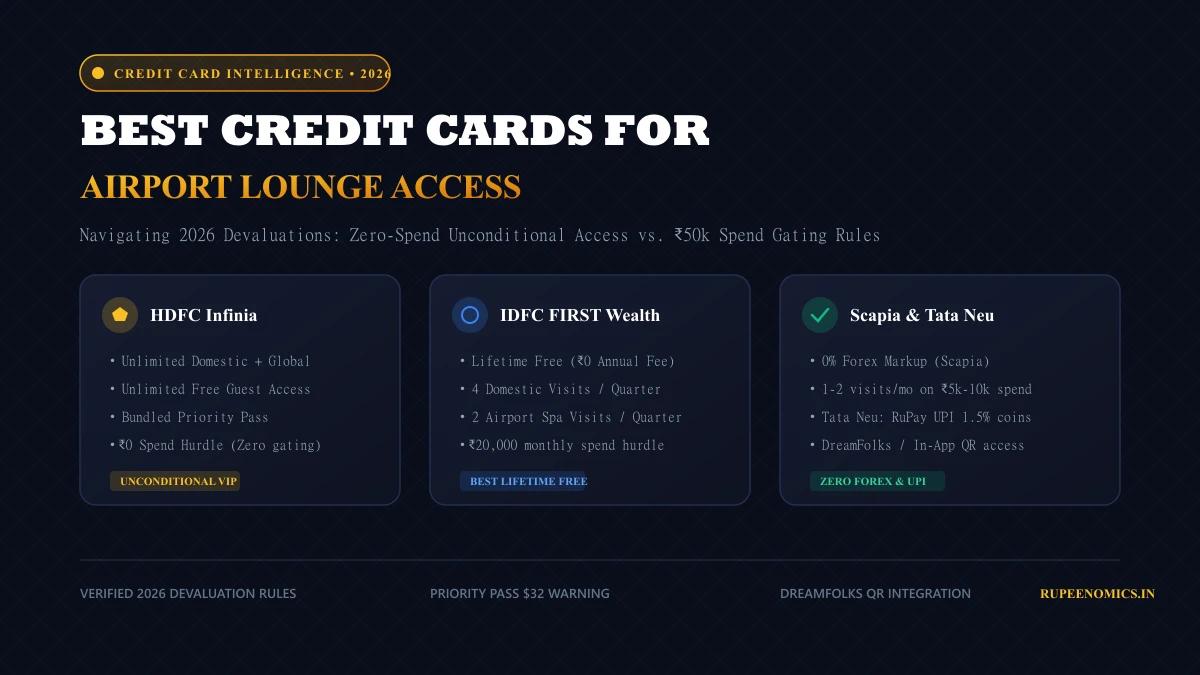
Best Credit Cards for Airport Lounge Access in India (2026): Spend Thresholds, Priority Pass & Devaluation Rules
Best Credit Cards for Airport Lounge Access in India (2026): Spend Thresholds, Priority Pass & Devaluation Rules Position-0 / Quick Answer: Which credit cards offer the best airport lounge access in I…
Best Credit Cards for Amazon & Flipkart India 2026: Top 6 Ranked
Indians spend ₹8+ lakh crore annually on e-commerce — and if you're paying full price without a rewards card, you're leaving money on the table. We calculated real annual savings for a person spend…
Best Credit Cards India 2026: Cashback, Travel, Fuel & Premium — Complete Comparison
Best Credit Cards India 2026: Cashback, Travel, Fuel & Premium — Complete Comparison The right credit card is not about the discount on your first transaction. It's about structural rewards — a car…